Proudly Serving Katy, Richmond & Fulshear Cinco Ranch
(281) 395-2100
|
(281) 394-4001

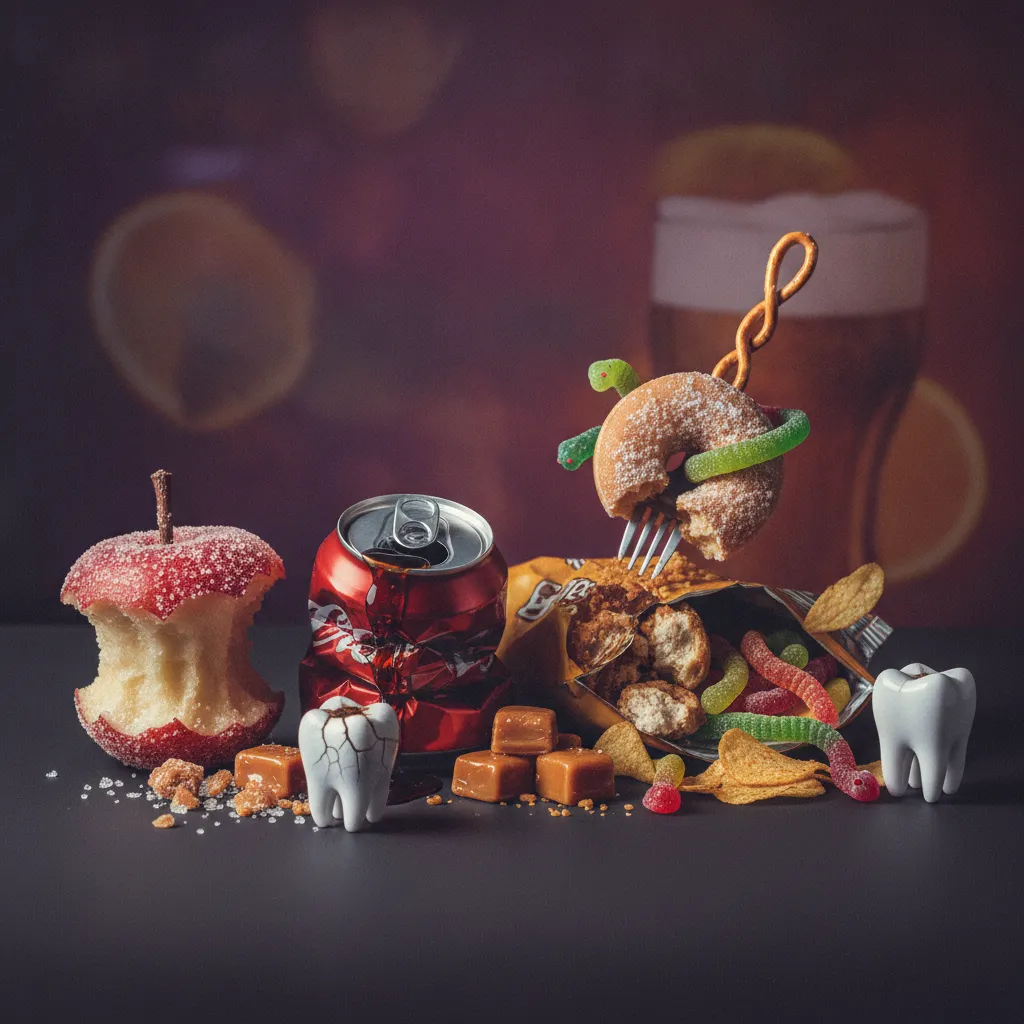
The foods that damage teeth most are sugary snacks, acidic drinks, sticky dried fruits, hard candies, and starchy processed foods. Sugar feeds oral bacteria that produce enamel-eroding acid, while acidic foods (pH below 5.5) dissolve enamel directly. Frequency matters as much as quantity — sipping soda throughout the day causes more damage than drinking it once with a meal.
1. Foods That Damage Teeth: The 9 Worst Offenders Ranked
The foods that damage teeth most severely do so through two mechanisms: direct acid erosion and bacterial acid production triggered by fermentable sugars.
Acid erosion is chemical and direct — when a food or drink drops the mouth’s pH below 5.5, enamel begins dissolving on contact [2]. Cavity formation is a separate process: bacteria in plaque metabolize fermentable sugars and release lactic acid as a byproduct, which then attacks enamel from the surface inward [1]. A food can trigger one mechanism, both, or neither depending on its composition.
Frequency of exposure matters more than single-serving quantity. Snacking on chips across a 3-hour stretch keeps oral pH depressed far longer than eating a slice of cake in 10 minutes, even if the cake contains more total sugar [1]. The mouth needs roughly 20 minutes to neutralize each acid attack; repeated snacking prevents that recovery window from opening.
Existing dental conditions also shift personal risk. Someone with enamel erosion faces the greatest threat from acidic foods regardless of sugar content. A cavity-prone patient faces the greatest threat from sticky, fermentable carbohydrates, even ones that aren’t particularly acidic.
According to the American Dental Association’s MouthHealthy resource, understanding which foods that damage teeth are most harmful — and why — is the first step toward making smarter dietary choices for long-term oral health.
Each entry below identifies the primary damage mechanism, a risk level relative to the other items on the list, and one specific differentiator that sets it apart from the rest.
“The frequency of sugar exposure is often more important than the total amount consumed. Every time you eat or drink something sugary, your teeth are under acid attack for about 20 minutes afterward.” — American Dental Association, MouthHealthy Nutrition Guidelines
2. Soda and Carbonated Drinks
Soda combines high sugar content with phosphoric and citric acid at pH levels as low as 2.5, making it one of the most damaging beverages for tooth enamel [2]. Among all foods that damage teeth, carbonated soft drinks are consistently ranked at the top by dental researchers due to their dual acid-and-sugar mechanism.
How do soda, juice, sports drinks, coffee, and alcohol compare in acidity?
Cola sits at approximately pH 2.5, well below the 5.5 threshold where enamel begins dissolving [2]. Orange juice ranges from pH 3.5–4.0. Sports drinks cluster around pH 2.9–3.7. Black coffee lands near pH 5.0, closer to the danger line than most people expect. Alcohol varies widely, but wine typically falls between pH 3.0 and 3.5.
The following beverages are ranked from most to least acidic, all falling below the enamel-safe pH of 5.5:
- Cola (pH ~2.5): Most acidic common beverage; combines phosphoric, citric, and carbonic acid
- Sports drinks (pH 2.9–3.7): High acidity plus sugar; consumed in large volumes during dehydration
- Wine (pH 3.0–3.5): Both red and white erode enamel; white wine has higher titratable acidity
- Orange juice (pH 3.5–4.0): Often consumed at breakfast when saliva buffering is lowest
- Beer (pH 4.0–5.0): Less acidic but still below the safe threshold; adds fermentable sugars
- Black coffee (pH ~4.85–5.10): Closer to the danger line than most people realize
Why are some beverages more damaging than others?
Three acid sources act simultaneously in cola: phosphoric acid, citric acid, and carbonic acid from carbonation itself [2]. Diet sodas remove the sugar but not the acid — enamel erosion risk is identical to regular cola [2]. Switching to diet soda eliminates the bacterial acid production pathway but leaves direct chemical erosion fully intact.
Sipping soda over 30 or more minutes extends acid exposure far beyond what a single serving consumed in under 5 minutes would cause [2]. A single can of regular cola contains up to 39g of sugar — nearly 10 teaspoons — enough to fuel bacterial acid production for 20 or more minutes after the last sip, even after the drink is finished [2]. That post-consumption window is why rinsing with water immediately after drinking matters.
3. Sticky Candy and Caramel
Sticky sweets cause disproportionate enamel damage because physical adhesion keeps sugar in direct contact with tooth surfaces long after eating ends [2].
Caramel and gummy candies cling to the pits and fissures of molars — areas where saliva, the mouth’s natural acid neutralizer, cannot reach effectively [1]. That trapped sugar stays active. Caramel can maintain sugar contact for 20 minutes or longer after eating, while a cookie typically clears the tooth surface in under 5 minutes [3]. Bacteria metabolize the trapped sugar into lactic acid, dropping local pH below 5.5 in the adhesion zone and triggering enamel dissolution precisely where the candy is stuck [1].
Hard candies add a second layer of risk. Slow dissolution extends sugar exposure time across 10 to 15 minutes per piece, and biting down to speed the process risks cracking enamel or fracturing existing restorations [2].
The differentiator here is concentration versus dispersal. A single caramel chew delivers roughly 5g of sugar in a sticky matrix that resists saliva clearance. The same caloric load consumed as a sweetened beverage disperses across the entire mouth, gets partially diluted by saliva, and clears the tooth surface far faster — reducing the window of bacterial acid production meaningfully.
“Sticky, chewy candies are among the worst foods that damage teeth because they adhere directly to enamel surfaces and resist the natural cleansing action of saliva, prolonging acid exposure well beyond what most patients realize.” — University of Rochester Medical Center, Health Encyclopedia: Dental Health and Diet
4. Dried Fruits
Why do dried fruits and whole grain breads harm teeth despite being nutritious?
Dried fruit packs the sugar density of candy into a sticky texture that behaves almost identically to caramel against tooth enamel, despite its reputation as a healthy snack [3]. These are among the most misunderstood foods that damage teeth, precisely because their health halo leads consumers to underestimate their oral health impact.
Raisins contain roughly 59g of sugar per 100g — nearly triple the sugar density of fresh grapes — and their sticky texture forces that sugar into tooth crevices where saliva clearance is slow [3]. Dried mango, apricots, and cranberries compound the problem: many commercial versions carry added sugar on top of their already-concentrated natural fructose content [3].
Which health foods have hidden sugar or acid content?
The sticky matrix of dried fruit is chemically similar to caramel in terms of adhesion to enamel surfaces [3]. Most consumers don’t treat a handful of raisins the same way they’d treat a caramel chew, but the mechanical behavior against teeth is nearly the same. This misconception makes dried fruit a high-risk food specifically for cavity-prone individuals who believe they’re making a tooth-safe choice. For more information, see Katech.
The differentiator that separates dried fruit from other sticky sweets: it also contains natural organic acids. Apricots carry malic acid; raisins contain tartaric acid [3]. These acids compound the sugar-driven bacterial acid attack with direct chemical erosion — a dual mechanism that plain caramel candy does not share.
5. Citrus Fruits and Juices
What pH levels make foods dangerous for tooth enamel?
Citrus fruits erode enamel directly through acid chemistry — no bacterial activity required, and no sugar content necessary to cause measurable damage [2].
Lemon juice has a pH of approximately 2.0–2.6, more acidic than vinegar, and research shows measurable enamel softening can occur within 1 minute of contact [2]. Orange juice sits around pH 3.5, still well below the 5.5 danger threshold, and is typically consumed in large volumes at breakfast, when overnight fasting has already reduced saliva production and buffering capacity [2].
Why is enamel erosion different from cavity formation?
Squeezing lemon into water does not make the drink safe. Even diluted citric acid at pH 4.0 erodes enamel with repeated daily exposure [2]. The volume consumed and frequency of contact matter more than concentration alone.
Enamel softened by acid becomes more vulnerable to mechanical abrasion immediately afterward. Brushing within 30 minutes of citrus consumption removes softened enamel faster than brushing after a neutral meal — a counterintuitive fact that catches many patients off guard [3]. Rinsing with plain water first and waiting 30 minutes before brushing reduces that abrasion risk significantly.
The key differentiator: citrus damage is purely erosive — chemical dissolution with no cavity-formation component. A patient with excellent bacterial control and low cavity history can still develop significant enamel loss from daily orange juice or lemon water habits, making citrus a distinct threat category from the sugar-driven foods elsewhere on this list [2].
6. Potato Chips and Starchy Snacks
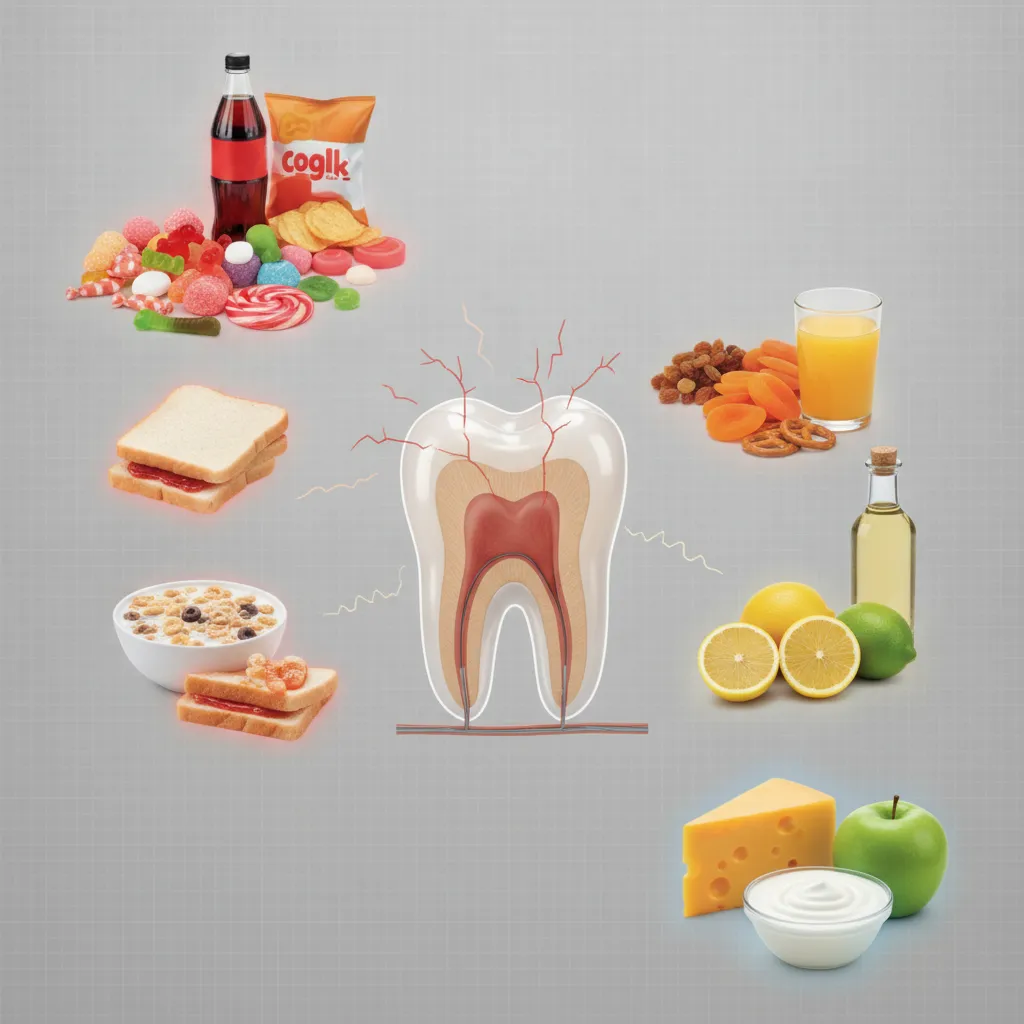
Starchy snacks like potato chips are among the most underestimated foods that damage teeth — salivary amylase converts their starch to fermentable sugar within seconds of chewing [3].
That converted sugar (primarily maltose) feeds oral bacteria just as effectively as table sugar, triggering acid production that can hold oral pH below 5.5 for 30–40 minutes per serving. Research published in dental nutrition studies indicates that starchy snack foods can suppress oral pH for up to 40 minutes per serving — comparable to the acid exposure window created by sugary candy. The slow clearance of starch particles is the core problem — not a single spike, but a prolonged low-pH window.
Chip fragments also pack into interproximal spaces between teeth, where they ferment for extended periods without flossing to clear them. Pretzels and crackers carry identical starch-to-sugar conversion risk and are often consumed in larger quantities because they feel light.
The stealth factor sets this category apart: most patients never flag chips as high-risk. People who consciously avoid candy but snack on chips throughout the workday are running the same bacterial fuel cycle — just without realizing it. According to Rejuvenation Dentistry’s analysis of bad foods for teeth, starchy snacks rank among the most overlooked dietary threats to enamel health precisely because of this misconception.
7. Alcohol and Wine
Alcohol damages teeth through two pathways simultaneously: direct acid erosion from wine’s low pH and systemic dehydration that strips the mouth of its primary acid defense — saliva [3].
Red and white wine both sit around pH 3.0–3.5, placing them among the most acidic beverages consumed regularly. White wine is more erosive than red per unit volume due to higher titratable acidity, despite similar pH readings. Beer is less acidic at pH 4.0–5.0 but still falls below the enamel-safe threshold of 5.5 and contributes fermentable sugars.
Alcohol suppresses saliva production systemically. Reduced salivary flow means less buffering capacity and slower acid clearance after any food or drink consumed during the same sitting.
That compounding effect is what separates alcohol from other acidic beverages: drinking wine with a sugary dessert creates a dual-threat environment — acid erosion plus bacterial fuel — that neither item would produce alone. Patients who report frequent wine consumption at dinner often show erosion patterns inconsistent with their reported sugar intake, precisely because of this interaction.
8. Coffee and Tea
Black coffee sits around pH 4.85–5.10, below the 5.5 enamel erosion threshold, and frequent sipping across a morning extends that acid exposure far beyond a single cup [3].
Adding sugar to coffee or tea converts a mild acid exposure into a dual event: acid contact plus bacterial fuel from the dissolved sugar. Tannins in coffee and black tea bind to enamel and promote surface staining — a cosmetic issue, but one that signals prolonged surface contact time.
Sipping coffee over two hours — common in office settings — keeps oral pH suppressed far longer than drinking the same volume in ten minutes. The exposure window matters as much as the pH level.
Green tea is the functional alternative most heavy coffee drinkers overlook. At pH 7.0–7.5, it sits at or above neutral, and its catechins actively inhibit Streptococcus mutans, the primary cavity-causing bacterium. Switching even one daily cup to green tea meaningfully reduces cumulative acid exposure without requiring a full habit overhaul.
9. Sports Drinks and Fruit Juice
Sports drinks and fruit juice carry a health halo that makes them more damaging in practice — both combine high acidity with significant sugar loads and are typically consumed slowly over extended periods. Like soda and sticky candy, these are foods that damage teeth through a dual mechanism of acid erosion and bacterial fuel, making them especially harmful when consumed frequently.
Gatorade and similar sports drinks range from pH 2.9–3.7, more acidic than orange juice [2], and are consumed in large volumes during activity when mouth breathing already reduces saliva flow. That dehydration-plus-acid combination accelerates enamel softening faster than the pH number alone suggests.
100% fruit juice is no safer. Apple juice averages pH 3.4 with roughly 24g of sugar per 8oz serving, comparable to many sodas in both acid and sugar load. Children are disproportionately affected because juice and sports drinks are marketed as healthy and consumed throughout the day in sippy cups, creating near-constant acid exposure on developing enamel. Studies suggest that children who consume juice or sports drinks more than three times daily face significantly higher rates of early childhood enamel erosion compared to those who primarily drink water or milk.
Athletes compound the problem by treating sports drinks as recovery tools, consuming them after exercise when saliva is already reduced by dehydration. Coconut water is frequently positioned as a natural alternative but still carries pH 4.5–5.0 and approximately 11g of sugar per cup — not a safe swap for anyone with enamel sensitivity. Plain water with electrolyte tablets remains the lowest-risk hydration option for enamel health.
“Parents and athletes are often surprised to learn that sports drinks and fruit juices rank among the foods that damage teeth most aggressively in children and active adults — their health reputation masks a genuinely harmful acid and sugar profile.” — American Dental Association, MouthHealthy: Foods That Damage Your Teeth
How to Protect Your Teeth Without Giving Up the Foods You Enjoy
Avoiding every item on this list isn’t realistic, but timing, technique, and a few targeted swaps can cut your enamel exposure significantly without overhauling your diet.
What preventive strategies work best for cavity-prone or enamel-eroded teeth?
Eat damaging foods with meals rather than as standalone snacks. Saliva production peaks during meals and neutralizes acid faster, shrinking the exposure window that would otherwise follow a between-meal snack.
For cavity-prone individuals, fluoride mouthwash used after rinsing — not after brushing — provides remineralization support within the critical post-exposure window when enamel is most receptive. For enamel-eroded individuals, eating cheese or drinking milk after an acidic meal raises oral pH and delivers calcium and phosphate directly to softened enamel surfaces, a clinically supported strategy that requires no additional products.
Specific food swaps that reduce risk without significant sacrifice:
- Sparkling water (pH ~5.5, no sugar) instead of soda or sports drinks
- Fresh fruit instead of dried fruit — lower sugar density and no sticky adhesion
- Cheese and nuts instead of chips — raise oral pH and provide calcium
- Green tea (pH 7.0–7.5) instead of coffee — neutral pH and cavity-inhibiting catechins
- Plain water with electrolyte tablets instead of sports drinks during exercise
These aren’t perfect substitutes in every context, but they reduce the acid-and-sugar combination that drives most enamel damage. The team at Villagio Family & Cosmetic Dental can assess your current erosion pattern and cavity risk during a routine exam, then tailor these strategies to your actual diet — not a generic checklist.
What’s the best technique for rinsing or cleaning teeth after problem foods?
Rinse with plain water immediately after consuming acidic or sugary foods — swishing for 30 seconds raises oral pH measurably faster than waiting. Then wait at least 30 minutes before brushing. Acid-softened enamel is more vulnerable to abrasive toothbrush contact, and brushing too soon removes surface mineral that would otherwise partially remineralize on its own.
Chewing sugar-free gum with xylitol after meals stimulates saliva flow and helps clear food particles from interproximal spaces — a useful bridge for situations where rinsing isn’t practical.
Frequently Asked Questions
How often can you eat acidic or sugary foods without damaging your teeth?
Frequency matters more than quantity — limiting acidic or sugary foods to mealtimes (two to three times daily) significantly reduces enamel exposure compared to snacking throughout the day [2]. Each time sugar or starch contacts plaque, acids attack enamel for up to 20 minutes [1]. Constant snacking means your enamel never fully recovers between acid attacks. Rinsing with water after eating and waiting at least 30 minutes before brushing helps limit cumulative damage.
Which food combinations make tooth damage significantly worse?
Pairing acidic drinks with sugary foods is the most damaging combination — the acid softens enamel while sugar feeds bacteria that produce additional acid [1]. Soda with candy, citrus juice with dried fruit, or sports drinks with starchy snacks all stack two separate attack mechanisms simultaneously. Alcohol combined with sugary mixers compounds the problem further by also reducing saliva flow, which is your mouth’s primary natural defense against acid buildup [3].
What foods actively strengthen tooth enamel and prevent cavities?
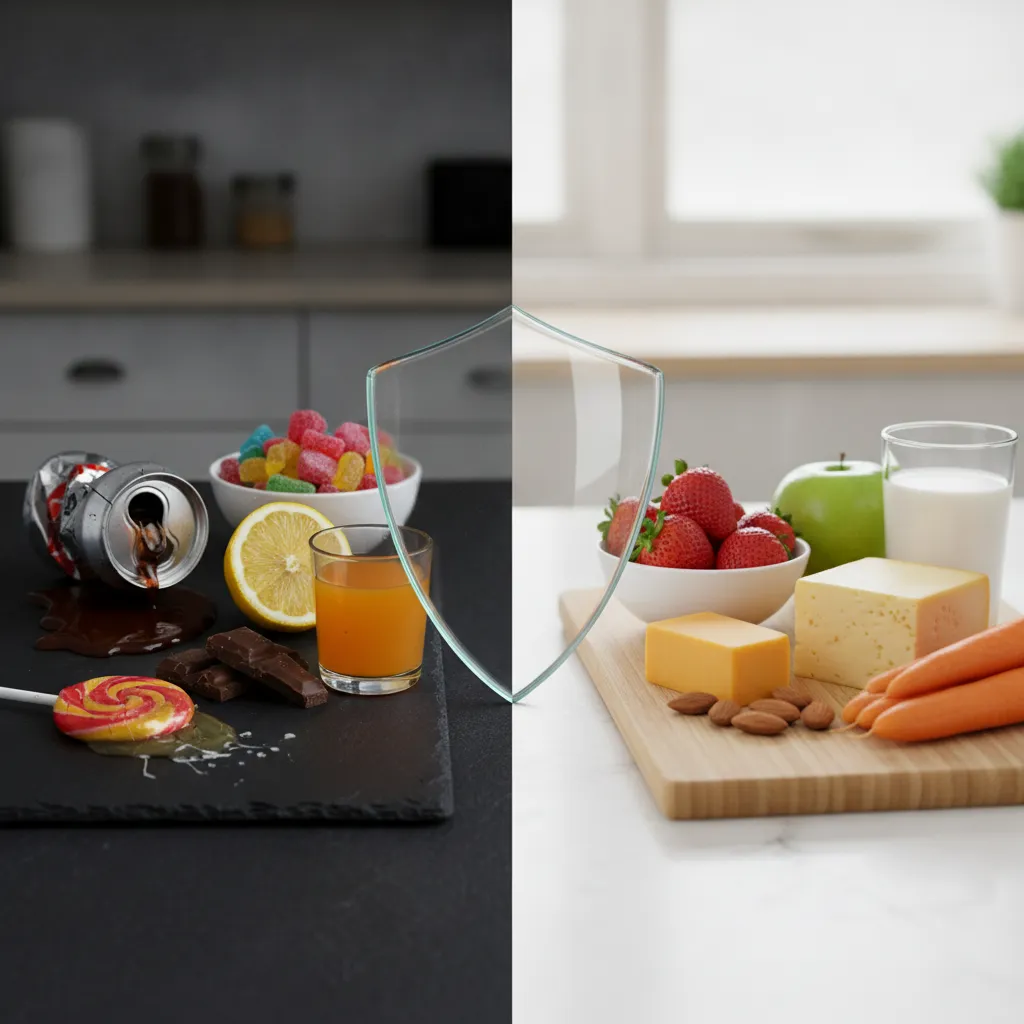
Dairy products — cheese, milk, and plain yogurt — actively strengthen enamel by supplying calcium and phosphate that remineralize tooth surfaces [1]. Crunchy vegetables like celery and carrots stimulate saliva production, which neutralizes acids naturally. Leafy greens provide calcium without added sugar. Fluoridated water supports remineralization throughout the day. At Villagio Family & Cosmetic Dental, our team can identify specific dietary gaps during your cleaning appointment and recommend targeted adjustments based on your enamel condition.
Is it better to brush immediately after eating damaging foods or wait?
Wait at least 30 minutes before brushing after eating acidic or sugary foods [2]. Acid temporarily softens enamel, and brushing while it’s weakened can physically scrub away the surface layer. Rinse with plain water immediately after eating to dilute acids and remove loose sugar — that’s the right first move. After 30 minutes, saliva has partially remineralized the enamel and brushing is safe and effective.
Are there any foods that damage teeth even when eaten in small amounts?
Yes — certain foods that damage teeth do so even in small quantities because of how they interact with enamel rather than how much sugar they contain. Lemon juice, for example, can begin softening enamel within one minute of contact regardless of serving size. Sticky candies and dried fruits cause harm through adhesion, not just sugar volume — even a small amount pressed into a molar fissure can trigger localized acid attacks lasting 20 minutes or more. Frequency and contact time matter more than portion size for these high-risk foods.
Conclusion
The most damaging foods — sticky sweets, acidic drinks, starchy snacks, and alcohol — share one trait: they either feed decay-causing bacteria or coat enamel in acid, and many do both [1][2]. Understanding which foods that damage teeth are most harmful, and why, empowers you to make smarter choices without eliminating everything you enjoy. Timing and frequency drive the real damage, not just the food itself. Three concrete steps make a measurable difference: limit sugary and acidic foods to mealtimes, rinse with water immediately after eating, and wait 30 minutes before brushing.
If you live in Katy, Fulshear, Richmond, or Cinco Ranch, schedule a cleaning at Villagio Family & Cosmetic Dental and ask your hygienist for a personalized dietary review — it takes five minutes and gives you a clear picture of where your enamel stands.
Sources & References
- Content – Health Encyclopedia – URochester Medicine
- Bad Foods | MouthHealthy – Oral Health Information from the ADA
- 11 Bad Foods For Teeth (And What To Eat Instead) | Rejuvenation Dentistry
Recommended Articles
Explore more from our content library: