Proudly Serving Katy, Richmond & Fulshear Cinco Ranch
(281) 395-2100
|
(281) 394-4001

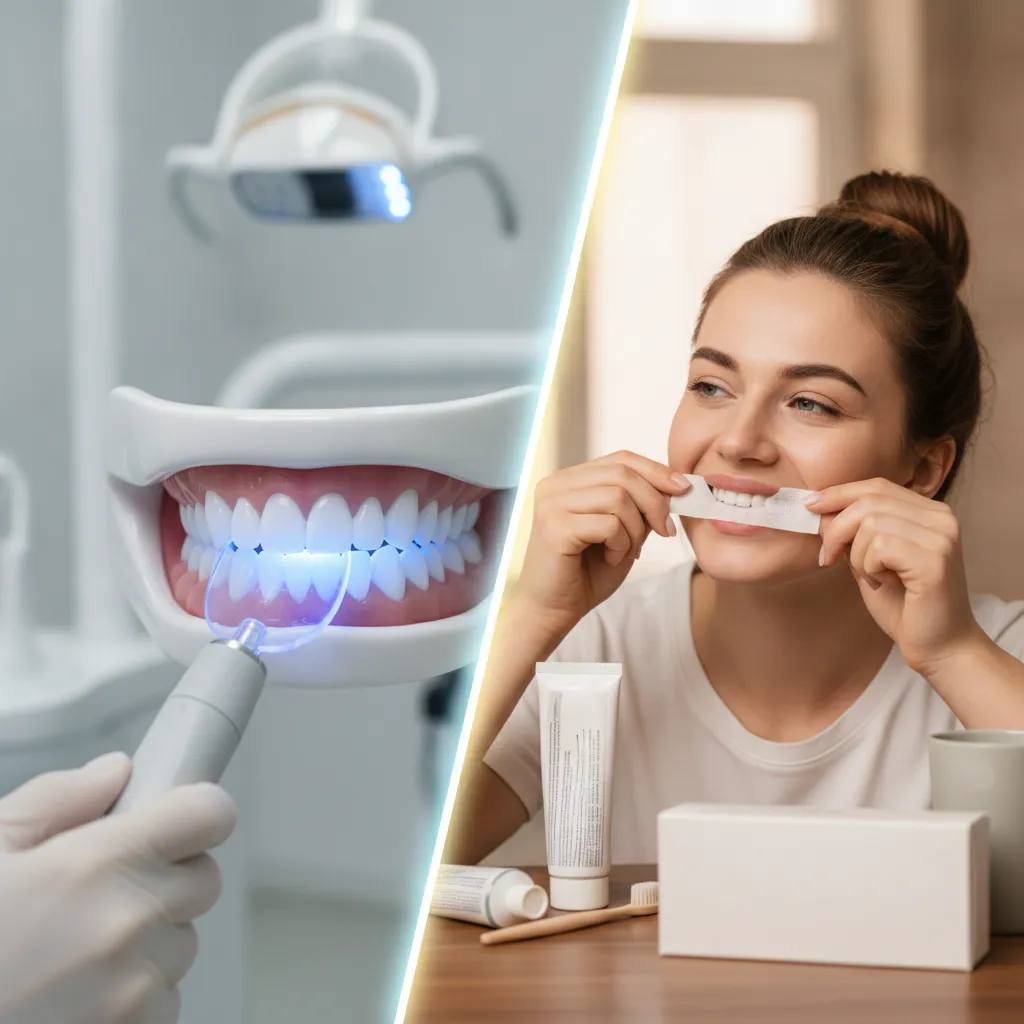
Understanding professional vs home whitening is essential. Professional whitening uses 25–40% hydrogen peroxide applied by a dentist, delivering 6–10 shades of improvement in a single 60-minute visit. At-home kits use 3–22% peroxide and take 2–4 weeks to reach comparable results, at roughly one-fifth the cost. The right choice depends on how fast you need results, your sensitivity history, and the type of stains you’re dealing with.
1. Professional vs Home Whitening: What Actually Differs
The core gap between professional and home whitening is peroxide concentration, fit, and speed, not just where the treatment happens. When evaluating professional vs home whitening, most patients focus only on price — but the delivery method and gel concentration are equally important factors.
How Whitening Gels and Bleaching Agents Remove Stains
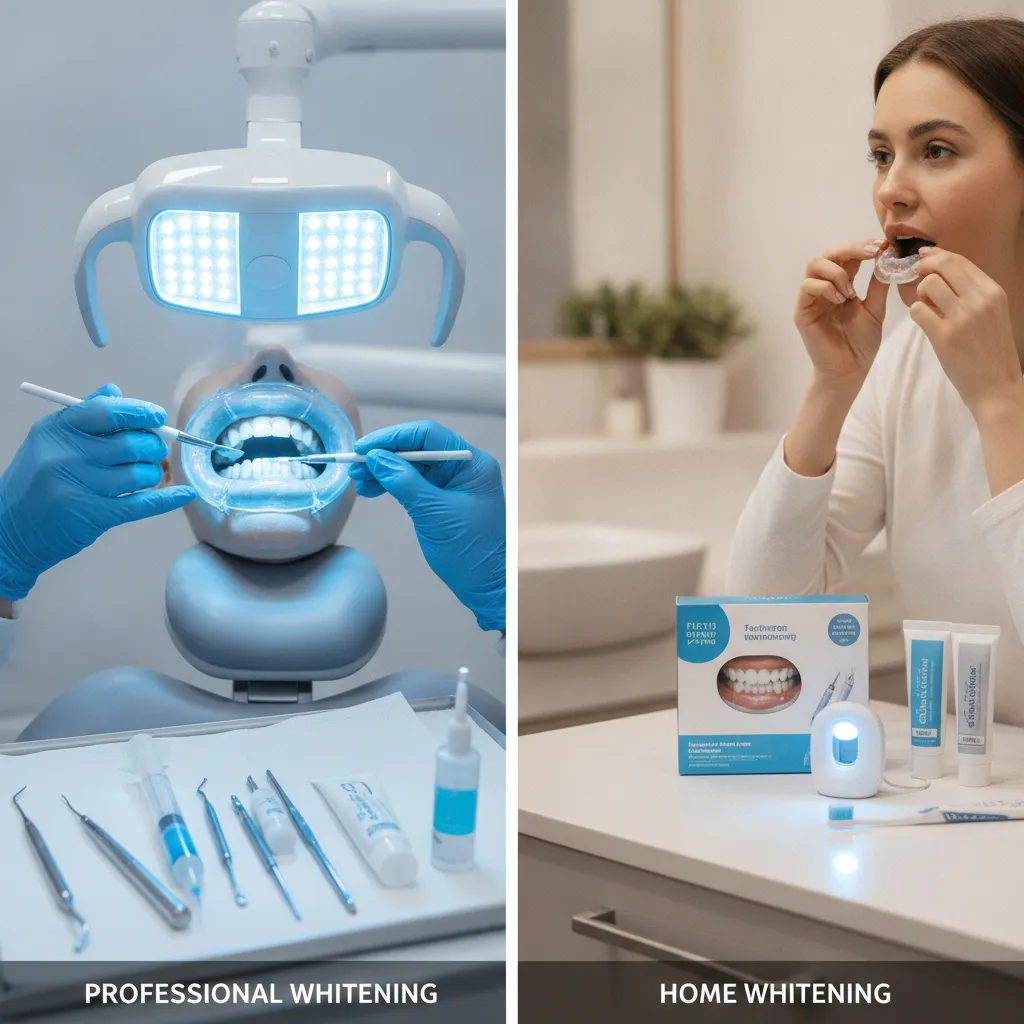
In-office treatments use 25–40% hydrogen peroxide [2], applied under dental supervision with light or laser activation to complete treatment in a single 45–90 minute session. OTC products, including Crest 3D Whitestrips at 10% hydrogen peroxide and AuraGlow LED kits, use 3–22% carbamide or hydrogen peroxide and require 30–60 minutes of daily application for 2–4 weeks to reach comparable results.
Peroxide penetrates enamel and breaks apart the carbon bonds in stain molecules through oxidation. Concentration determines how fast that process works, not whether it works at all.
A middle tier most comparisons skip entirely: dentist-dispensed take-home trays use 10–22% carbamide peroxide, professional-grade concentration with at-home convenience. The critical advantage over store-bought kits is fit. Custom-molded trays keep gel off gum tissue, which directly reduces soft-tissue irritation and chemical burns. OTC strips and universal-fit trays offer no such protection.
“Custom-fitted trays are the single most underappreciated advantage of dentist-supervised whitening. The precise fit prevents gel from contacting gum tissue, which is the primary cause of soft-tissue irritation in at-home users.” — Dr. Linda Greenwall, Specialist in Restorative Dentistry, British Dental Association
- In-office (e.g., Zoom, KöR): 25–40% hydrogen peroxide, 45–90 min, single session
- Dentist take-home trays: 10–22% carbamide peroxide, custom fit, 1–2 weeks
- OTC strips/kits (e.g., Crest 3D Whitestrips, AuraGlow): 3–10% hydrogen peroxide, 2–4 weeks
2. Intrinsic vs Extrinsic Stains: Which Type Responds to Whitening
Not all tooth discoloration responds to bleaching, stain origin determines which whitening method, if any, will actually work.
Why Some Teeth Stay Yellow Even After Professional Whitening
Extrinsic stains from coffee, tea, red wine, and tobacco sit on the enamel surface. Both professional and OTC whitening agents dissolve them effectively, this is the category where any peroxide-based product delivers visible results.
Intrinsic stains are embedded in dentin, the layer beneath enamel. Tetracycline antibiotic exposure during tooth development and fluorosis are the two most common causes. Professional whitening can lighten these stains, but it rarely eliminates them [1]. Veneers or composite bonding typically produce better outcomes for intrinsic discoloration. According to the American Dental Association, patients with intrinsic staining should always consult a dentist before attempting any whitening treatment.
Age-related yellowing combines both stain types: enamel thins over time, making the naturally yellow dentin more visible, while surface stains accumulate simultaneously. Whitening clears the extrinsic layer, it cannot reverse dentin darkening caused by aging.
Gray or blue-toned stains from tetracycline are the least responsive to any peroxide treatment, regardless of concentration or application time [1].
One candidacy filter worth knowing before booking any whitening appointment: crowns, veneers, and composite bonding do not respond to peroxide. If your visible teeth include restorations, whitening the natural teeth around them creates a mismatch, a detail that rarely gets adequate attention in OTC product marketing.
3. Cost Comparison: Professional Whitening vs At-Home Kits in 2024–2025
Professional whitening runs $300–$1,000 per session; OTC kits cost $30–$55, but the price gap narrows when you factor in longevity and retreatment frequency. A thorough professional vs home whitening cost analysis must account for how often each method needs to be repeated.
Detailed Cost Breakdown: In-Office vs At-Home Whitening Options
- In-office whitening (Zoom, KöR, BriteSmile): $300–$1,000 per session, depending on the system used and local market rates [2]
- Dentist-dispensed take-home trays: $150–$400, which typically includes custom tray fabrication and 2–4 syringes of carbamide peroxide gel
- OTC whitening strips (Crest 3D Whitestrips Professional Effects): $35–$55 per kit; AuraGlow LED kits run $30–$50
- Whitening toothpastes: $5–$15, the lowest-cost option, but these only address surface debris through mild abrasion; they contain no bleaching agent and do not change tooth color
Dental insurance almost never covers cosmetic whitening. What many patients in Katy, TX and surrounding areas don’t realize: as of 2024 IRS guidance, certain FSA and HSA accounts allow OTC whitening product purchases as a qualified medical expense. That can reduce the effective out-of-pocket cost on strips and kits by 20–30% depending on your tax bracket, a cost offset worth checking with your benefits administrator before buying.
For a comprehensive breakdown of professional vs home whitening costs and product comparisons, Dental Associates provides a detailed overview of both treatment tiers.
Villagio Family & Cosmetic Dental offers professional whitening options at the in-office and take-home tier, ask the team which concentration and delivery method fits your stain type and budget before purchasing an OTC kit that may underdeliver.
4. Results Longevity: How Long Each Method Actually Lasts
Professional whitening results last 1–3 years with maintenance; OTC strips typically fade within 3–6 months, but individual biology affects both timelines significantly.
In-office treatments produce the longest-lasting baseline, though patients who continue drinking coffee or wine daily without any maintenance can see noticeable re-staining within 6 months. Dentist-dispensed take-home trays fall in the middle: most patients maintain visible brightness for 6–12 months before a touch-up is needed. OTC strips and universal-fit trays deliver results that typically last 3–6 months before re-staining becomes apparent [2].
Diet is the most controllable variable. Coffee, red wine, and tobacco are the fastest re-staining agents across all whitening methods, reducing or eliminating them can extend any whitening result by 30–50%, regardless of which treatment you used. For more information, see Articles.
The variable most OTC kits never mention: saliva pH and enamel porosity differ meaningfully between individuals. Higher enamel porosity allows stain molecules to re-adhere faster, and acidic saliva accelerates that process. A dentist can assess both factors during an exam and recommend a maintenance schedule calibrated to your specific oral chemistry, something no strip kit or app can replicate.
5. Sensitivity and Side Effects: What Each Method Does to Your Teeth
Tooth sensitivity is the most common side effect of any whitening treatment, but the severity, duration, and cause differ sharply between professional and at-home methods.
How to Minimize Tooth Sensitivity and Gum Irritation During Whitening
Clinical literature puts sensitivity rates at roughly 38% of professional whitening patients and up to 67% of OTC strip users. The higher OTC rate is largely a delivery problem: ill-fitting strips allow gel to spread beyond tooth surfaces, contacting gum tissue and increasing overall irritation. Higher peroxide concentrations used in-office cause more acute sensitivity, but it typically resolves within 24–48 hours post-treatment. OTC strip users often experience lower-grade sensitivity that persists throughout the full 2–4 week treatment window.
Two mitigation strategies with consistent clinical support: using a potassium nitrate toothpaste such as Sensodyne for two weeks before starting any whitening treatment reduces nerve sensitivity at the outset. After an in-office session, dentists can apply fluoride varnish directly to the teeth, which accelerates enamel remineralization and shortens the sensitivity window.
The sharpest differentiator between professional vs home whitening on the safety side is gum bleaching, chemical burns caused by gel overflow onto soft tissue. This is almost exclusively an OTC risk. Custom-fitted trays, like those provided at Villagio Family & Cosmetic Dental, are fabricated from a precise mold of your teeth and create a barrier that prevents gel from reaching the gums entirely. Store-bought trays and strips offer no equivalent protection.
“The evidence consistently shows that professionally supervised whitening produces fewer adverse soft-tissue events than unsupervised at-home use, primarily because the delivery system can be controlled and adjusted based on patient response.” — Dr. Van B. Haywood, Professor Emeritus, Department of Restorative Sciences, Augusta University College of Dental Medicine
- Before treatment: Use potassium nitrate toothpaste (Sensodyne) for 2 weeks
- After in-office treatment: Ask your dentist about fluoride varnish application
- OTC users: Apply strips only to tooth surfaces; avoid contact with gum line
- High-sensitivity patients: Dentist-dispensed trays with lower-concentration gel are a safer starting point than in-office high-concentration sessions
6. Speed of Results: When You Need White Teeth Fast
A single in-office session delivers 6–10 shades of improvement in 60–90 minutes, the only whitening method that works when you have less than 48 hours.
OTC strips require a minimum of 10–14 days before meaningful improvement shows, with full results taking 3–4 weeks. That timeline rules them out for weddings, job interviews, or class reunions with a hard date on the calendar.
Dentist-dispensed take-home trays close the gap. Because they use higher peroxide concentrations than OTC products, visible results appear in 3–5 days, a middle option for patients with a week or more to prepare.
The protocol most cosmetic dentists recommend for event-driven patients is a two-phase approach: one in-office session for immediate lift, followed by dentist-dispensed trays for ongoing maintenance. This combination protects the investment and extends results well past the event itself, a detail most professional vs home whitening comparisons skip entirely. The Consumer Guide to Dentistry’s in-office vs at-home whitening comparison also recommends this two-phase strategy for patients with time-sensitive goals.
7. Candidacy: Who Should Choose Professional and Who Can Go OTC
The right whitening method depends less on preference and more on your dental history, stain severity, and whether any conditions disqualify you from whitening altogether.
Professional whitening at a practice like Villagio Family & Cosmetic Dental is the appropriate choice for patients with moderate-to-severe extrinsic staining, a history of sensitivity that requires supervised treatment, an event within two weeks, or a track record of OTC strips that didn’t deliver.
OTC products are a reasonable fit for patients with mild surface staining, no significant sensitivity history, and a budget-focused goal, particularly for maintenance between professional sessions rather than as a primary treatment.
Teeth Types and Conditions That Don’t Respond Well to Whitening
Absolute contraindications for any whitening method include pregnancy, active cavities, cracked teeth, exposed roots, and severe gum disease. Each of those conditions requires dental treatment before whitening is safe to attempt. The National Institute of Dental and Craniofacial Research advises patients to complete a full dental exam before beginning any whitening regimen.
Patients with crowns or veneers on front teeth face a specific problem: whitening agents only affect natural enamel. Treating the surrounding teeth without consulting a dentist first creates a visible color mismatch between the restorations and the newly brightened natural teeth.
Children under 16 and nursing mothers are excluded from most professional whitening protocols as well. OTC packaging often buries this restriction in fine print, a candidacy filter worth checking before purchasing any kit.
8. Maintenance Schedule: Keeping Whitened Teeth Bright Long-Term
Whitening results fade without a consistent maintenance plan, the schedule you follow in the weeks after treatment determines how long the improvement lasts.
How Often to Touch Up Whitening Treatments to Maintain Results
Immediately after a professional session, avoid chromogenic foods and drinks, coffee, red wine, berries, soy sauce, for 48 hours. This is the “white diet” window, when enamel pores are most open and surface staining takes hold fastest.
After that window closes, a touch-up with OTC strips or dentist-dispensed gel every 3–6 months offsets the gradual staining that diet and aging cause. Daily use of a whitening toothpaste, Colgate Optic White and Arm & Hammer Advance White are two widely available options, extends results by mechanically removing surface deposits between touch-ups.
An annual in-office touch-up session typically costs $100–$300 less than the initial full treatment at most practices, making it a cost-effective way to maintain a professional baseline.
One maintenance tool competitors rarely mention: electric toothbrushes with oscillating heads remove surface stains 21% more effectively than manual brushing, according to a 2020 Cochrane review. Adding one to your routine costs less than a single OTC strip kit and pays dividends across every whitening method.
9. Is Professional Whitening Worth the Cost?
Professional whitening costs 6–20 times more than OTC strips, but the price gap narrows significantly when you factor in speed, longevity, and the cost of repeated OTC purchases.
For patients who have already tried OTC strips without satisfactory results, professional treatment is the logical next step, not a luxury upgrade. Continuing to buy kits that don’t work is its own cost.
The longevity math is straightforward. One professional treatment at $500, lasting two years, runs roughly $21 per month. Four OTC strip kits per year at $50 each totals $200 annually, comparable over the same period, without the same depth of result.
The safety premium carries real weight for patients with sensitivity, gum recession, or existing dental work. Unsupervised OTC use, particularly overuse, carries documented risk of enamel damage and gum irritation that a supervised in-office treatment avoids by design.
One value that almost never appears in competitor cost breakdowns: the psychological return. Dental patient satisfaction studies document measurable confidence gains in social and professional settings following cosmetic whitening. That outcome is real, even if it doesn’t appear on a price comparison chart.
How to Choose Between Professional and At-Home Whitening
Start with your stain type: intrinsic staining, discoloration from medication, trauma, or aging inside the tooth, requires a dentist consultation before any whitening product is considered.
Extrinsic staining, caused by food, drink, and tobacco, responds to both methods. From there, apply three filters in order. When weighing professional vs home whitening, these three decision points will guide most patients to the right choice without guesswork.
- Timeline: Need results in under two weeks? Professional in-office treatment is the only option. Have two to four weeks available? Dentist-dispensed take-home trays or OTC strips both work, depending on budget.
- Budget: Under $60 points to OTC strips. Between $150 and $400, dentist-dispensed take-home trays deliver stronger results with professional-grade gel. Above $400, in-office treatment at a practice like Villagio Family & Cosmetic Dental is the appropriate tier.
- Sensitivity history: Any history of tooth or gum sensitivity moves the decision to professional supervision, regardless of budget. The concentration and application method in a supervised setting can be adjusted in ways no OTC product allows.
Before starting any method, check for crowns, veneers, or bonding on visible teeth. Whitening agents don’t affect dental restorations, treating the surrounding natural teeth without a prior consultation creates a color mismatch that requires additional work to correct. A brief appointment with your dentist resolves this before it becomes a problem.
Frequently Asked Questions
Can you whiten teeth that have crowns or veneers?
Whitening agents do not change the color of crowns, veneers, or composite bonding, only natural tooth enamel responds to peroxide. If you whiten your natural teeth without accounting for existing restorations, the result is mismatched shading. A dentist at Villagio Family & Cosmetic Dental can evaluate your existing restorations before treatment and recommend whether new restorations are needed to match your post-whitening shade.
How many shades whiter can you realistically expect from professional whitening?
Professional in-office whitening typically delivers 6–10 shades of improvement in a single appointment, depending on the original tooth color and stain type [2]. At-home strips and trays generally produce 2–4 shades of change over several weeks. Intrinsic stains, those caused by medication, fluorosis, or trauma, respond less predictably than surface stains from food and drink.
Is it safe to use whitening strips every day?
Daily strip use beyond the manufacturer’s recommended cycle, typically 10–14 days, increases the risk of tooth sensitivity and gum irritation. Most over-the-counter strips use 6–10% hydrogen peroxide, which is safe at directed intervals but can irritate soft tissue with overuse. If sensitivity develops, stop use and consult a dentist before continuing any whitening regimen.
Does teeth whitening damage enamel permanently?
Used as directed, peroxide-based whitening does not permanently damage enamel. Studies show that professional-strength gels temporarily increase enamel porosity during treatment, but mineral content restores within 24–48 hours with normal saliva exposure. The risk of lasting enamel damage rises with overuse of acidic whitening products or unsupervised high-concentration treatments, another reason professional oversight matters for anyone whitening more than once or twice a year.
How do I know whether professional vs home whitening is right for my specific situation?
The decision between professional vs home whitening comes down to three personal factors: the severity and type of your staining, your timeline for results, and your sensitivity history. Patients with mild extrinsic staining, no sensitivity issues, and several weeks available are reasonable candidates for OTC strips. Anyone with intrinsic staining, dental restorations on visible teeth, a history of sensitivity, or a deadline under two weeks should consult a dentist before purchasing any whitening product.
Conclusion
The right whitening method depends on three factors: how much change you want, how quickly you need it, and whether your teeth and gums are healthy enough to handle peroxide treatment. Professional whitening delivers faster, more predictable results, especially for stubborn stains, while at-home options suit mild discoloration and maintenance between office visits. Crowns, veneers, and existing sensitivity all affect which approach is appropriate, and neither option works well without a baseline dental exam first.
If you’re in the Katy, Fulshear, or Cinco Ranch area, schedule a whitening consultation at Villagio Family & Cosmetic Dental to get a shade assessment and a treatment plan matched to your actual tooth color and dental history, not a one-size-fits-all kit.
Sources & References
- Professional Teeth Whitening vs. At-Home Teeth Whitening
- In-office Whitening vs At-home Whitening – Consumer Guide to Dentistry
Recommended Articles
Explore more from our content library: