Proudly Serving Katy, Richmond & Fulshear Cinco Ranch
(281) 395-2100
|
(281) 394-4001

When you search for a family dentist near me, you’re looking for more than just a convenient address. A family dentist handles dental care for every age group — from toddlers losing their first teeth to adults managing crowns, gum disease, or cosmetic concerns — all under one roof. The best practices combine broad service menus with flexible scheduling, clear insurance policies, and a clinical team experienced across life stages. Finding the right one means knowing what to look for before you book.
1. What a Family Dentist Near Me Actually Does (and Why It Matters)
A family dentist treats patients of every age, from toddlers to seniors, under one roof, making consolidated care the defining advantage over specialty-only practices.
Unlike a pediatric dentist, who stops seeing patients in their late teens, or a general dentist who may turn away young children, a family practice covers the full age spectrum without interruption. That continuity matters clinically: a single provider tracking your dental history across decades spots patterns — recurring decay in specific quadrants, early gum recession, bite shifts — that a new practice starting from scratch would miss entirely.
Scheduling is the practical payoff. When every family member sees the same practice, back-to-back appointment blocks replace four separate trips to four separate offices, which is the single biggest reason families keep their appointments consistently.
Why do some family dentists have better reputations than others?
Reputation in family dentistry is built on two things: clinical range and patient experience across age groups. A practice that handles a five-year-old’s first visit and a grandparent’s crown in the same morning has proven its breadth. Practices that refer out frequently, or that clearly prefer adult patients, show their limits quickly through word of mouth.
What should you look for in a family dentist’s approach to care?
When you search for a family dentist near me, you’re ready to act, so evaluate rather than browse. Ask whether the practice sees children under three, whether it offers in-house orthodontic assessments, and whether it holds same-day slots for urgent cases. Those three questions separate a genuinely full-scope practice from one that uses “family dentistry” as a marketing label.
What questions should you ask before booking your first appointment?
Before committing to any practice, prepare a short list of qualifying questions to ask on the first call. The answers will quickly reveal whether a practice is the right fit for your family’s specific needs:
- Does the practice see children under age three?
- Which dental insurance plans are accepted in-network?
- Are same-day slots held for dental emergencies?
- Does the practice offer orthodontic assessments or clear aligner therapy?
- What is the after-hours contact process for urgent dental pain?
- Is there an in-house membership plan for uninsured patients?
A practice that answers these questions clearly and specifically — rather than redirecting you to a website or a callback — demonstrates the kind of patient communication that tends to carry through into the clinical experience itself.
2. Comprehensive Services Family Dentists Offer for Kids and Adults
A well-equipped family dental practice covers pediatric-specific care, adult restorative work, and cosmetic treatments, all without sending patients to outside specialists for routine needs.
How do pediatric dental services differ from adult services at a family practice?
Children need services tied to active development: dental sealants to protect newly erupted molars, fluoride treatments to strengthen enamel before it fully mineralizes, space maintainers when a primary tooth is lost early, and first-visit protocols designed to build comfort rather than just complete a chart. Adults require a different menu — crowns, bridges, periodontal therapy for gum disease management, and cosmetic work that children’s teeth aren’t ready for.
Preventive care — cleanings, exams, X-rays, and oral cancer screening — sits at the foundation for both groups. Skipping preventive visits doesn’t pause dental disease; it allows biofilm to calcify into tartar, small cavities to reach the pulp, and early gum inflammation to advance into bone loss. The restorative costs that follow are consistently higher than the preventive visits that would have caught the problem early.
What specialized treatments can family dentists provide?
A qualified family practice can offer orthodontic assessments, clear aligner therapy such as Invisalign, professional teeth whitening, and tooth-colored composite restorations in-house. Villagio Family & Cosmetic Dental, serving Katy, Fulshear, Richmond, and Cinco Ranch, TX, provides this breadth of services under one roof, meaning patients rarely need an outside referral for routine cosmetic or restorative work.
Fewer referrals is a direct clinical advantage. Every handoff between providers introduces a gap: new intake paperwork, a delay in scheduling, and a break in the clinical narrative that the original dentist was tracking. A practice that handles most cases internally keeps that narrative intact.
3. How Often You Should Visit a Family Dentist
Most patients need two dental visits per year, but that baseline shifts based on age, disease history, and the presence of restorative work — not a single universal rule.
The twice-yearly recommendation exists for a specific reason: oral biofilm, the bacterial layer that causes decay and gum disease, reaches a clinically significant accumulation level in roughly six months for most patients. Professional cleaning at that interval disrupts the cycle before it causes measurable damage. Early caries also have a detection window: caught in the enamel layer, they can often be remineralized or treated with a small filling. Missed past that window, they reach dentin and pulp, requiring root canals or extractions.
What is the 2 year rule for dentists, and does it apply to family dentistry?
The “two-year rule” — the idea that healthy adults can safely skip to annual or biennial visits — does not apply uniformly. Extending intervals increases the probability that a problem is found at a more advanced stage, where treatment is more complex and more expensive. The math is straightforward: a cavity found at six months costs a filling; the same cavity found at eighteen months may cost a crown.
Children in active development, adults with a history of periodontal disease, and seniors with crowns, bridges, or implants each carry higher risk profiles that warrant more frequent monitoring, sometimes every three to four months. Treating consistent dental visits as cost avoidance, rather than a health habit, is the framing that tends to keep families on schedule.
4. When to See a Family Dentist for Gum Pain or a Dental Emergency
Acute swelling, abscess signs, dental trauma, and lost restorations causing pain all require same-day contact — not a wait-and-see approach or a next-available appointment.
Each of those categories worsens with delay for a distinct reason. A dental abscess is a bacterial infection that can spread along tissue planes into the jaw, neck, or airway — a progression that has caused life-threatening complications in documented cases. Dental trauma left unaddressed allows the tooth socket to begin remodeling within hours, narrowing the window for successful reimplantation or stabilization. A lost crown or broken restoration exposes dentin and pulp to oral bacteria, accelerating decay in a tooth that was already structurally compromised. When searching for a family dentist near me, confirming genuine emergency availability should be a top priority.
What emergency dental services are available after hours or on weekends?
A well-run family practice holds same-day slots specifically for urgent cases rather than filling every appointment slot with routine care. After-hours access typically means a direct call-routing system that reaches a provider — not a voicemail — so a triage decision can be made before the next business day. Practices that offer genuine emergency availability describe their protocols specifically: response time targets, who answers the after-hours line, and what conditions qualify for same-day treatment.
How quickly can a family dentist see you for an emergency?
Most competing local practice pages mention emergency care without specifying response times or after-hours access, which tells patients very little. When evaluating a practice, ask directly: how many same-day slots are held each day, and what is the after-hours contact process? Villagio Family & Cosmetic Dental is structured to address urgent dental needs promptly, so Katy-area families aren’t left managing a dental crisis through a general voicemail system.
5. Can a Family Dentist Fix a Rotten or Severely Damaged Tooth?
A family dentist can save or replace most severely damaged teeth in-house — the clinical decision depends on how much healthy tooth structure and viable root remain.
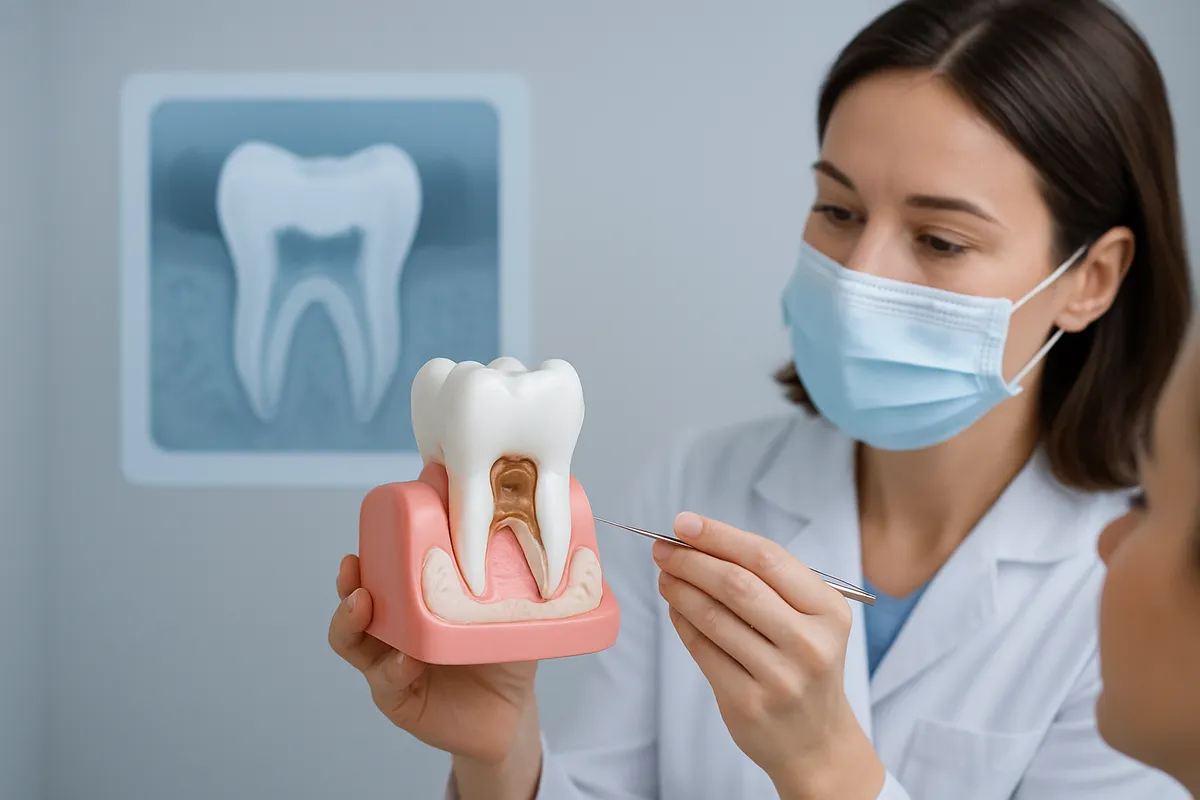
The threshold between saving and extracting a tooth is structural. When decay or fracture has reached the pulp — the nerve and blood supply at the tooth’s core — a root canal removes the infected tissue and seals the canal, preserving the root. A crown then restores the visible portion. That pathway works as long as the root itself is intact and the surrounding bone can support the restored tooth. When the root is fractured vertically, the bone is severely compromised, or the remaining tooth structure cannot support a crown, extraction becomes the clinical recommendation.
What are your options if a tooth is too damaged to fill?
The restorative spectrum runs from least to most invasive:
- Composite filling — handles minor decay with minimal tooth removal
- Inlay or onlay — covers larger cavities that a standard filling can’t support structurally
- Crown — caps a tooth that is cracked or heavily restored
- Root canal plus crown — addresses pulp involvement while preserving the root
- Extraction — the endpoint when the tooth cannot be preserved
After extraction, the two primary replacement options are a dental implant — a titanium post placed into the jawbone that functions like a natural root — or a bridge, which anchors a false tooth to the adjacent teeth on either side.
Implants preserve jawbone density over time because the post provides the stimulation that a natural root would; a bridge does not. The right choice depends on bone volume, adjacent tooth health, and patient preference — all of which a dentist assesses at the consultation. Villagio Family & Cosmetic Dental handles most of these restorative cases in-house, which means the provider who diagnosed the problem is the same one managing the repair: no referral delay, no repeated intake process, no break in clinical continuity.
6. Insurance Plans and Payment Options at Family Dental Practices
Knowing whether a practice is in-network before you book can significantly reduce your out-of-pocket costs — and most local dental pages don’t tell you this upfront. This is one of the most practical factors to confirm when choosing a family dentist near me.
Which dental insurance plans do local family dentists accept?
In-network status means the practice has a contracted fee schedule with your insurer. Out-of-network care uses the same insurance, but your plan reimburses at a lower rate, leaving you responsible for a larger share of the bill. That gap can be meaningful for a family with multiple members needing treatment in the same calendar year.
Most competing local pages omit insurance details entirely. Practices that publish this information — or answer it clearly on the first call — tend to attract patients who are ready to book, not still researching.
Do family dentists offer financing plans or payment arrangements?
Three options appear most often at independent family practices: in-house payment plans spread the balance over several months; third-party financing through programs like CareCredit offers budget-friendly to mid-range access depending on credit approval; and membership plans give uninsured patients a flat annual fee covering preventive visits with discounts on additional treatment.
Before committing to any practice, ask three specific questions: which insurance plans are accepted in-network, whether an in-house payment plan requires a credit check, and whether the membership plan covers routine preventive care or only discounts it.
7. How to Find a Family Dentist Near Me with Real Emergency Availability
A practice that lists “emergencies welcome” as a headline is not the same as one with a defined same-day protocol — and the difference matters when a tooth fractures on a Sunday.
What after-hours protocols do family dentists have in place?
Operational emergency availability means three things: reserved same-day slots that aren’t filled by routine appointments, a live after-hours line rather than a voicemail box, and a stated triage callback window — typically within one to two hours. Without all three, “we see emergencies” is marketing language, not a clinical commitment.
Proximity alone does not equal availability. A dentist two miles away with no same-day capacity is less useful during an acute situation than one five miles away with a dedicated urgent slot. Before choosing a practice, ask directly: what happens if you call after 6 p.m. with pain, what the weekend access policy is, and who covers emergencies when the primary dentist is unavailable.
Practices that detail their actual response process — callback time, covering provider, after-hours contact number — give you information you can act on. Those that only advertise availability give you nothing to verify.
8. Independent Family Dentist vs. Corporate Dental Chain
The core trade-off is relationship continuity versus convenience infrastructure — and which matters more depends entirely on what your family needs from dental care.
What are the pros and cons of choosing an independent family dentist?
Corporate dental groups can affect clinical decision-making through structural pressures: production quotas tied to provider compensation, higher staff turnover rates, and rotating dentists mean the person examining your child this year may not be the one who saw them last year. That breaks the clinical history thread that helps a dentist catch changes over time.
An independent practice like Villagio Family & Cosmetic Dental operates differently. The same dentist tracks your records across years, and treatment recommendations aren’t filtered through a corporate protocol layer designed to standardize care across dozens of locations. That continuity is particularly valuable for pediatric patients and for adults managing ongoing conditions like gum disease or teeth grinding.
Corporate chains do hold genuine advantages: extended evening and weekend hours, multiple locations within a metro area, and billing systems built for high patient volume. For a single-visit procedure where continuity isn’t a factor, those conveniences are real.
The decision comes down to whether you prioritize a consistent clinical relationship or scheduling flexibility. Neither answer is wrong, but knowing which you’re choosing helps you avoid disappointment later.
9. What Patient Reviews Actually Reveal About a Family Dentist
The most useful review signals aren’t star ratings — they’re the specificity of the feedback, the recency, and how the practice responds when something goes wrong.
Where can you find verified reviews and ratings for local family dentists?
Google Business Profile, Healthgrades, and Zocdoc each aggregate patient feedback through different verification mechanisms. Cross-referencing across all three reduces the risk that a single platform’s rating has been shaped by a review campaign rather than actual patient experience. A practice with a large number of Google reviews and a consistent pattern on Healthgrades is more credible than one with many five-star ratings on a single platform and nothing elsewhere.
When reading reviews, weight these signals most heavily: complaints or praise that name a specific procedure or staff member, reviews posted within the last 12 months, and the practice’s written responses to negative feedback. A response that addresses the patient’s concern directly — rather than a generic “we’re sorry you feel that way” — indicates a practice that treats complaints as clinical feedback rather than reputation management problems.
Most competing local pages in the “family dentist near me” search space don’t teach readers how to interpret reviews — they just link to their own rating. A reader who knows how to evaluate review patterns across platforms has a concrete tool that most searchers never get.
How to Choose the Right Family Dentist Near Me
Evaluate in this order — age-range coverage, service menu, insurance compatibility, emergency protocols, then reviews — and you’ll eliminate poor fits before making a single call.
Sequencing matters because each step filters out a different failure mode. A practice that doesn’t treat children fails criterion one regardless of how strong its reviews are. A practice with no in-network agreement with your plan fails criterion three regardless of how close it sits to your home. Working through the list in order prevents wasted calls to practices that can’t serve your family.
The single most predictive question to ask during a first call: how does the practice handle a dental emergency for an established patient after hours? The answer reveals whether emergency care is a real protocol or a marketing claim, and it tells you something about how the practice values patient relationships generally.
Proximity is a necessary filter, not a sufficient one. A practice two blocks away that doesn’t accept your insurance and has no pediatric experience fails two of the four core criteria before you’ve even scheduled a cleaning.
What separates a good family dentist from a great one is proactive communication. At Villagio Family & Cosmetic Dental, that means walking patients through a full treatment plan — what’s needed now, what can wait, and why — rather than addressing problems only after they become urgent. That approach keeps families informed, reduces surprise costs, and builds the kind of trust that makes patients stay for years rather than search again next time they move.

Frequently Asked Questions
At what age should a child first see a family dentist?
A child should see a dentist by age one or within six months of their first tooth appearing. The American Academy of Pediatric Dentistry recommends this timeline to catch early decay and establish healthy habits before problems develop. At Villagio Family & Cosmetic Dental, early visits also help young patients get comfortable with the office environment before any treatment is needed.
Can a family dentist provide orthodontic treatment like Invisalign or braces?
Many family dentists offer orthodontic options, including Invisalign clear aligners, directly in their practice. Villagio Family & Cosmetic Dental provides Invisalign treatment for both teens and adults, so families in Katy, Fulshear, and Cinco Ranch can address alignment issues without a separate specialist referral. Complex cases may still require an orthodontist, but most mild-to-moderate alignment concerns are handled in-office.
What happens if I don’t have dental insurance — can I still afford a family dentist?
No insurance doesn’t mean no dental care — most family dental practices offer alternative payment paths. Villagio Family & Cosmetic Dental accepts flexible financing options and works with patients to make treatment accessible. In-house membership plans and third-party financing through providers like CareCredit are common options worth asking about when you call to schedule. Preventive care now almost always costs less than restorative treatment later.
How is a family dentist different from a pediatric dentist?
A family dentist treats patients of all ages — children, teens, adults, and seniors — under one roof, while a pediatric dentist specializes exclusively in children up to young adulthood. For most families, a family dentist is the practical choice: one practice manages everyone’s records, schedules, and treatment history. Children with significant dental anxiety or complex developmental needs may benefit from a pediatric specialist referral.
How do I know if a family dentist near me is accepting new patients?
The most direct approach is to call the practice and ask. Many practices also indicate new-patient availability on their website or Google Business Profile. When you call, confirm not just that they’re accepting new patients, but that they can accommodate your full family — including any young children — and that your insurance is accepted in-network. Booking a new-patient exam for the whole family in a single appointment block is often possible at practices structured for family care.
Conclusion
Choosing a family dentist near me means more than convenience — it means one trusted provider who knows your child’s first tooth and your own crown history. The most important moves: schedule that first visit for your youngest child before age one, confirm the practice handles the services your family actually needs (orthodontics, cosmetic work, emergency care), and ask about payment options before insurance becomes a barrier.
If you’re in Katy, Fulshear, Richmond, or Cinco Ranch, call Villagio Family & Cosmetic Dental to book a new-patient exam for your whole family in a single appointment block — it’s the fastest way to get everyone on the same preventive care schedule.
Recommended Articles
Explore more from our content library: