Proudly Serving Katy, Richmond & Fulshear Cinco Ranch
(281) 395-2100
|
(281) 394-4001

If you are considering braces for adults, you are far from alone — and the results are just as effective as treatment in adolescence. Modern options range from traditional metal brackets to ceramic braces, lingual braces, and clear aligners, each suited to different bite complexities, lifestyle demands, and visibility preferences. The main differences from teen treatment are longer average timelines and the need to account for existing dental work, bone density, and gum health before starting.
1. Why Braces for Adults Are More Common Than You Think
Adult orthodontic treatment is mainstream — 1 in 3 orthodontic patients today is an adult [2], and that number has grown steadily as discreet treatment options have expanded. This is particularly relevant for braces for adults.
Why might an adult need orthodontic treatment?
The reasons adults seek treatment go well beyond appearance. Bite problems, jaw pain, and teeth that have shifted after years without a retainer are among the most common clinical drivers. Crowding that seems minor at 25 can worsen noticeably by 40, creating difficulty chewing and accelerating enamel wear.
Some cases are elective — a patient wants a straighter smile and chooses to act on it. Others are clinically recommended: a dentist identifies a bite pattern causing joint stress or gum recession that will progress without correction. Both are legitimate reasons to start treatment.
Discreet options like ceramic brackets and clear aligners have reduced the social visibility of treatment considerably, which has lowered the barrier for adults who previously hesitated.
How common is it for adults to get braces?
Adult bone structure is fully set by the time treatment begins, unlike in adolescents, whose jaws are still developing. This biological difference means tooth movement in adults is slower and requires more precise force calibration. Treatment planning accounts for this from the start, which is why adult cases are often staged differently than teen cases, even when the clinical goals look similar.
2. Traditional Metal Braces
Metal braces remain the most clinically capable fixed orthodontic option — they handle severe crowding, significant bite correction, and complex multi-tooth movement that other systems cannot reliably match. When considering braces for adults, this point stands out.
The mechanism is straightforward: metal brackets bond to the front surface of each tooth, and a continuous archwire threads through them. The wire applies steady, calibrated pressure that moves teeth incrementally over time. The orthodontist adjusts the wire at intervals to redirect that pressure as teeth respond.
For adults with severe crowding, large overbites or underbites, or cases requiring coordinated movement across many teeth simultaneously, metal braces outperform clear aligners and ceramic alternatives. They also require no removal discipline — the brackets stay on, so treatment progress doesn’t depend on patient compliance with wearing schedules.
The visibility trade-off is real, but many adults choose metal anyway for its durability and lower maintenance demands. One detail the top search results skip: because adult bone density is higher than in adolescents, archwire adjustments in adult cases are often spaced further apart to allow adequate bone remodeling time. This affects how frequently patients need to come in — appointments may be less frequent but remain equally important.
3. Ceramic Braces
Ceramic braces use tooth-colored or clear brackets to reduce visibility while delivering the same mechanical force and clinical range as traditional metal braces.
The underlying system is identical to metal: brackets bond to the tooth surface and an archwire applies continuous pressure to move teeth. The difference is material — ceramic brackets blend with natural tooth color, making them far less noticeable in professional or social settings. For those exploring braces for adults, this matters.
The practical concern adults raise most often is staining. Coffee, tea, and red wine can discolor the clear elastic ties that hold the archwire in place. Adults consume these at a higher frequency than most teens, so staining between adjustment appointments is a real consideration, not a minor footnote.
The ideal candidate is an adult who needs the clinical strength of fixed braces but works in a client-facing or high-visibility environment where metal brackets feel like a barrier to starting treatment.
One limitation the top results consistently overlook: ceramic brackets are more brittle than metal. For adults who grind their teeth — a condition called bruxism, which is more prevalent in adults dealing with work-related stress — that brittleness increases the risk of bracket fracture. An orthodontist should assess grinding habits before recommending ceramic over metal for these patients.
4. Lingual Braces
Lingual braces are fixed brackets bonded to the tongue-side of the teeth, making them completely invisible from the front — the most discreet fixed orthodontic option available.
Because the brackets sit on the inner surface of each tooth, no hardware is visible during normal conversation or in photographs. The archwire runs along the same hidden surface, applying the same type of continuous pressure as conventional braces. This directly impacts braces for adults outcomes.
The speech adjustment period is a genuine short-term challenge. The tongue contacts the brackets during speech, which temporarily affects pronunciation, particularly with sounds like “s” and “t.” For adults who present publicly, give client presentations, or perform, this is worth factoring into timing. Most patients adapt within a few weeks, but the adjustment is real and should be anticipated rather than minimized.
Lingual braces suit adults who combine high visibility requirements with clinical complexity that clear aligners cannot fully address — public speakers, performers, and client-facing professionals who also have significant bite issues.
The differentiator most sources miss: lingual brackets are custom-fabricated for each individual patient’s tooth anatomy, not selected from standard sizes. That custom fabrication process adds lead time before treatment can begin, and it demands a higher level of provider skill to place and adjust correctly. Not every dental practice offers lingual braces, and the quality of outcomes depends heavily on the provider’s experience with the system.
5. Clear Aligners
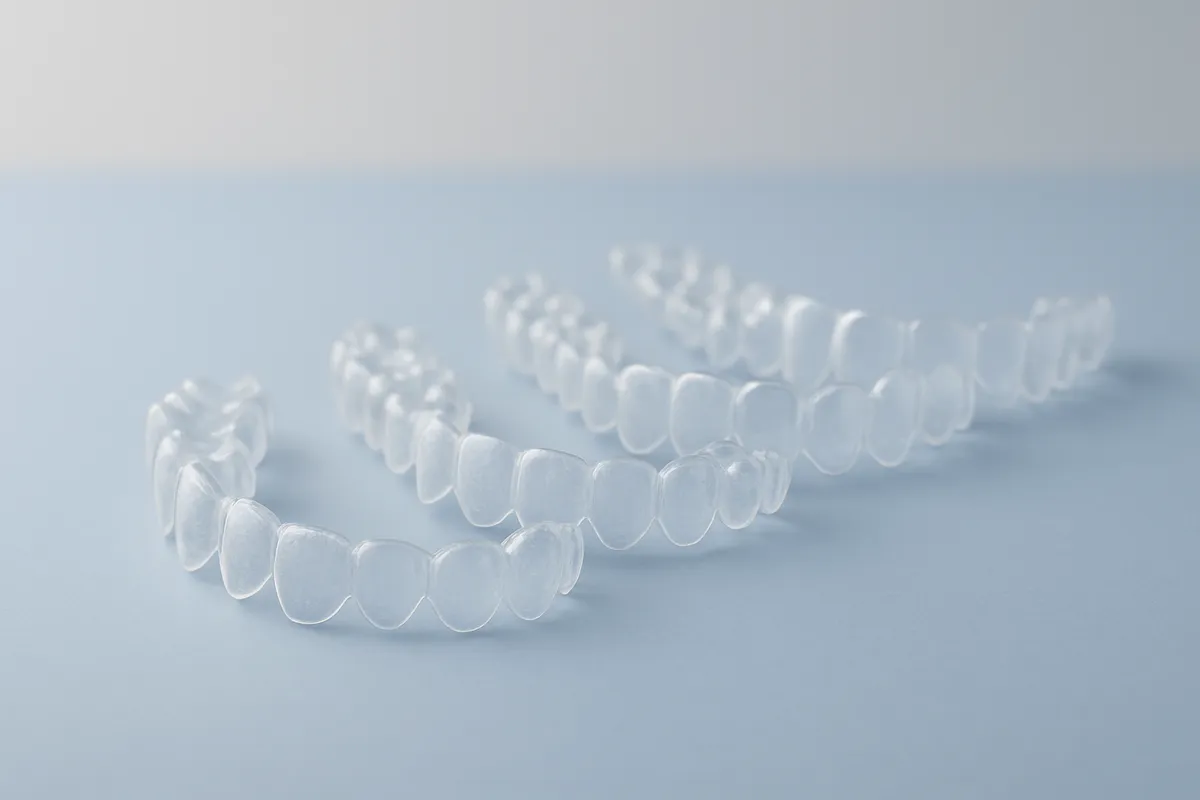
Clear aligners use a series of custom-fitted removable trays to move teeth gradually — no brackets, no wires, and no visible hardware during treatment.
Each tray is worn for a set period, then swapped for the next in the series. The trays apply incremental pressure to specific teeth, guiding movement according to a digital treatment plan mapped out before the first tray is made. The process is precise, but it depends entirely on the trays being worn consistently. This is particularly relevant for braces for adults.
How do clear aligners compare to traditional braces for adult treatment?
Aligners handle mild-to-moderate crowding and spacing cases well. Where they reach their ceiling is severe bite correction — significant overbites, underbites, or cases requiring large vertical tooth movement. The reason is mechanical: without fixed anchor points bonded to each tooth, the force aligners can apply is less direct than a bonded bracket-and-wire system. For complex cases, braces for adults still offer more predictable outcomes.
The compliance factor is significant and worth stating plainly. Aligners must be worn the required hours each day — typically around 20 to 22 hours — to stay on schedule. Adults with unpredictable routines, frequent travel, or demanding work schedules should weigh this honestly before choosing aligners over a fixed system.
How do maintenance and daily care differ between braces and aligners?
Aligners are removed for eating and brushing, which simplifies oral hygiene considerably. Fixed braces require more deliberate cleaning around brackets and wires. Both approaches demand consistency — the difference is where that consistency is applied.
One practical consideration the top search results skip entirely: adults with existing crowns, bridges, or veneers require additional planning before aligner treatment begins. Attachments — small tooth-colored anchors bonded to teeth to help aligners grip and direct movement — cannot always be placed on crowns or veneers in the same way as on natural enamel. A provider needs to account for existing restorations when designing the treatment plan, which can affect which movements are achievable and how the trays fit. At Villagio Family & Cosmetic Dental, this kind of restorative history is reviewed before any aligner treatment is recommended, so the plan reflects your full dental picture from the start.
6. How Long Adult Orthodontic Treatment Takes
Adult treatment typically runs 18 to 36 months, longer than teen treatment because mature bone remodels more slowly in response to orthodontic pressure.
In adolescents, bone turnover is rapid, which allows teeth to move faster. Adult bone is denser and less metabolically active, so the same amount of tooth movement takes more time. This is the core biological reason adult timelines extend beyond what most people expect when they first ask about braces for adults.
What is the typical treatment timeline for different types of adult braces?
Mild spacing cases, regardless of appliance type, can resolve in 12 to 18 months. Severe crowding, significant bite correction, or skeletal discrepancies routinely push treatment past two years. The appliance chosen matters less than the complexity of what needs to move. When considering braces for adults, this point stands out.
Adults frequently need pre-treatment dental work before orthodontic movement can begin. Extractions, periodontal therapy, or replacing failing crowns must be completed first, adding weeks to months before the first wire or aligner tray is placed.
Why does treatment duration vary between patients?
Fixed braces apply continuous force around the clock. Clear aligners only work while worn — the American Association of Orthodontists recommends 20 to 22 hours of daily wear [2], and patients who fall short consistently extend their own timelines. Compliance is the single variable most within a patient’s control.
7. Insurance Coverage and Financing Options for Adult Braces
Many dental insurance plans cover pediatric orthodontics but limit or exclude adult coverage entirely — always verify your specific policy before assuming any benefit applies.
Adult orthodontic coverage, where it exists, typically comes with a lifetime maximum benefit that applies regardless of age. Some plans impose age cutoffs, commonly 18 or 19, that eliminate adult patients from orthodontic benefits altogether. Others provide partial reimbursement up to a fixed cap, regardless of total treatment cost.
How do you maximize insurance benefits for braces?
When reviewing a policy, look for four specific items: the age limit for orthodontic eligibility, any waiting period before benefits activate, the lifetime maximum, and the percentage of covered charges the plan pays. If your plan has a waiting period and you haven’t met it, starting treatment early can mean paying the full cost out of pocket.
What payment plans and financing options are available for adult braces?
Three financing paths are commonly available. In-office payment plans spread the cost across monthly installments directly with the practice. Third-party dental financing, through lenders that specialize in healthcare, offers longer terms, sometimes interest-free for promotional periods. HSA and FSA accounts allow pre-tax dollars to cover orthodontic expenses, which effectively reduces the real cost for eligible patients. For those exploring braces for adults, this matters.
On the cost spectrum: metal braces sit at the budget-friendly end of fixed options. Ceramic and lingual braces are mid-range to premium. Clear aligner costs vary widely depending on provider type and case complexity — a factor worth discussing directly with your provider.
8. Risks and Complications Adults Should Know Before Starting
Adults face several orthodontic risks that teenagers rarely encounter — gum health, bone density, and existing dental work all create complications that require monitoring throughout treatment.
What specific complications should adults be aware of during treatment?
Root resorption, a shortening of tooth roots caused by sustained orthodontic pressure, is a known risk in all patients. Adults with pre-existing gum recession or bone loss face a higher baseline risk and warrant closer radiographic monitoring during treatment.
Active gum disease is a hard stop before braces can be placed. Moving teeth through inflamed periodontal tissue accelerates bone loss because the supporting structures are already compromised. Any active infection or gum disease must be fully treated and stable before orthodontic forces are applied.
After treatment ends, adult teeth are more prone to shifting than adolescent teeth because periodontal fibers retain a “memory” of their original position and pull teeth back over time. Consistent retainer use is not optional — it is the mechanism that holds the result. This directly impacts braces for adults outcomes.
How can you minimize risks and complications?
One risk the top-ranking sources on this topic don’t address: certain medications alter bone remodeling in ways that directly affect orthodontic treatment. Bisphosphonates, prescribed for osteoporosis, slow bone turnover, which can reduce tooth movement and complicate treatment planning. Some blood pressure medications affect gum tissue. These are conversations to have with your orthodontist before treatment begins, not after movement has started.
9. How to Choose Between Braces and Aligners Based on Your Lifestyle
The right appliance depends on case complexity, how visible your teeth are in daily work, and whether your schedule supports the discipline aligners require.
Which option is best if you have a professional appearance requirement?
Severe bite issues and significant crowding favor fixed braces — they apply precise, continuous forces that clear aligners cannot always replicate for complex tooth movement. Mild-to-moderate cases have genuine flexibility, and either appliance type can produce good outcomes.
For client-facing or on-camera professionals, clear aligners and ceramic braces are the least visible options. Lingual braces, bonded to the back surface of teeth, are invisible from the front entirely, though they come with a higher cost and an adjustment period for speech. Metal braces are the most visible fixed option but also the most mechanically reliable for complex cases.
Aligners require removal discipline: 20 to 22 hours of daily wear is the standard recommendation [2]. Frequent travelers, people with irregular meal schedules, or anyone who tends to leave aligners out during long meetings face a real risk of extending their treatment timeline if that discipline slips. This is particularly relevant for braces for adults.
Existing dental work is a practical filter most adults overlook before their consultation. Crowns, bridges, and implants don’t move with orthodontic force — implants are anchored directly in bone. A bridge connecting multiple teeth makes individual tooth movement impossible without removing it first. These factors narrow the realistic appliance options before any preference conversation begins.
How to Choose the Right Orthodontic Provider as an Adult
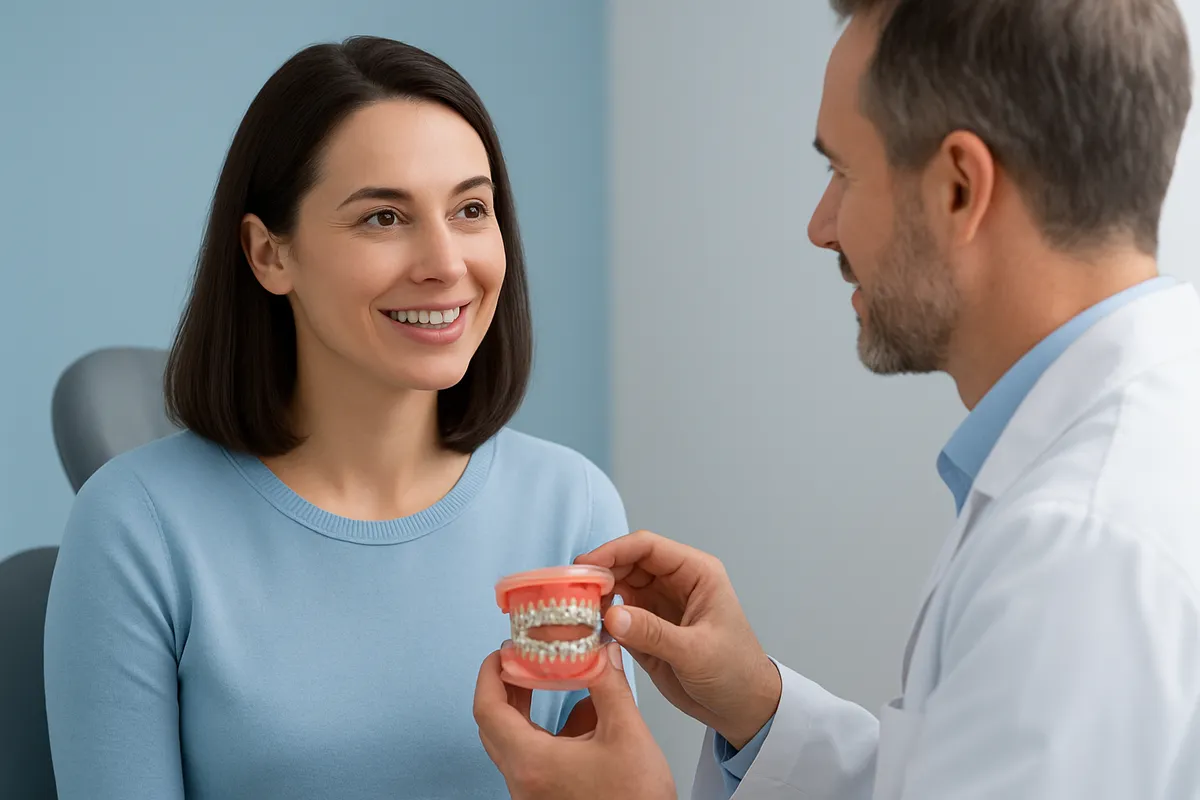
A thorough adult orthodontic consultation covers X-rays, gum health, existing dental work, and a written treatment plan — any evaluation that skips these steps is incomplete.
What questions should you ask during your initial consultation?
A complete first appointment should include full diagnostic records: panoramic and periapical X-rays, a gum health screening, and a review of any crowns, bridges, or implants already in place. The consultation should end with a written treatment plan that includes a realistic timeline and a defined retention protocol — not a verbal summary you’ll have to reconstruct later.
Three questions worth asking before you commit: What happens to my treatment plan if my gum health changes mid-treatment? How will attachments or brackets be handled around existing crowns? What does the retention plan look like after active treatment ends, and who monitors it?
Red flags in a rushed consultation are specific. No gum health screening before recommending appliances, no discussion of pre-treatment dental work, or a treatment plan presented before full records are reviewed — these are signs the evaluation wasn’t built around your actual clinical picture. When considering braces for adults, this point stands out.
General dentists who offer orthodontic services have completed additional training, but dedicated orthodontists complete a two- to three-year residency focused entirely on tooth movement and bite correction. For straightforward cases, either can be appropriate. For complex adult cases — significant crowding, bite correction, or patients with gum disease history — the depth of an orthodontic specialist’s training is a meaningful factor. At Villagio Family & Cosmetic Dental, adult patients receive a full clinical evaluation before any treatment recommendation is made, so the plan reflects your actual oral health, not a templated starting point.
Frequently Asked Questions
Is it worth getting braces as an adult?
Yes, braces correct bite problems, reduce uneven tooth wear, and lower the risk of gum disease — not just improve appearance. The American Association of Orthodontists notes that 1 in 3 orthodontic patients today are adults [2], which reflects how broadly dentists and patients alike recognize the functional benefits. Straighter teeth are easier to clean, which directly supports long-term oral health. At Villagio Family & Cosmetic Dental, adult orthodontic consultations cover both cosmetic goals and underlying bite concerns so treatment addresses the full picture.
Can adults get braces if they have crowns, implants, or veneers?
Adults with existing dental work can often still get braces, though the treatment plan requires careful coordination. Implants are fixed in the bone and cannot be moved by braces, so tooth positioning around them must be planned in advance [1]. Crowns and veneers can generally be bracketed, but the bracket bonding process differs from natural enamel. A thorough clinical exam before treatment starts is the only way to confirm which options are safe for your specific restorations.
What are the psychological aspects of getting braces as an adult?
Most adults report improved confidence once treatment is underway, even before it finishes. The primary concern beforehand is visibility — worrying about how braces look in professional or social settings. Clear aligners and ceramic braces address that directly. Research consistently links straighter teeth to higher self-reported confidence [2], and many adult patients say the decision to start treatment was the harder step than wearing the appliances themselves.
Do adults need to wear a retainer after braces, and for how long?
Yes, retainer wear after braces is permanent, not temporary. Teeth naturally shift throughout life, and without a retainer, relapse is common [1]. Most dentists recommend nightly retainer wear indefinitely after the initial full-time phase (typically 3–6 months post-treatment). Skipping the retainer is the most frequent reason adults end up needing a second round of orthodontic treatment later. Your dentist will prescribe the specific schedule based on how your teeth responded to treatment. For those exploring braces for adults, this matters.
At what age is it too late to get braces as an adult?
There is no upper age limit for braces for adults, provided your gum health and bone structure can support orthodontic treatment. Adults in their 40s, 50s, and beyond successfully complete orthodontic treatment every year. The key prerequisite is stable periodontal health — active gum disease must be treated before braces can be placed. Older adults may also need more frequent monitoring during treatment, but age alone is not a disqualifying factor. A clinical evaluation is the only way to determine candidacy.
Conclusion
Adult braces are a clinical decision as much as a cosmetic one — misaligned teeth contribute to gum disease, uneven wear, and bite dysfunction that compounds over time. The right appliance depends on the severity of your case, your existing dental work, and how visible you need treatment to be. Clear aligners handle mild-to-moderate cases well; traditional or ceramic braces cover more complex corrections.
The one step worth taking now: book a consultation at Villagio Family & Cosmetic Dental and ask specifically about bite alignment, not just aesthetics. That single conversation will tell you which option fits your teeth, your schedule, and your long-term oral health goals.
Sources & References
- 3 Discreet Options to Traditional Braces for Adults – Ascent Family Dental
- Adult Orthodontics: Smile with Confidence at Any Age | American Association of Orthodontists
Recommended Articles
Explore more from our content library: