Proudly Serving Katy, Richmond & Fulshear Cinco Ranch
(281) 395-2100
|
(281) 394-4001

Cosmetic dentistry cost varies widely because it depends on which procedure you choose, how many teeth are involved, and whether the work is purely cosmetic or also restorative. Simple treatments like professional teeth whitening sit at the budget-friendly end, bonding and clear aligners fall into the mid-range, and veneers or full smile makeovers land in the premium tier since they involve custom lab work and multiple visits. The best way to know your real investment is a consultation, where a dentist evaluates your teeth and goals and gives you a personalized, transparent quote.
How Much Does Cosmetic Dentistry Cost by Procedure Type?
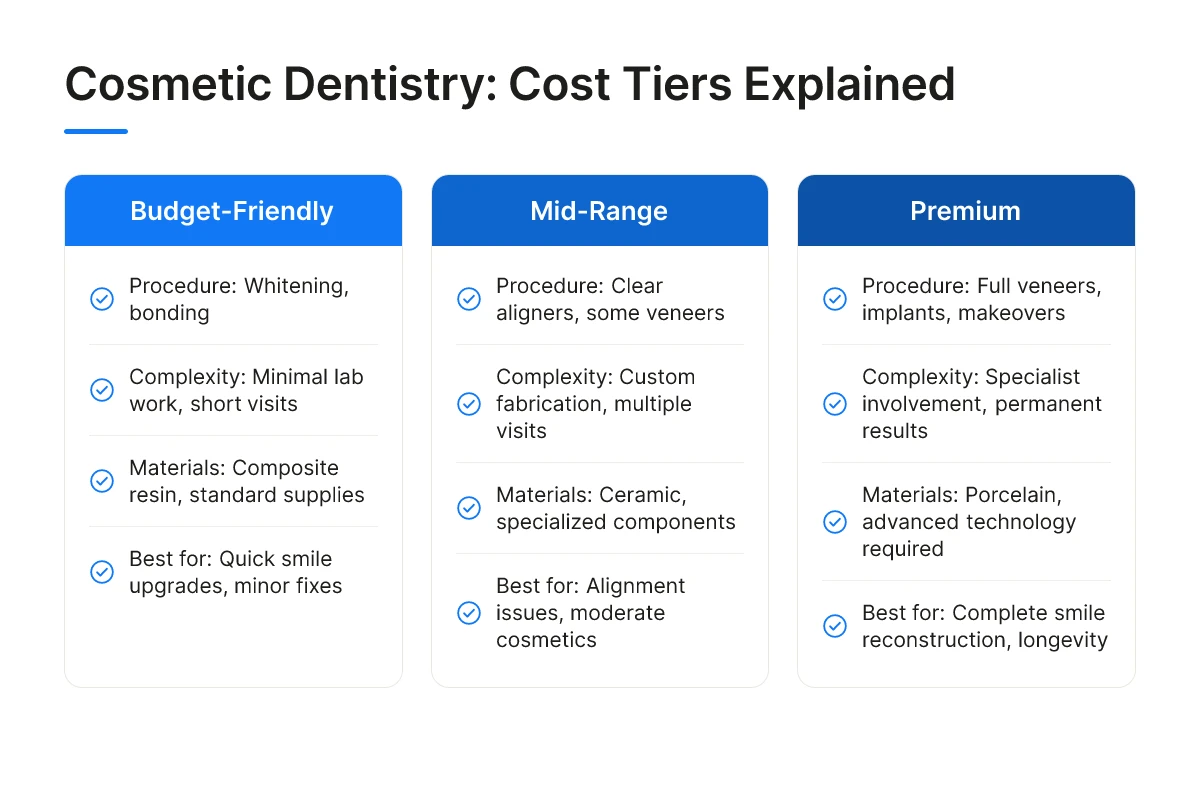
Cosmetic dentistry cost falls into three general tiers, budget-friendly, mid-range, and premium, based on how much lab work, material customization, and appointment time each procedure requires.
- Budget-friendly tier: Professional teeth whitening and dental bonding, which require minimal chair time and no lab fabrication.
- Mid-range tier: Clear aligners, which require digital scans, treatment planning, and a series of custom trays produced over months.
- Premium tier: Veneers and dental implants, which require lab-fabricated restorations, multiple appointments, and in the case of implants, a surgical phase.
What’s the Cost Breakdown for Whitening, Veneers, and Implants?
Whitening sits at the budget-friendly end because it involves a single treatment or a short series of visits, no impressions, and no custom fabrication. The dentist applies a bleaching agent and adjusts strength based on sensitivity, that’s the entire process. Bonding follows close behind: a dentist sculpts composite resin directly onto the tooth in one visit, which keeps labor and material costs low even though it corrects chips, gaps, and discoloration.
Clear aligners occupy the mid-range because they require digital scans, a treatment-planning phase, and a series of custom trays produced over months, more coordination than whitening, but still far short of a lab-fabricated restoration.
Veneers and dental implants sit in the premium tier for a specific reason: both require a physical or digital impression sent to a dental lab, a custom-fabricated piece made specifically for that patient’s mouth, and at least two appointments spaced weeks apart. Implants add another layer of complexity, a surgical placement phase, a healing period that can run several months, and often a specialist referral for the surgical component. The permanence of both results, unlike whitening’s gradual fade, is part of what justifies the higher investment. For a broader look at how these tiers compare, the Cosmetic Dentistry Cost Guide from Aspen Dental breaks down average pricing patterns by procedure.
How Do Cosmetic Dentistry Costs Compare Across Regions?
Practice overhead, local cost of living, and regional demand all shift pricing between markets, so the same procedure can carry a different price tag in one metro area versus another. A practice in a higher cost-of-living region generally carries higher rent, staffing, and lab fees than one in a smaller market, those overhead differences pass through to treatment pricing regardless of the procedure’s complexity.
A full smile makeover isn’t priced as a single flat fee, it’s the sum of whichever procedures make up the plan, whether that’s whitening plus bonding, or veneers combined with implants. The total reflects each component’s tier, which is why two patients’ makeovers can carry very different investments depending on what their smile actually needs.
What Factors Affect the Price of Cosmetic Dental Procedures?
Cosmetic dentistry cost moves with five variables: material, case size, dentist expertise, insurance coverage, and whether treatment happens in-office or at home.
- Material choice: Composite resin versus porcelain or ceramic.
- Case complexity: A single tooth repair versus a full-arch smile makeover.
- Dentist expertise and technology: In-house labs, digital scanning, and years of cosmetic case experience.
- Insurance coverage: Whether the procedure overlaps with restorative necessity.
- Setting: In-office, dentist-supervised treatment versus at-home kits.
Two patients asking for the same word, “veneers” or “whitening”, can walk out with quotes that differ significantly, because the label describes a goal, not a fixed procedure.
Material Choice Drives the Base Price
Composite resin costs less than porcelain or ceramic because it’s applied directly to the tooth in a single visit and doesn’t require a lab-fabricated restoration. Porcelain veneers and crowns cost more because they resist staining better, hold their shape longer, and mimic the light-reflecting quality of natural enamel more closely. For families in Katy weighing a quick fix against a decade-long investment, material is often the single biggest line item on the estimate.
Case Complexity: One Tooth vs. a Full Arch
A single chipped front tooth is a contained repair. A full-arch smile makeover, reshaping eight to ten teeth for symmetry and color match, multiplies both material cost and chair time. Complexity also includes prep work: bite adjustments, gum contouring, or treating decay before cosmetic work can begin all add to the total.
Dentist Experience and In-House Technology
A dentist using digital scanning can design and preview a restoration without messy impressions, often shortening the timeline. Practices with an in-house lab can mill a crown same-day, while those outsourcing to an external lab add turnaround time and lab fees to the quote. Experience matters too, a dentist who has placed hundreds of veneers typically prices differently than one newer to cosmetic cases, reflecting predictability of outcome.
Does Dental Insurance Cover Any Cosmetic Procedures?
Most cosmetic dentistry is elective, meaning standard dental insurance excludes it entirely, whitening and veneers chosen purely for appearance rarely qualify. The exception is procedures with a restorative function: a crown placed because a tooth is fractured or decayed, which also happens to improve appearance, may be partially covered under the restorative portion of a plan. Villagio Family & Cosmetic Dental reviews each case to identify where a treatment plan overlaps with restorative necessity, so patients understand what portion, if any, insurance might offset.
How Do In-Office Treatments Compare to At-Home Options?
In-office treatment costs more upfront but delivers faster, longer-lasting, dentist-supervised results, a professional whitening session uses stronger agents under controlled conditions, and veneers are custom-fitted rather than generic. At-home kits cost less initially but work more slowly, produce less predictable shading, and offer no clinical oversight if sensitivity or fit issues arise. For patients weighing this tradeoff alongside other procedure costs, the 2026 guide to cosmetic dental costs outlines how setting and supervision affect overall value.
What Are the Most Affordable Cosmetic Dentistry Options?
Professional teeth whitening and dental bonding sit at the lowest end of cosmetic dentistry cost, making them the most practical entry points for a first smile upgrade.
Whitening addresses one problem, dullness or staining, and does it fast, usually in a single visit. Bonding solves a wider range of small cosmetic issues: chips, gaps, uneven edges, or a tooth that’s slightly shorter than its neighbors. Both procedures require no lab work and no temporary restorations while you wait, which keeps costs down compared to treatments that involve custom-fabricated materials.
What Cheaper Alternatives Exist to Veneers and Full Mouth Implants?
Bonding is the direct budget alternative to porcelain veneers for minor shape or spacing corrections, though it wears faster and needs more frequent touch-ups. A dentist applies tooth-colored composite resin directly to the tooth and shapes it chairside, which cuts out the lab fees and multiple appointments veneers typically require. The tradeoff is durability, bonding material can chip or stain over a few years in a way that porcelain resists for much longer. For a patient with one or two minor flaws rather than a full smile redesign, that tradeoff often makes sense.
When misalignment is part of what’s bothering a patient, clear aligners offer a mid-range option between whitening/bonding and a full restorative rebuild. They cost more than bonding but generally less than combining orthodontics with multiple veneers, and they solve a structural problem rather than masking it.
Staging treatment, whitening this year, bonding next, aligners after that, spreads investment out instead of committing to one large case upfront. At the opposite end, a full mouth implant case represents the premium tier of cosmetic and restorative dentistry, reserved for patients rebuilding significant tooth loss or structural damage. Most families in Katy start well before that point, and staged, smaller procedures let them build toward a better smile without that scale of commitment.
How Can I Pay for Cosmetic Dentistry If Cost Is a Concern?
Most patients manage cosmetic dentistry cost through a combination of in-house payment plans, third-party financing, tax-advantaged accounts, and staged treatment rather than one lump sum.
What Financing and Payment Plan Options Are Available?
Many dental practices, including Villagio Family & Cosmetic Dental, offer in-house payment plans that split a larger treatment cost into manageable monthly amounts. This works well for procedures like veneers or a multi-tooth smile makeover, where paying the full balance upfront isn’t realistic for most household budgets.
When a practice doesn’t offer in-house plans, or a patient needs a larger credit line, third-party financing fills the gap. Healthcare credit cards and patient financing companies are common routes, they work similarly to a store credit card but are built specifically for medical and dental expenses, with approval decisions usually made quickly during the same visit.
Flexible spending accounts (FSA) and health savings accounts (HSA) are worth checking before scheduling treatment. Both let patients apply pre-tax dollars toward elective dental work, which effectively lowers the real cost since that money was never taxed to begin with.
Staging treatment is a financing strategy in its own right. Completing one procedure now, say, whitening or bonding, and scheduling veneers or a full smile makeover for later spreads cost across multiple pay periods without any loan or credit line involved.
Common ways patients cover cosmetic dentistry cost include:
- In-house payment plans offered directly by the dental practice.
- Third-party healthcare financing or dental credit cards.
- Pre-tax FSA or HSA funds applied toward elective treatment.
- Staging procedures over time instead of paying for a full makeover at once.
The simplest step is talking about budget openly at the consultation. A dentist who knows what a patient can realistically spend can sequence treatment in an order that addresses the most pressing concerns first, while pushing less urgent work to a later date.
What’s Included in a Cosmetic Smile Makeover and What’s the Total Investment?
A smile makeover is not one procedure with one price tag, it’s a custom mix of treatments, so cosmetic dentistry cost adds up based on what your case actually needs.
No two smile makeovers look the same. One patient might need whitening and bonding to fix a chipped front tooth. Another might need veneers on six teeth, minor alignment, and an implant to replace a missing molar. The plan is built around your goals, a brighter smile, straighter teeth, replacing gaps, not pulled from a fixed menu.
What Drives the Total Investment Up or Down
Three variables shape the final number: how many teeth are involved, which procedures get combined, and how many visits the plan requires. Whitening alone might wrap up in one or two appointments. A full reconstruction involving veneers, bonding, and implants can stretch across several months and multiple stages, which naturally moves the total from budget-friendly territory toward a premium investment.
A single discolored tooth treated with bonding sits at the lower end. A full arch of veneers paired with orthodontic alignment sits at the higher end. Most patients land somewhere between those two points, depending on how much correction their smile needs.
How the Consultation Shapes Your Estimate
The consultation is where the guesswork ends. At Villagio Family & Cosmetic Dental, the dentist examines your teeth, discusses your goals, and scopes out exactly which procedures apply to your case before quoting a number. That exam turns a vague online price range into a plan specific to your mouth.
Can You See Real Patient Examples with Before/After Results?
Ask to see them. A reputable practice can walk you through cases with similar starting points, worn enamel, gaps, discoloration, so you can gauge realistic outcomes before committing to a plan.
Always request an itemized treatment plan. Seeing the cost broken down by procedure shows exactly which parts of the makeover drive the total, so you can prioritize or phase treatment if budget is a factor.
Frequently Asked Questions
Is cosmetic dentistry ever covered by insurance?
Rarely, because most insurance plans classify cosmetic work as elective and exclude it from coverage. There’s one common exception: if a procedure also restores function or repairs damage, like a crown placed after a fracture or bonding that fixes a chipped tooth from an injury, your plan may cover part of it under restorative benefits. Ask your insurer to review the specific procedure code before assuming it’s excluded.
What’s the cheapest way to improve my smile?
Professional teeth whitening and dental bonding are usually the lowest-cost ways to make a visible improvement. Whitening brightens your existing teeth in one visit, while bonding repairs chips, gaps, or discoloration on individual teeth without the cost of veneers or crowns.
How long do cosmetic dentistry results typically last?
Results range from one to two years for whitening up to 10-15 years or longer for veneers and crowns with good care. Bonding typically lasts 3-7 years before touch-ups are needed, while implants can last decades. Diet, oral hygiene, and habits like teeth grinding all affect how long results hold up.
Should I get a consultation before comparing costs online?
Yes, online price ranges can’t account for your specific teeth, bite, or treatment goals. A consultation gives you an exam-based estimate and lets you compare real options, like whether bonding could achieve what you assumed required veneers.
Does the number of teeth treated change the overall price significantly?
Yes, cost generally scales with the number of teeth involved, since each additional tooth adds material, lab time, or chair time depending on the procedure. Treating one front tooth with bonding costs far less than reshaping a full arch of veneers. This is why an exam-based quote for your specific case matters more than a generic per-procedure price range found online.

Conclusion
Cosmetic dentistry costs vary widely because the price follows the procedure, the material, and the number of teeth involved, not a flat industry rate. Start with the least invasive option that solves your concern, ask about financing or payment plans before ruling anything out, and get an in-person exam rather than budgeting off national averages alone. If you’re in Katy, Fulshear, Richmond, or Cinco Ranch, TX, the next concrete step is scheduling a consultation at Villagio Family & Cosmetic Dental to get an exam-based estimate for your specific smile goals.
Recommended Articles
Explore more from our content library: