Proudly Serving Katy, Richmond & Fulshear Cinco Ranch
(281) 395-2100
|
(281) 394-4001

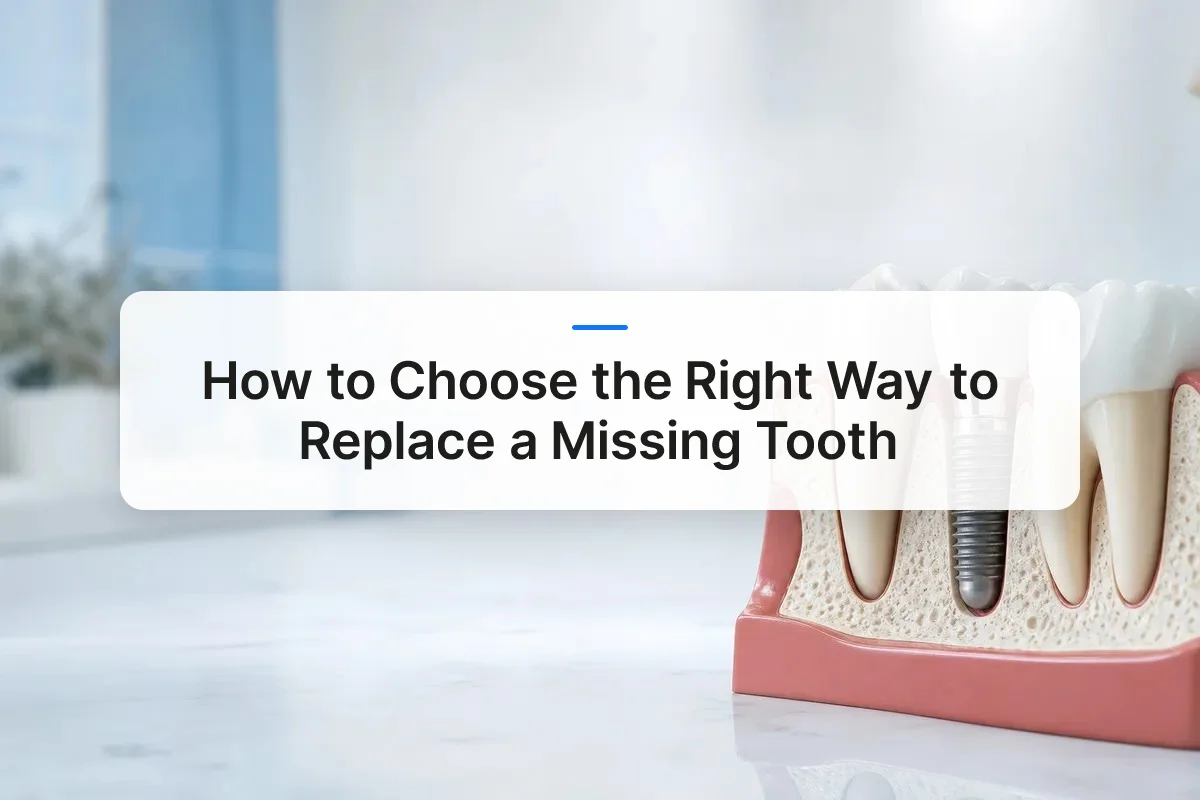
Understanding missing tooth replacement is essential. The right way to replace a missing tooth depends on your bone health, budget, and how long you want the solution to last: a dental implant is the only option that replaces the tooth root and typically lasts decades, a bridge restores the tooth in fewer visits by anchoring to neighboring teeth, and a partial denture offers a removable, budget-friendly fix that can also hold space for other missing teeth. Act quickly, waiting too long lets surrounding bone and teeth shift, which can narrow your options and raise future treatment complexity.
Act Fast: What to Do Right After Losing a Tooth
What you do in the first 30 minutes after a tooth comes out affects whether it can be saved and how your permanent missing tooth replacement turns out later.
Is There First Aid I Should Do Immediately After Losing a Tooth?
Yes, find the tooth and handle it only by the crown, never the root. If it’s a permanent tooth, rinse it gently with water (no scrubbing) and try to place it back in the socket. If that’s not possible, drop it in a glass of milk or hold it in your cheek with your own saliva; both keep the root cells alive far longer than water or a dry tissue.
- Rinse the empty socket gently with warm salt water to clear debris without disturbing the clot forming underneath.
- Fold a piece of clean gauze, place it directly over the socket, and bite down with steady pressure for 10 to 15 minutes to control bleeding.
- Apply a cold compress to the outside of the cheek in short intervals to reduce swelling.
- Avoid rinsing forcefully, spitting, or using a straw for the next 24 hours, that can dislodge the clot and delay healing.
Call our Katy office the same day if the tooth was knocked out by trauma, if bleeding won’t stop after firm pressure, or if you can see the socket is deep or the jaw feels misaligned, these need same-day emergency evaluation, not a routine appointment. If the tooth was already loose from decay or gum disease and came out on its own with minimal bleeding, a scheduled visit within a few days is usually appropriate.
Speed matters beyond the first hour. Once a tooth is gone, the jawbone that used to support it starts remodeling almost immediately, and neighboring teeth can begin drifting into the open space within weeks. That shift narrows the options available later, a gap left too long may lose the bone density an implant needs or the alignment a bridge requires. First aid is about saving the tooth and the socket right now; the decision between an implant, bridge, or partial denture is a separate conversation we cover next, and it’s one worth having before that window closes, especially since delaying missing tooth replacement tends to make every option more complicated.
Compare Your Missing Tooth Replacement Options
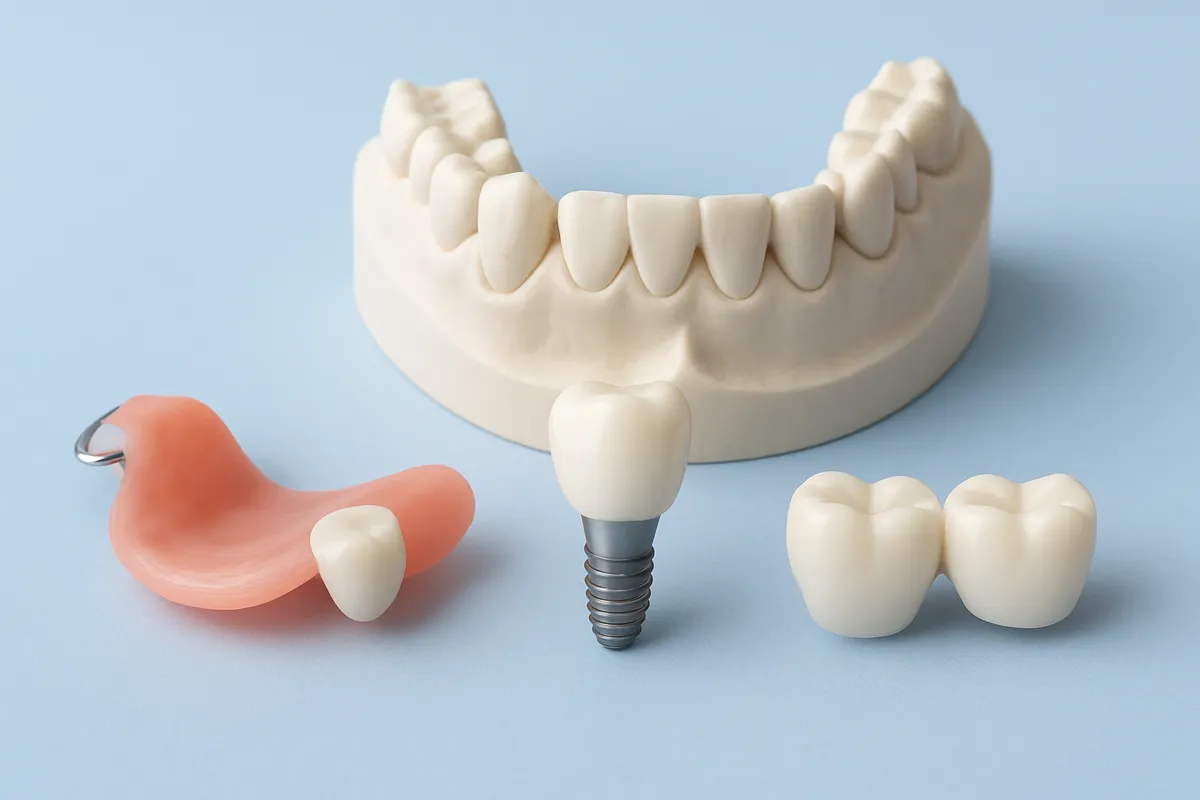
Three approaches dominate missing tooth replacement today: dental implants, tooth-supported bridges, and removable partial dentures, each working on a different mechanical principle. For a broader overview of how these options compare, this guide to tooth replacement options for missing teeth covers the basics of each approach.
The right choice depends on what happens to the bone underneath the gap and to the teeth standing next to it. Some options protect those structures. Others put them under new strain. Understanding the mechanics behind each one, before weighing cost, timeline, or durability, makes the decision in the next section much easier to follow.
What Is a Dental Implant and How Does It Work?
A dental implant replaces the root of the missing tooth with a titanium post surgically placed into the jawbone, which then fuses with living bone through a process called osseointegration.
- A titanium post is inserted directly into the jawbone at the site of the missing tooth.
- Over a period of healing, bone cells grow around and bond to the titanium surface, anchoring the post as if it were a natural root.
- Once fusion is complete, a connector piece (abutment) and a custom crown are attached on top, restoring the visible tooth.
Because the post sits inside the bone, it gives the jaw something to hold onto, mimicking the stimulation a natural tooth root provides. Neighboring teeth are left completely untouched during the process, which is a big reason implants are often considered the gold standard for missing tooth replacement.
What Is a Dental Bridge and How Does It Work?
A tooth-supported bridge fills the gap by anchoring a false tooth to the two natural teeth on either side of it.
- The teeth on both sides of the gap are filed down to create small, crown-shaped anchors.
- Crowns are placed over each of those changed teeth.
- A false tooth (pontic) is fused between the two crowns, and the whole unit is cemented in place as one fixed piece.
A bridge restores the bite line quickly and doesn’t require surgery, but it depends entirely on the health of the two supporting teeth, which permanently lose some of their natural structure in the process.
What Are Dentures and Partial Dentures for a Single Missing Tooth?
A removable partial denture is an appliance holding a prosthetic tooth that clips onto the neighboring teeth with small metal or plastic clasps, and it comes out for cleaning.
Unlike an implant or a bridge, nothing is fixed permanently in the mouth, the appliance rests on the gum and hooks onto adjacent teeth for stability. This makes it the least invasive of the three options, since no drilling or surgery is involved, though it also makes it the least stable during chewing. You can also compare these details against this resource on replacing missing teeth, including costs and options, which breaks down how each approach fits different budgets.
Each path treats the jawbone and neighboring teeth differently: an implant preserves bone, a bridge changes adjacent teeth, and a partial denture leaves both alone but offers less day-to-day stability. That distinction is the foundation for choosing between them.
Weigh Longevity, Safety, and Fit Before You Decide
Durability, candidacy, and your own budget and health history should drive your missing tooth replacement decision, not just the sticker price at a first visit.
Which Tooth Replacement Option Lasts the Longest?
Implants typically outlast bridges and dentures because the titanium post fuses directly with your jawbone instead of depending on neighboring teeth or a removable fit. That fusion process, called osseointegration, gives the replacement tooth its own foundation the same way a natural root does. A bridge, by contrast, transfers chewing force onto the two teeth anchoring it, which can wear those teeth down over years of use [4]. Dentures rely on the gum ridge and suction or clasps, and that ridge naturally changes shape as bone remodels underneath it.
Are Dental Implants Safe for Seniors with Bone Loss?
Implants can still work for many seniors with bone loss, but the jawbone needs enough density and volume to hold the post securely, and a bone graft is often the answer when it doesn’t. Grafting rebuilds the ridge using bone material that integrates with your existing jaw, and it’s a proven step before implant placement, but it adds several months of healing before the implant itself can go in [2]. Age alone rarely disqualifies a patient; what matters is bone quality, gum health, and how well any underlying conditions like diabetes are managed. A dentist can order imaging to measure bone density and map out whether grafting is needed before recommending an implant.
What Are the Pros and Cons of Each Option for My Situation?
The right choice depends on what’s already going on in your mouth, not just what sounds most advanced.
- Healthy adjacent teeth: A bridge makes sense if the teeth next to the gap are strong and unlikely to need extra work, it uses that existing structure instead of surgery.
- Budget constraints: A partial denture costs less upfront and works well for replacing multiple teeth without the healing time implants require.
- Long-term bone preservation: An implant is the only option that stimulates the jawbone directly, which helps prevent the bone loss that follows tooth loss over time.
Looking at cost over a 10 to 20 year span changes the math. Implants tend to avoid repeat replacement costs once healed, since the post itself rarely needs redoing. Bridges may need remaking as the anchor teeth wear or develop decay underneath the crown. Dentures often need relining every few years and full replacement as the gum ridge shifts shape. A family dentist can evaluate bone density, gum health, and your bite pattern in one visit to narrow these options down to the one or two that actually fit your situation, rather than leaving you to guess from a brochure. This kind of missing tooth replacement evaluation is also a good time to ask about maintenance products, such as a water flosser designed for cleaning around bridges, implants, and dentures.
Budget and Schedule Your Treatment Timeline
Cost and timing usually decide which missing tooth replacement a patient chooses, so plan for both before you commit to a treatment path.
Think in tiers rather than exact dollar amounts, since fees vary by case complexity and location. Removable partial dentures sit at the budget-friendly end. Fixed bridges land in the mid-range tier, priced above a partial denture but below an implant in most practices. Single-tooth implants fall into the premium tier upfront, reflecting the surgical component, the implant fixture itself, and the crown restoration, though many patients find the per-year cost evens out because implants are built to last decades rather than needing periodic relining or replacement.
Insurance treats these options differently, and that difference catches people off guard. Many dental plans apply a set percentage toward “basic” or “major” restorative work, which typically includes bridges and dentures, up to an annual maximum. Implants sometimes fall under a separate category or a distinct allowance, and some older plans still exclude the surgical placement phase even when they cover the crown. Coverage details vary widely by carrier and plan year, so call your insurance provider and ask specifically how they classify implant placement, bone grafting, and the final restoration before you schedule anything. Our team at Villagio Family & Cosmetic Dental verifies benefits for Katy, Fulshear, Richmond, and Cinco Ranch families before treatment starts, so there are no surprise gaps between what a plan promises and what it actually pays.
What’s the Timeline from Start to Finish for Dental Implants?
- Initial consultation and 3D imaging to assess bone density and plan implant position
- Bone grafting, if the exam shows insufficient bone volume, followed by a healing period that commonly runs several months
- Implant placement surgery, where the titanium post is set into the jawbone
- Osseointegration healing, the period where bone fuses to the implant, generally taking a few months before the site is stable enough to load
- Crown attachment, the final step that completes the visible tooth
Cases without grafting move faster; cases requiring bone rebuilding add real time. Ask your dentist for a case-specific timeline rather than assuming a fixed number of months.
How Quickly Can I Get a Bridge or Denture After Losing a Tooth?
A bridge or partial denture is typically completed in a handful of visits spread across a few weeks, since neither option requires waiting for bone to fuse to a surgical post. Impressions, fabrication, and fitting make up most of that timeline. This makes bridges and dentures the faster route to a functional, natural-looking result when a patient needs the gap closed quickly, for a wedding, a job change, or simply to stop food from catching in the space. Implants take longer and cost more upfront, but they preserve jawbone in ways a bridge or denture cannot, which matters for long-term value even when speed and initial budget point toward the other options.
Common Mistakes to Avoid When Replacing a Missing Tooth
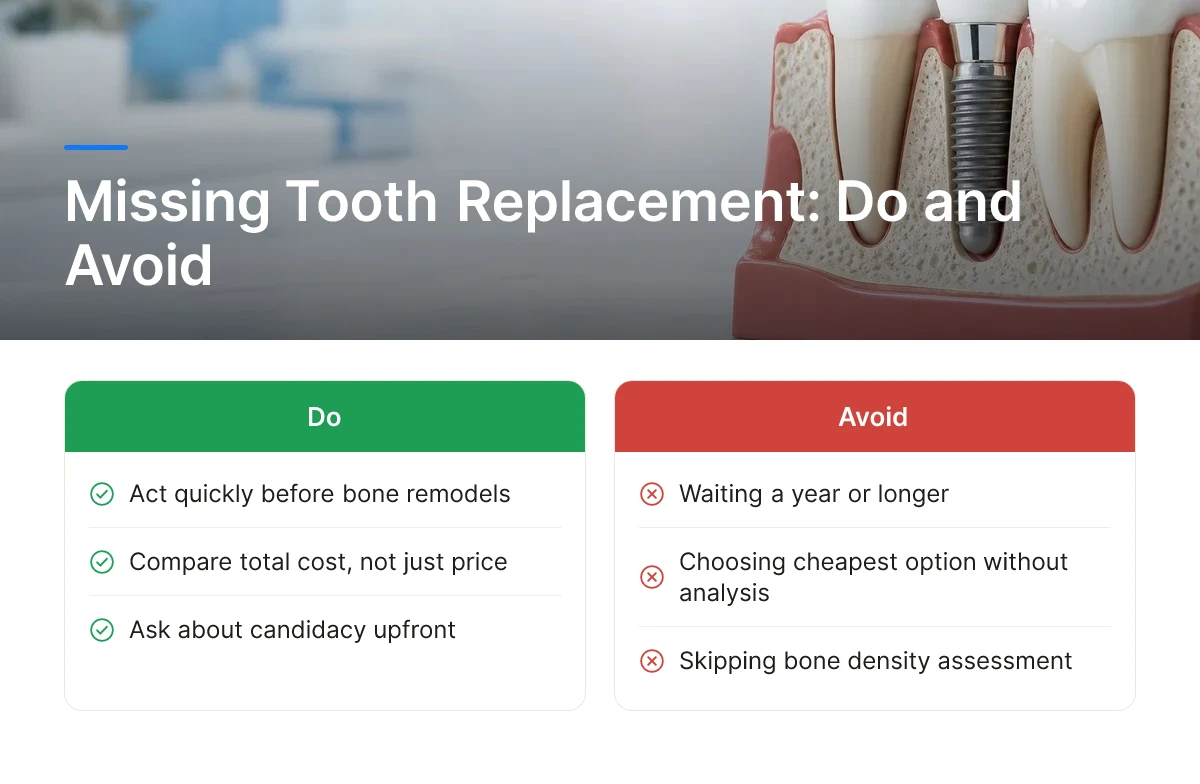
Most missing tooth replacement problems trace back to five decisions made too fast or with too little information, and each one is avoidable with the right questions upfront.
1. Waiting too long to act
Bone starts remodeling within months of tooth loss, and the surrounding teeth begin drifting into the empty space. Patients who wait a year or more sometimes learn their jawbone no longer has enough density to support an implant without a bone graft first, turning a straightforward procedure into a longer, more expensive one.
2. Picking the cheapest option without looking at total cost
A partial denture or bridge often looks like the budget-friendly choice next to an implant’s upfront price. But bridges typically need replacement every decade or so, and removable dentures require relines and adjustments over time, costs that add up and can exceed what an implant would have cost over the same span.
3. Treating a removable partial as permanent
A flipper or removable partial denture is designed as a temporary bridge, literally and figuratively, while a permanent plan is finalized [4]. Wearing one indefinitely can accelerate bone loss under the missing tooth site and shift how remaining teeth bite together.
4. Skipping the bone and gum evaluation
Committing to an implant before checking bone density or gum health is backwards. A short evaluation, sometimes with imaging, tells the dentist whether the jaw can support an implant as-is or needs preparation, and whether gum disease needs treating first so it doesn’t undermine the result.
5. Not confirming insurance details in advance
Coverage for implants, bridges, and dentures varies widely by plan, and some insurers cover only a portion of one option while excluding another entirely [2]. Confirming what’s covered, and what counts as a waiting period or annual maximum, before treatment starts prevents a surprise balance after the work is done. For an outside perspective on how these five options weigh against each other, see this rundown of five options for replacing a missing tooth.
At Villagio Family & Cosmetic Dental, we walk Katy-area patients through bone health, gum condition, and coverage details before recommending a path, so the plan holds up years down the road instead of needing a redo.
Frequently Asked Questions
What is the cheapest way to replace a missing tooth?
A removable partial denture or a flipper typically costs less upfront than a bridge or an implant. Both restore appearance and basic chewing function quickly, though they don’t stop bone loss the way an implant does. For patients on a tight budget, a removable option is often the practical starting point for missing tooth replacement, with an eye toward a more permanent solution later.
Can I wait a while before replacing a missing tooth?
You can wait, but nearby teeth start shifting into the gap within weeks to months, complicating future treatment. The longer the space sits empty, the more the jawbone beneath it shrinks. If cost or timing is a concern, tell your dentist, they can suggest an interim option to prevent shifting.
Do I need a bone graft before getting a dental implant?
Only if imaging shows insufficient bone width or height to anchor the implant securely. Bone loss is common when a tooth has been missing for a year or more, since the jaw resorbs bone that no longer has a root stimulating it. A CT scan during your consultation determines whether grafting is necessary or whether the implant can proceed as planned.
What happens if I don’t replace a missing tooth at all?
Neighboring teeth drift into the gap, opposing teeth over-erupt, and the jawbone in that area gradually shrinks. Over time this can shift your bite, strain your jaw joint, and make later treatment more complex and costly. Chewing efficiency also drops, which can affect diet and digestion, problems that tend to compound the longer the gap goes untreated.
How do I know which missing tooth replacement option is right for me?
The best way to know is a hands-on evaluation that checks bone density, gum health, the condition of neighboring teeth, and your budget together, since no single option fits every case. A dentist can walk through implants, bridges, and dentures side by side during a consultation, comparing candidacy and long-term cost so the missing tooth replacement you choose actually matches your mouth and your goals.

Conclusion
Replacing a missing tooth comes down to three factors: how much bone support remains, how soon you act, and what long-term outcome you want. Implants offer the strongest bone preservation, bridges work well when adjacent teeth already need crowns, and dentures remain a practical option for multiple missing teeth. Waiting rarely makes the decision easier, shifting teeth and bone loss only narrow your options over time. The next concrete step: schedule an exam and X-ray with Villagio Family & Cosmetic Dental to find out which missing tooth replacement option fits your bone structure, budget, and timeline before the gap changes your bite.
Sources & References
- Tooth Replacement Options for Missing Teeth and Care | Aspen Dental
- 5 Options for Replacing a Missing Tooth | BloorWestSmiles
- Replacing Missing Teeth: Costs and Options | AARP
Recommended Articles
Explore more from our content library: