Proudly Serving Katy, Richmond & Fulshear Cinco Ranch
(281) 395-2100
|
(281) 394-4001

You can lower your out-of-pocket dental crown cost through five practical levers: verifying insurance benefits before treatment, choosing a payment plan or dental discount membership, selecting a durable mid-range material instead of the priciest option, timing treatment to avoid extraction and future replacement costs, and asking your dental practice for a transparent, itemized quote upfront. Combining even two or three of these strategies typically reduces what you pay out of pocket compared to booking treatment without a plan.

1. Verify Your Insurance Coverage Before You Book
Calling your insurance provider before scheduling treatment tells you exactly what portion of dental crown cost your plan will pay, so nothing on the final bill catches you off guard.
How Do I Find Out If My Insurance Plan Covers Crowns?
Call the number on your insurance card or ask our front desk team at Villagio Family & Cosmetic Dental to run a benefits check before you schedule the procedure. We can confirm your plan’s crown coverage, deductible status, and how much of your annual maximum remains. This is particularly relevant for dental crown cost.
Coverage decisions often hinge on whether the crown is classified as medically necessary, for example, to protect a tooth after a root canal or large fracture, versus elective or cosmetic. Plans that treat a crown as cosmetic typically pay far less, or nothing at all.
Annual maximums and waiting periods also matter. If you’ve already used most of this year’s benefit on other treatment, or your plan imposes a waiting period on major restorative work, the amount your insurer pays this year could look very different from what it would pay in January.
This step suits patients with active dental insurance who want to avoid billing surprises. Don’t settle for a verbal percentage over the phone, request a pre-treatment estimate in writing from your insurer. A written estimate locks in specifics and gives you something to reference if the claim comes back different than expected.
2. Ask About Payment Plans and Dental Discount Memberships
Financing routes like in-house payment plans and dental discount memberships can spread out or reduce dental crown cost when insurance falls short.
Are There Dental Discount Programs or Membership Plans Available?
Many practices, including Villagio Family & Cosmetic Dental, offer in-house payment plans that split a crown’s total cost into smaller monthly installments rather than requiring payment in full at the time of service. This keeps treatment moving without forcing patients to delay care while saving up.
Third-party financing is another category worth asking about. These programs work like a line of credit specifically for healthcare expenses, and approval, interest rates, and repayment terms vary by provider and by the applicant’s credit profile, so it’s worth comparing more than one option before signing.
For patients without insurance, dental discount or membership plans work differently than insurance. Instead of reimbursing you after the fact, they reduce the fee upfront in exchange for an annual membership cost, which can make a real difference for anyone facing a mid-range to premium-tier crown [4]. When considering dental crown cost, this point stands out.
This route fits uninsured patients or anyone weighing a higher-cost material or complex case. Before committing to any plan, ask explicitly whether it applies only to the crown procedure itself or also covers lab fees and follow-up adjustment visits, that distinction affects your real out-of-pocket total.
3. Choose the Crown Material That Fits Your Budget and Longevity Needs
Matching crown material to tooth location and expected wear often saves more money over time than picking the lowest sticker price today.
Which Crown Material Offers the Best Value for Longevity?
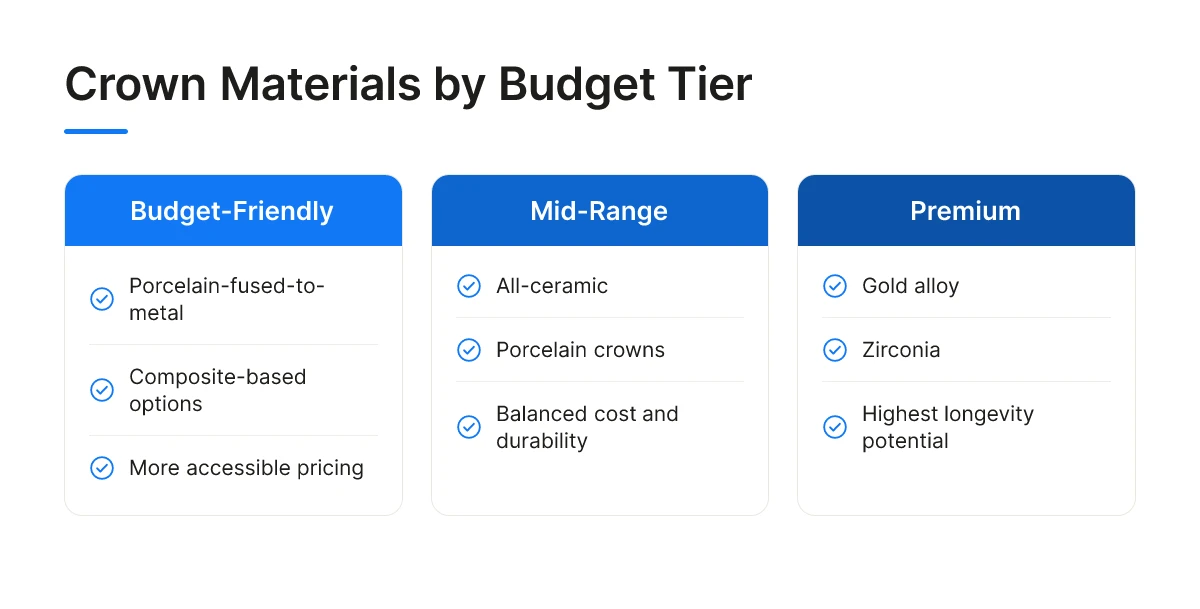
Crown materials generally fall into budget-friendly, mid-range, and premium tiers. Porcelain-fused-to-metal and composite-based options tend to sit at the more accessible end, all-ceramic and porcelain crowns occupy the middle to upper range, and gold alloy or zirconia often price at the premium tier depending on the case [5].
Tooth location changes the calculation. Back teeth absorb far more bite force from chewing, so a stronger, more wear-resistant material there can prevent the crown from cracking or loosening early, avoiding a second round of costly treatment down the line.
Choosing the cheapest material for a highly visible front tooth carries its own risk. A budget-tier option that discolors, chips, or needs replacement in a few years can end up costing more in total than paying for a longer-lasting material upfront.
This comparison suits patients weighing multiple material quotes rather than chasing the lowest number on paper. Frame the decision around cost-per-year-of-use: a crown priced higher but rated for 15-20 years [5] often beats a cheaper option that needs redoing twice in that same span. For those exploring dental crown cost, this matters.
4. Ask for a Transparent, Itemized Treatment Quote
An itemized quote breaks dental crown cost into its individual parts, so you know exactly what you’re paying for before treatment starts.
Does the Crown Cost Include the Initial Exam, X-Rays, and Tooth Preparation?
A thorough quote should list the exam, diagnostic X-rays, tooth preparation, the temporary crown, lab fees for fabricating the final crown, and the placement visit itself as separate line items [2]. When a quote bundles everything into one number, it’s harder to spot what happens if your case changes mid-treatment.
Are Follow-Up Visits and Adjustments Included in the Quoted Price?
Bite adjustments or minor fit corrections after the crown is seated aren’t always covered under the original quote. Ask directly whether follow-up visits are included or billed separately, since this is one of the most common sources of surprise charges.
Tooth preparation complexity can also shift the scope after the initial exam. Extensive decay, a cracked tooth needing a root canal first, or a weak tooth base can all add steps that weren’t priced into the original estimate.
This approach works best for patients comparing quotes across providers or budgeting precisely for a mid-range to premium procedure. Before treatment begins, ask the practice to flag which line items are fixed costs and which are estimates that could change once they see the tooth up close.
5. Weigh Same-Day Crown Technology Against Traditional Multi-Visit Crowns
Same-day crowns cut a visit and a temporary crown from the process, but that convenience doesn’t always translate into the lowest dental crown cost.
How Does Same-Day Crown Technology Compare in Price to Traditional Multi-Visit Crowns?
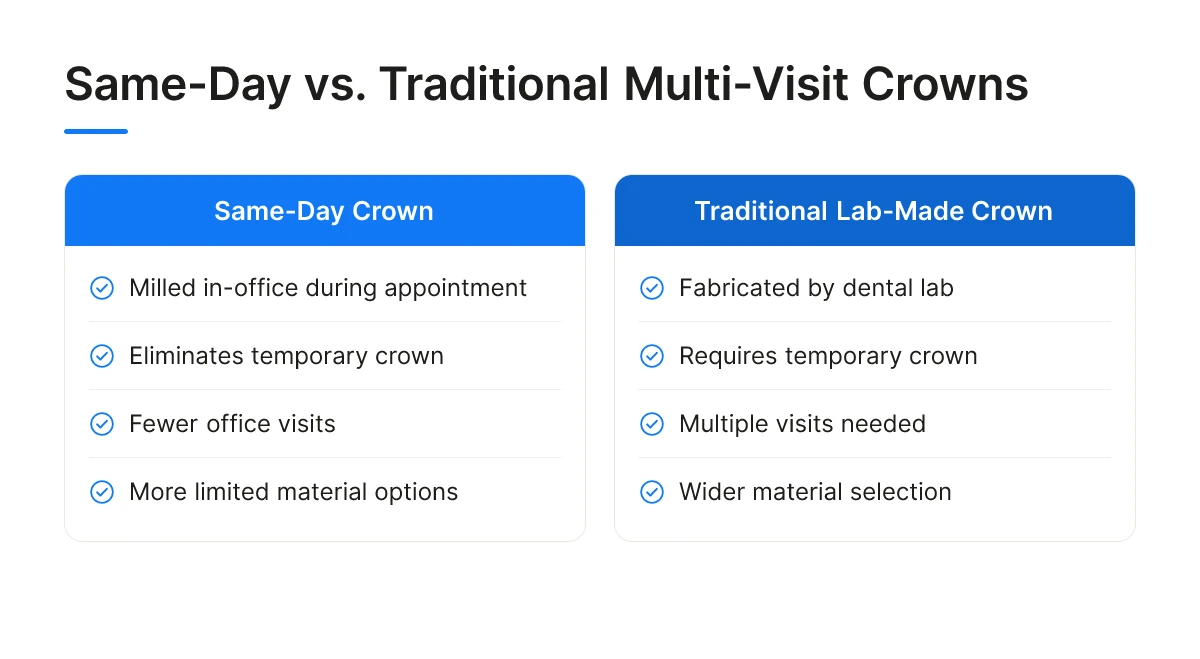
Same-day crown technology mills the final crown in-office during a single appointment, eliminating the temporary crown and the second visit a traditional lab-made crown requires [2]. That reduces indirect costs too, fewer trips to the office means less time away from work or school pickup.
Material options for same-day crowns are more limited than what a dental lab can produce, which affects how the material-tier cost comparison plays out. A traditional crown sent to an outside lab may offer broader material choices, including some premium options not available for same-day milling. This directly impacts dental crown cost outcomes.
Fewer visits also means less risk of a temporary crown cracking or falling off between appointments, a real inconvenience with traditional workflows. Still, same-day isn’t automatically cheaper for every case.
This option suits patients who value fewer appointments and can accommodate a longer single visit. Complex cases involving multiple teeth or significant bite adjustments may still need the traditional multi-visit workflow, regardless of which technology a practice offers.
6. Address a Needed Crown Now Instead of Delaying Treatment
Delaying a needed crown almost always raises total dental crown cost, because a weakened tooth keeps decaying and can progress to a root canal or extraction.
A cracked or heavily decayed tooth that just needs a crown today can fail further while you wait. Bacteria reach the nerve, the fracture spreads, and what was a single restorative step turns into a root canal followed by a crown, or worse, an extraction and replacement. This isn’t a scheduling inconvenience, it’s a compounding financial decision, since each stage of decline adds its own procedure and fee on top of the original one.
What Are My Realistic Options If I Delay Crown Treatment?
Ask about temporary stabilization, such as a provisional restoration that protects the tooth while you arrange payment. If you need crowns on multiple teeth, get all of them evaluated at once so you know the full scope before choosing what to address first.
How Can I Prioritize Crown Treatment Within My Budget?
Rank teeth by risk: the one causing pain, the one with a visible fracture, and the one affecting your bite come first. Teeth with no symptoms and stable, small fractures can often wait a bit longer without the same downside.
7. Compare the Long-Term Cost of a Crown Versus Extraction
Extraction looks cheaper today, but a crown that saves the natural tooth is usually the lower-cost path once you count what extraction requires afterward. This is particularly relevant for dental crown cost.
Pulling a tooth solves the immediate problem, but an empty socket doesn’t stay empty for long in practice. Neighboring teeth drift into the gap, opposing teeth over-erupt, and your bite shifts, problems that often require orthodontic correction or restorative work months or years later. That’s on top of needing a bridge, implant, or partial denture just to restore chewing function in the first place.
What Are the Long-Term Costs of Tooth Extraction Versus Crown Placement?
A crown sits at a mid-range cost tier and keeps the natural root, nerve feedback, and jawbone stimulation intact. Extraction plus replacement usually lands in a higher cost tier overall, since it stacks the extraction fee with a second, separate restorative procedure, and sometimes a third, if the bite shifts before you replace the tooth.
This comparison is exactly what we walk through with patients at Villagio Family & Cosmetic Dental during a consultation, laying out both paths side by side instead of defaulting to extraction because it looks cheaper on paper. Patients deciding between saving a damaged tooth and pulling it deserve to see the full sequence of likely next steps before choosing.
8. Protect Your Crown to Avoid Paying for It Twice
Good maintenance habits stretch a crown’s lifespan and prevent the early-replacement expense that erases whatever you saved upfront.
Grinding your teeth at night, chewing ice, and skipping routine checkups all shorten how long a crown lasts. A crown that fails at year four instead of year twelve means paying for a second restoration far sooner than necessary, maintenance is the long-term half of total cost of ownership, not a side topic separate from what you paid at placement.
What’s the Typical Lifespan of a Dental Crown?
Lifespan varies by material, with porcelain and zirconia crowns often lasting 10 to 20 years and porcelain-fused-to-metal typically in the 5-to-15-year range [5]. Actual lifespan depends heavily on how the crown is treated day to day, not just the material chosen. When considering dental crown cost, this point stands out.
How Do Maintenance Costs Factor Into the Total Investment Over Time?
Routine checkups let your dentist catch a loosening margin or hairline crack before the crown fails outright, when a small adjustment is still possible instead of a full remake. A nightguard is a relatively low-cost way to prevent grinding damage, protecting a restoration that cost far more to place. Patients who already have a crown, or are about to get one, get the most value from building these habits in early.
How to Choose the Right Strategy to Lower Your Dental Crown Cost
Match strategy to your situation by checking insurance first, comparing material tiers next, and filling any remaining gap with a payment plan or membership option.
Start by confirming what your insurance actually covers for a crown, since benefits and waiting periods vary and combining coverage with fee-for-service budgeting avoids surprises at checkout [2]. If a gap remains, compare material tiers realistically rather than assuming you need the most expensive option available.
Tooth location matters here. A front tooth that shows when you smile makes a cosmetic material upgrade, like all-ceramic, worth prioritizing, while a back molar that does the heavy chewing work benefits more from a durable option like zirconia or a metal alloy than from a cosmetic finish nobody sees [5].
Bring a written list of questions to your consultation: what your plan covers, which materials are being recommended and why, and exactly what’s included in the quoted price, lab fees, follow-up adjustments, anesthesia. If the tooth is severely damaged, ask directly for a side-by-side comparison of crown-versus-extraction costs so you’re deciding with the full picture, not just the number on one estimate.
Frequently Asked Questions
How does tooth location affect dental crown pricing?
Molars often cost more to crown than front teeth because they carry heavier bite force and may need stronger materials like zirconia or metal alloy [5]. Back-tooth crowns also demand more precise fit work given limited visibility and access, which can add to the dentist’s chair time. Front-tooth crowns lean toward cosmetic materials like porcelain, priced for a natural look rather than raw strength. For those exploring dental crown cost, this matters.
What percentage of crown costs does typical dental insurance cover?
Most dental plans cover crowns as a major procedure, typically paying a portion after the deductible rather than the full bill [2]. Coverage amounts vary widely by plan and by whether the crown is deemed medically necessary versus cosmetic. Checking your annual maximum and any waiting periods before treatment helps you budget the remaining out-of-pocket balance accurately.
What’s the price difference between porcelain, ceramic, and metal crowns?
Porcelain and ceramic crowns generally run higher than metal because of the lab work involved in matching natural tooth color, while gold or metal alloy crowns cost more upfront but often outlast them [5]. Zirconia sits in a similar range to porcelain but tends to resist chipping better [5]. Composite resin is usually the most budget-friendly option, though it wears down faster and needs replacement sooner [5].
What questions should I ask to compare crown costs and quality between providers?
Ask for an itemized, written estimate that separates the crown material, lab fees, and any prep work like a core buildup or root canal [2]. Confirm whether the price includes a temporary crown, how many years the crown is warrantied, and what happens if it needs adjustment or replacement. Also ask if same-day crown technology is available, since it can reduce visits and lab costs [2].
How does transparent pricing help me make an informed decision about a crown?
Transparent pricing lets you compare material options and payment paths before committing, so there are no surprise charges at checkout [3]. Knowing the full cost upfront also makes it easier to plan around insurance timing, financing, or a dental savings plan without delaying needed treatment.

Conclusion
Crown costs come down to a handful of controllable factors: the material you choose, how your insurance benefits are timed, and whether you compare itemized estimates before committing to treatment. Families in Katy, Fulshear, Richmond, and Cinco Ranch can lower out-of-pocket costs further by asking about same-day crown options, financing plans, and preventive care that catches problems before they require a crown at all. The choice of provider matters just as much as the material, a clear, written estimate protects you from surprise fees. Call Villagio Family & Cosmetic Dental to request an itemized crown estimate and find out which payment options apply to your plan before you schedule treatment.
Sources & References
- Managing the Bill: A Practical Guide to Dental Crown Payment Options
- Transparent Dental Pricing: Your Guide to Clear Costs
- Tips for Reducing Out‑of‑Pocket Dental Expenses – Southern Boulevard Dental
- Average Cost of a Crown: What You Need to Know
Recommended Articles
Explore more from our content library: