Proudly Serving Katy, Richmond & Fulshear Cinco Ranch
(281) 395-2100
|
(281) 394-4001

You’re likely a good candidate for dental implants if you have healthy gums, adequate jawbone density to support a titanium or zirconia post, and no uncontrolled conditions like diabetes or active gum disease. Age alone rarely disqualifies anyone, the deciding factors are bone volume, overall healing capacity, and habits like smoking that slow osseointegration. Patients with significant bone loss, uncontrolled chronic illness, or certain medication histories may need additional steps first, such as bone grafting, or may be better suited to alternatives like bridges or dentures.
Am I a Good Candidate for Dental Implants?
Candidacy comes down to three things: enough jawbone to hold the implant, a body that can heal well, and habits that support rather than sabotage that healing. Most adults in Katy and the surrounding Fulshear and Cinco Ranch communities meet these criteria without much intervention. Others need a preparatory step first, which is different from being ruled out entirely.
What Bone Density and Health Conditions Affect My Eligibility for Implants?
A dental implant only works if your jawbone has enough density and volume to fuse with the titanium post, a process called osseointegration [1]. When a tooth has been missing for months or years, the bone that once supported it starts to resorb, since the jaw no longer receives the chewing pressure that keeps it stimulated. This gradual bone loss is the single most common reason someone isn’t an immediate candidate, more common than any single medical condition [2].
Several health conditions also complicate candidacy. Uncontrolled diabetes slows healing and raises infection risk at the surgical site [3]. Active periodontal disease means the gums and supporting bone are already compromised, so the infection needs to be treated before an implant can be placed [2]. Certain autoimmune conditions and a history of head or neck radiation can also interfere with bone healing and integration [3]. None of these automatically closes the door, they just mean your dentist needs a fuller health picture before recommending a timeline.
Are There Age Restrictions for Getting Dental Implants?
Age itself is not a disqualifier for dental implants, what matters is whether the jawbone has finished growing. The real exception is teenagers and young patients whose jaws are still developing, since placing an implant in a growing bone can lead to misalignment as the surrounding teeth continue to shift [1]. Older adults, including patients in their seventies and eighties, are routinely approved as long as their bone and overall health support it. We see this often at Villagio Family & Cosmetic Dental, where healthy adults well past retirement age move through the implant process without added risk tied to age alone.
Smoking and poor oral hygiene deserve their own mention because they’re modifiable, unlike age or genetics. Smoking restricts blood flow to the gums, which slows healing and raises the risk of implant failure [3]. Poor oral hygiene lets bacteria build up around the implant site, increasing infection risk during the critical healing window [3]. The encouraging part is that many of the factors that look disqualifying at first, including low bone density and gum disease, can often be corrected with grafting or periodontal treatment, turning a “no” into a “not yet.”
What Happens During the Dental Implant Process, and How Long Does It Take?
Dental implants move through six sequential stages, consultation and imaging, occasional bone grafting, surgical placement, a healing period called osseointegration, abutment placement, and the final crown, and the whole path typically spans several months to a year.
The process starts with a consultation that includes 3D imaging, usually a cone-beam CT scan, to map jawbone density, nerve position, and sinus location [2]. If the scan shows insufficient bone volume, your dentist may recommend grafting first, adding healing time before implant placement can proceed [3]. Once the jaw is ready, the titanium post is surgically set into the bone during a procedure most patients tolerate with local anesthesia and a short recovery window [1].
How Long Will I Be Without Teeth During the Implant Process?
Rarely, most patients wear a temporary restoration for both appearance and function while the implant heals underneath.
For a single front tooth, a removable flipper or bonded temporary bridge fills the visible gap. For back teeth, some patients skip a temporary altogether since the space isn’t visible when smiling. The one phase you can’t rush is what happens beneath the gumline: osseointegration, the process by which the jawbone physically fuses to the titanium post [1]. This fusion is what gives dental implants their stability and bite strength, and it’s also why the timeline can’t be compressed with a faster technique.
What Is the Complete Timeline From Consultation to Having My Final Tooth?
Osseointegration alone typically takes several months, since bone remodeling happens gradually and can’t be rushed without risking implant failure [2]. Only after your dentist confirms the implant has fused does treatment move to abutment placement, the small connector piece, followed by taking impressions for your final crown.
Single-tooth cases with adequate existing bone often finish faster than cases involving grafting, multiple implants, or a full arch. Full-arch reconstructions involve more extensive surgical planning and longer healing windows across multiple implant sites, which naturally extends the overall timeline [4]. At Villagio Family & Cosmetic Dental, we walk patients in Katy and Fulshear through each stage with imaging and a realistic calendar upfront, so there are no surprises about how many appointments the process actually requires.
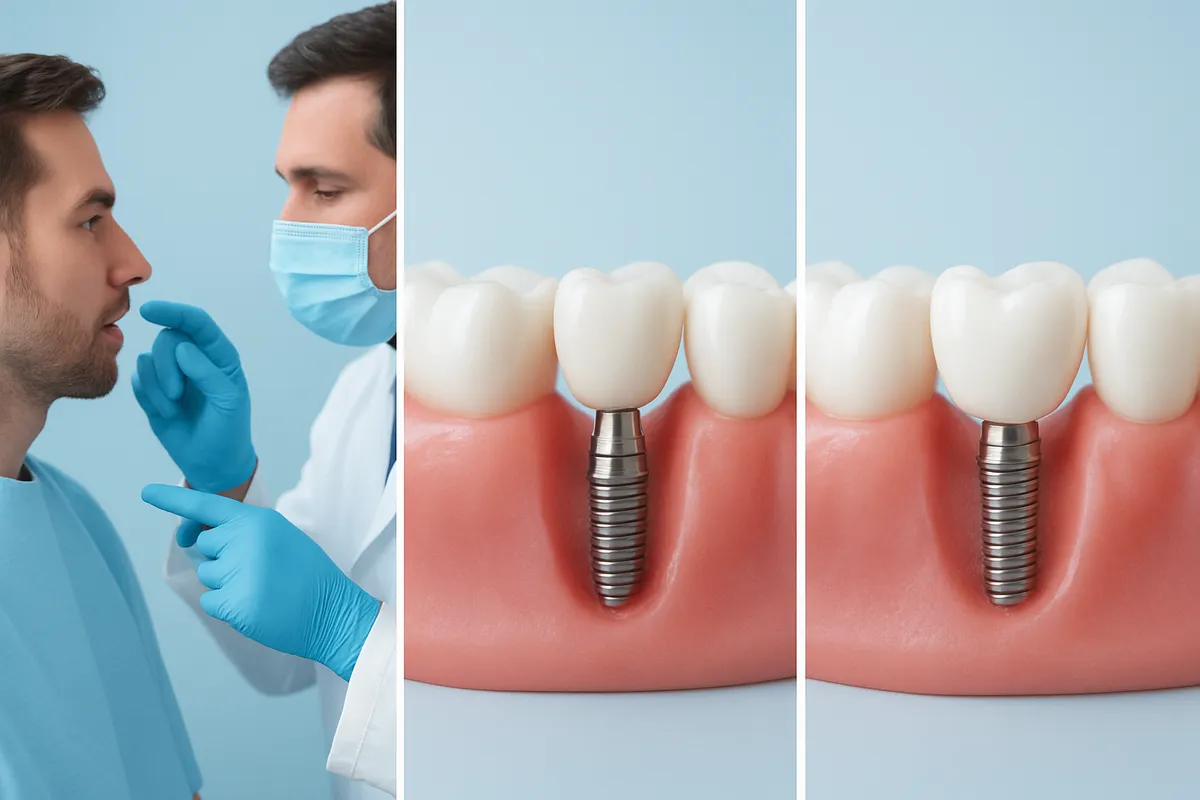
What Are the Potential Downsides and Complications of Dental Implants?
Dental implants involve real surgery with real recovery time, and a small percentage fail even when everything is done correctly. Most patients handle the process well, but going in with accurate expectations matters more than optimism.
How Painful Is the Dental Implant Procedure and Recovery?
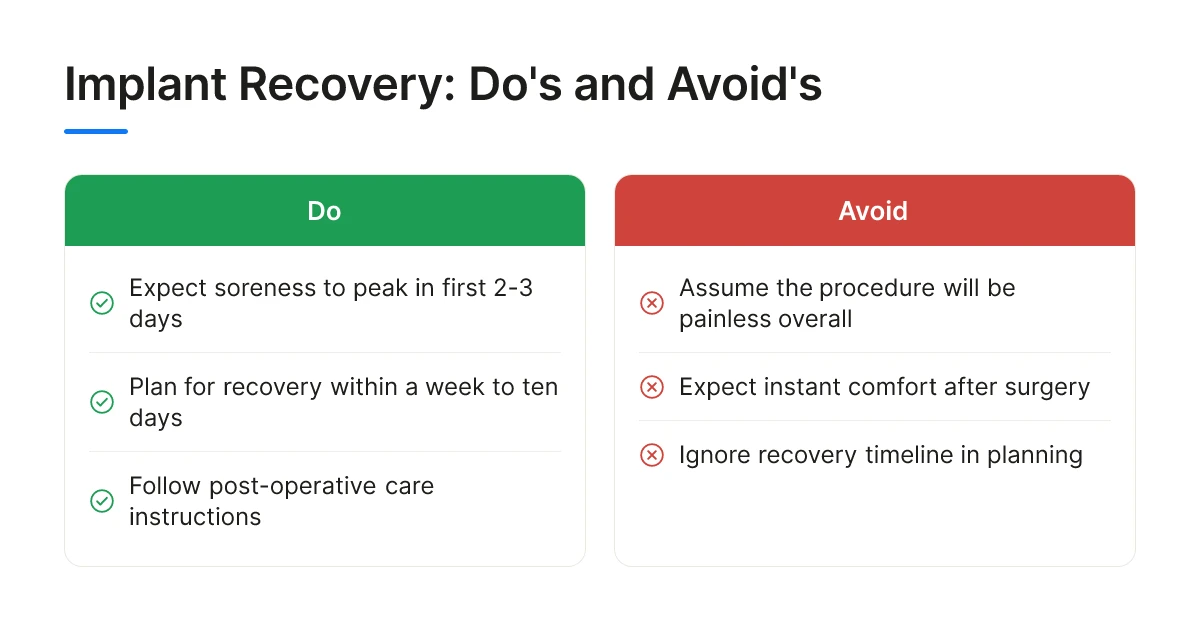
The placement surgery itself is done under local anesthesia (sometimes with sedation), so patients feel pressure, not pain, during the procedure. The soreness shows up afterward, typically peaking in the first 2-3 days and fading within a week to ten days, comparable to what many patients describe after a tooth extraction.
Normal recovery looks like mild swelling, tenderness at the site, and manageable discomfort controlled with over-the-counter or prescribed pain relievers. Warning signs that go beyond normal healing include fever, pus, a bad taste that won’t go away, increasing pain after day four or five, or an implant that feels loose. Any of those point to infection or a healing problem and need a call to the dentist, not a wait-and-see approach.
What Are the Failure Rates and Long-Term Success Statistics for Implants?
Implant failure happens through one of three main mechanisms. The first is a failure of osseointegration, the jawbone never fuses properly to the titanium post, usually discovered in the first few months. The second is peri-implantitis, an infection of the gum and bone around an otherwise well-integrated implant, similar to gum disease but affecting implant tissue [1]. The third is mechanical overload, where chronic teeth grinding or a bad bite puts more force on the implant than it’s designed to handle over time.
Long-term success rates for dental implants are consistently high, but “high” is not “guaranteed.” Certain factors measurably raise the risk of complications: smoking impairs healing and blood flow to the gums, uncontrolled diabetes slows tissue repair, and poor oral hygiene lets bacteria build up around the implant the same way it would around a natural tooth [3]. Patients who manage these factors well tend to see the best long-term outcomes.
Less common but worth knowing about: implants placed in the lower jaw carry a small risk of affecting a nearby nerve if positioning isn’t precise, and upper-jaw implants near the back of the mouth can involve the sinus cavity. Neither is common, and both are exactly why a thorough evaluation, including imaging that maps bone height, nerve location, and sinus position before any drilling happens, is standard practice, not an upsell.
How Much Do Dental Implants Cost, and What Are My Payment Options?
Dental implants sit at the premium end of tooth-replacement pricing because they involve surgical placement, a healing period, and lab-fabricated restorations rather than a single office visit.
A bridge or partial denture uses your existing teeth or gum ridge for support, which keeps materials and chair time lower. An implant, by contrast, replaces the root itself, a titanium post placed in the jawbone, left to fuse with bone over several months, then topped with an abutment and custom crown [1][2]. That extra biological step, plus the surgical skill required to place the post accurately, is what separates implant pricing from cheaper alternatives.
What Is the Average Cost of a Single Tooth Implant?
We won’t quote a specific number here, because cost varies too much by case to state one figure responsibly, several variables move the total up or down. Whether you need bone grafting before placement is usually the biggest swing factor; patients with bone loss from long-term tooth loss or gum disease often need a graft procedure first, adding both cost and treatment time [3]. Replacing a single tooth costs far less than restoring multiple teeth or a full arch. Material choice also matters: standard titanium posts are the long-established option, while zirconia implants, a newer alternative, typically carry a higher price.
Does Dental Insurance Cover Implants, and What Financing Plans Are Available?
Most dental insurance plans treat implants as a partially covered or entirely excluded procedure, so check your plan documents rather than assume coverage before committing. Some plans cover the crown portion but not the surgical placement, others exclude implants outright while covering a bridge or denture as the “alternate benefit,” and annual maximums often fall well short of the total treatment cost regardless.
Practical financing usually comes down to three paths: in-house payment plans that let a practice spread cost across the treatment timeline, third-party healthcare financing companies that offer monthly payment terms, and phased treatment where a dentist stages the work, extraction and grafting first, implant placement later, crown last, so cost is spread out rather than due all at once. At Villagio Family & Cosmetic Dental, our team walks patients through which of these options fits their treatment plan and budget before any procedure begins.
Cost is also a candidacy conversation, not just a budget one. A patient with significant bone loss, uncontrolled health conditions, or a preference for a faster, lower-cost fix may be better served by a bridge or denture regardless of what implants cost, the right restoration is the one that matches both your anatomy and your priorities, not just the one with the lowest price tag.
How Do I Care for Dental Implants After Treatment?
Dental implants need daily brushing and flossing plus regular professional checkups, skipping either raises the risk of bone loss around the implant over time.
What Maintenance and Daily Care Do Dental Implants Require?
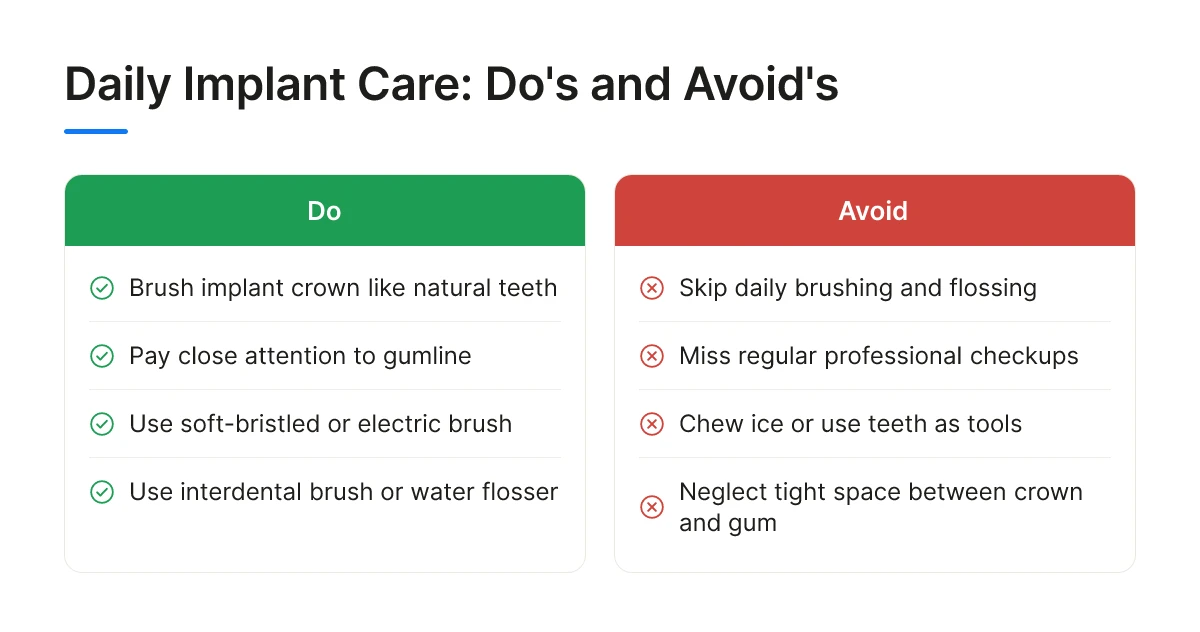
Brush the implant crown the same way you brush a natural tooth, paying close attention to the gumline where plaque tends to collect. A soft-bristled or electric brush works well, and an interdental brush or water flosser designed for implants reaches the tight space between the crown and gum that a regular floss pass can miss. Avoid habits that put unnecessary stress on the restoration, such as chewing ice or using your teeth to open packaging, the crown itself resists decay, but the surrounding gum and bone tissue can still be damaged by trauma.
Professional cleanings matter even more once implants are involved, not less. Peri-implantitis, inflammation and bone loss around an implant caused by bacterial buildup, can progress for months without pain or visible symptoms [3]. Regular checkups let your dentist catch early signs of gum recession or bone loss before they threaten the implant’s stability, which is why the consultation and eligibility process described earlier in this article doesn’t end once the crown is placed.
A few habits shorten implant lifespan more than others. Grinding your teeth at night without a nightguard puts repeated pressure on the implant and crown, smoking slows healing and raises failure risk even after full integration [3], and skipping follow-up visits lets small problems turn into bigger ones.
Handled consistently, dental implants are built to function like the teeth they replace for many years, a meaningful difference from removable dentures, which need to be taken out, cleaned separately, and refitted as your jaw changes over time. For families in Katy, Fulshear, Richmond, and Cinco Ranch weighing tooth-replacement options, that day-to-day simplicity is often what tips the decision in favor of implants once eligibility has been confirmed.
Frequently Asked Questions
Can I get dental implants if I have low bone density?
Low bone density does not automatically rule out implants, but it usually means an added step before surgery. Bone grafting can rebuild the jaw structure needed to support an implant, and many patients who initially lack sufficient bone volume qualify after this preparatory treatment [2]. A CT scan during your consultation confirms whether grafting is necessary.
Is there an upper age limit for dental implants?
No fixed age disqualifies a patient, overall health matters more than the number on a birth certificate [2]. Older adults with well-managed medical conditions and adequate bone support routinely qualify. What matters is whether the jaw and gums can support healing, not age itself.
What’s the difference between titanium and zirconia implants?
Titanium implants are the traditional choice, prized for decades of clinical use and reliable fusion with bone through osseointegration [1]. Zirconia implants are a newer, metal-free alternative, often chosen by patients with metal sensitivities or a preference for a tooth-colored post. Both integrate with the jawbone, but your dentist will recommend one based on your health history and aesthetic goals.
What happens if a dental implant fails?
Implant failure is uncommon, and most cases stem from gum disease, smoking, uncontrolled diabetes, or poor oral hygiene undermining healing [3]. When failure occurs, the dentist removes the implant, addresses the underlying cause, and often allows the site to heal before attempting a second placement. Patients who follow post-surgical care instructions face significantly lower risk.
Are dental implants a permanent solution?
Implants are designed to be a long-term, durable replacement, not a temporary fix like a removable denture. With good oral hygiene and regular dental visits, the titanium post can last for decades, though the crown on top may eventually need replacement due to normal wear.
Conclusion
Candidacy for dental implants comes down to a handful of controllable factors: bone density, gum health, and how well conditions like diabetes or smoking habits are managed. Few patients are permanently disqualified, most who face a challenge today can qualify after grafting, periodontal treatment, or better health management [3]. The real starting point isn’t guesswork about your jawbone or age; it’s a CT scan and an evaluation from a dentist who can tell you exactly where you stand. If you’re in Katy, Fulshear, Richmond, or Cinco Ranch and wondering whether implants fit your situation, schedule a candidacy consultation with Villagio Family & Cosmetic Dental to get a definitive answer rather than another list of maybes.
Sources & References
- Are You a Good Candidate for Dental Implants? Here’s What You Need to Know
- Am I a Candidate for Dental Implants? | Eligibility Factors | Vestal NY – Vestal Dental Associates
- What Disqualifies You From Dental Implants? | Aria Dental
- Am I a Candidate for Dental Implants, Parmer Oaks Dental Care Cedar Park Texas
Recommended Articles
Explore more from our content library: