Proudly Serving Katy, Richmond & Fulshear Cinco Ranch
(281) 395-2100
|
(281) 394-4001

Preparing for cosmetic dental procedures means completing a candidacy consultation, choosing which procedures fit your smile goals and budget, and readying yourself physically and mentally before the appointment. Start by identifying what bothers you about your smile (color, chips, gaps, alignment), get a dentist’s evaluation of which procedure actually addresses it, then follow pre-appointment steps: avoid staining foods/drinks, arrange time off if needed, and plan how you’ll manage any anxiety or discomfort. Most patients feel ready once they understand exactly what will happen, what recovery looks like, and what results to expect.
Prerequisites: Decide Which Cosmetic Dental Procedures Fit Your Smile Goals
Match your specific concern, stained teeth, chips, gaps, minor misalignment, or worn edges, to a general procedure category before you book anything, then confirm the details at a consultation.
Most patients research cosmetic dental procedures the way they’d research any big purchase: reading about veneers, whitening, and bonding until the categories blur together. Skip the deep dive into mechanics for now. Instead, name the problem in plain terms. Discoloration that toothpaste won’t fix generally points toward whitening or bonding. Chipped or uneven edges point toward bonding or veneers. Gaps and minor crowding often point toward orthodontic options or veneers, depending on severity. This narrows the conversation before you sit in the chair, so the appointment is about confirming a plan rather than starting from zero [1].
Which Cosmetic Dental Procedure Is Most Popular, and Why?
Teeth whitening is typically the entry point for most patients because it is visible, fast, and reversible compared to procedures that alter tooth structure permanently [2].
Parents in Katy and Fulshear juggling school pickups and weekend sports tend to gravitate toward the option that fits into a lunch break. Whitening can be done chairside in a single visit or through a custom take-home tray [1], which explains why it’s often the first cosmetic treatment people try before considering veneers, bonding, or crowns.
Am I a Good Candidate, or Are There Procedures I Should Avoid?
Good candidacy depends on healthy gums, enough remaining natural tooth structure, realistic expectations about results, and no untreated decay or infection sitting underneath the cosmetic problem [2].
A dentist typically wants restorative issues resolved first, a cavity or an infected root canal needs treatment before a veneer or crown goes anywhere near it. Hold off on elective cosmetic work if you have active gum disease, cavities that haven’t been filled, uncontrolled teeth grinding that could damage new restorations, or if you’re pregnant and the procedure isn’t urgent [2]. None of this replaces a professional exam. Self-diagnosing from articles and forums is a common misstep; a single consultation visit is the practical starting point, since a dentist can spot decay, bone loss, or bite issues that aren’t obvious to you. At Villagio Family & Cosmetic Dental, that first visit is where smile goals, budget, and clinical reality get reconciled before any procedure is scheduled.
Prepare Physically and Mentally Before Your Cosmetic Dental Procedure
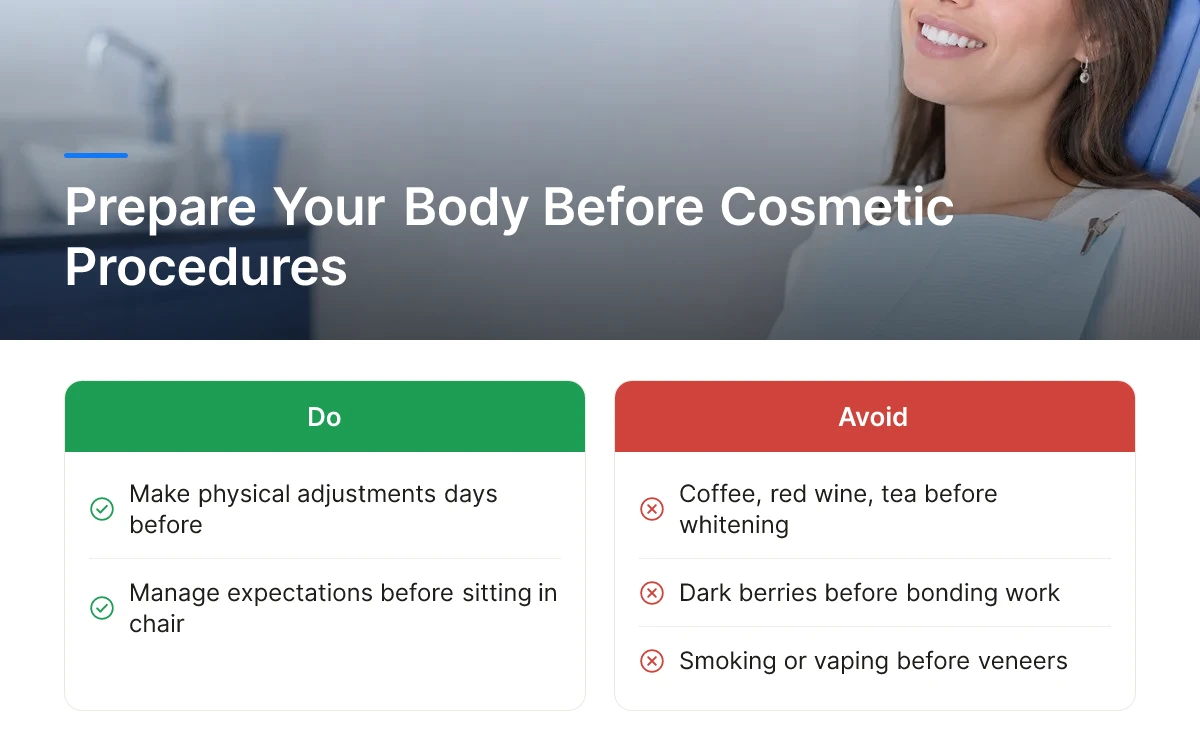
Good preparation for cosmetic dental procedures comes down to two things: managing your body’s variables and managing your own expectations before you sit in the chair.
Start with the physical side. A few adjustments in the days before your visit make a measurable difference in comfort and results.
- Skip coffee, red wine, tea, and dark berries for at least 48 hours before whitening or bonding work, staining agents can interfere with how evenly the material cures or how your natural teeth look next to it.
- Stop smoking or vaping in the days leading up to procedures like veneers or bonding, since tobacco can discolor new restorations faster than natural enamel [1].
- Eat a full meal beforehand if you know numbing is part of the plan, local anesthesia makes chewing difficult for a few hours afterward, and showing up hungry only adds stress.
- Arrange a ride home if any form of sedation is involved. Sedation affects reaction time and judgment well past the appointment itself, so plan transportation in advance rather than the morning of.
Mental prep matters just as much. Bring reference photos of smiles you like, dentists use these to calibrate shade, shape, and proportion instead of guessing at your goals. Write your questions down beforehand; anxiety and unfamiliar terminology make it easy to blank out mid-conversation. If dental visits make you nervous, say so plainly. A good team adjusts pacing, explains each step before it happens, and gives you breaks, but only if they know you need them.
What Should I Expect During My Cosmetic Dental Appointment?
Most cosmetic appointments follow a predictable sequence, and knowing it in advance removes a lot of the guesswork that fuels anxiety.
- Check-in and health review: confirming medical history, medications, and any changes since your last visit.
- Goal discussion: reviewing your reference photos and talking through realistic outcomes for veneers, bonding, whitening, or crowns [2].
- Imaging or impressions: X-rays, digital scans, or physical molds depending on the procedure.
- The procedure itself: timing varies widely, whitening can take under an hour, while veneers or crowns often require multiple visits [1].
- Aftercare instructions: what to eat, what to avoid, and when to call if something feels wrong.
How Painful Is Cosmetic Dentistry, and What Pain Management Options Are Available?
Most cosmetic dental procedures involve mild discomfort at most, and dentists have several tools to keep it that way [2]. Local anesthesia numbs the treatment area for procedures like crowns or bonding. Patients with significant anxiety or longer procedures can often discuss sedation options with their dentist beforehand. For soreness afterward, over-the-counter pain relievers typically handle it, your dental team will tell you which to avoid if you’re getting whitening, since some can increase sensitivity temporarily.
Distinguish Cosmetic From Restorative Needs Before You Book
Restorative dentistry repairs decay, fractures, or missing teeth to restore function and health; cosmetic dental procedures improve appearance on a foundation that’s already structurally sound [2]. Knowing which category your case falls into changes what you ask for at your first visit and what your insurance is likely to pay.
A patient in Cinco Ranch with a cracked molar needs a crown for function, that’s restorative. A patient in Fulshear who wants whiter, more uniform front teeth with no decay present is asking for a cosmetic dental procedure. The distinction sounds simple until you sit in the chair, because many treatments do both jobs at once.
Can a Single Procedure Address Both Cosmetic and Restorative Needs?
Yes, a crown or bonding can repair a damaged tooth and improve its appearance in the same visit, which is exactly why the line between categories gets blurry [1]. WebMD notes that crowns are used both to protect a weakened tooth and to change or recolor it for a better-looking smile [1]. Bonding works the same way: your dentist might apply it to fix a chip from a bike accident and, in the process, correct the tooth’s shade and shape [1].
This overlap creates confusion at billing time. Insurance plans generally cover restorative work tied to decay, injury, or disease, but they typically exclude anything classified as purely cosmetic [2]. When a single procedure serves both purposes, coverage often comes down to documentation and how the treatment is coded. Ask your dentist directly which category your recommended procedure falls into, and ask them to document the functional justification if part of the work is medically necessary. Don’t assume, get it in writing before you commit to treatment.
Sequencing matters as much as classification. A restorative problem, an active cavity, a fractured tooth, gum disease, has to be resolved before cosmetic work goes on top of it. Veneers bonded over a tooth with untreated decay, or whitening applied while gums are inflamed, won’t hold up and may accelerate damage underneath. Fix the foundation first, then build the smile you want on top of it.
Plan for Recovery, Longevity, and Budget After Your Cosmetic Dental Procedure
Recovery time, how long results last, and what you’ll pay are three separate variables, and matching them to your own priorities matters more than picking whatever procedure looks best in a before-and-after photo. Most cosmetic dental procedures fall somewhere between a lunch-break appointment and a multi-week healing process, so knowing which category you’re signing up for changes how you schedule the weeks around it.
What Downtime and Recovery Should I Plan For With Different Procedures?
Downtime depends entirely on what’s being done to the tooth or gum tissue, not on cosmetic dentistry as a category. In-office teeth whitening has essentially zero recovery, patients walk out and go back to work the same afternoon, though temporary sensitivity to hot or cold is common for a day or two [1]. Bonding is similarly quick, usually finished in a single visit with no downtime [2].
Veneers and crowns sit in the middle. Because they require shaving down enamel to fit the restoration, you’ll likely have a temporary tooth in place for one to two weeks while the permanent piece is fabricated, and some gum sensitivity is normal during that window [1]. Procedures that involve the gum line or bone, like implants, carry the longest recovery, sometimes several days of swelling and soft-tissue healing before you’re back to normal chewing [1]. If you’re a Katy or Cinco Ranch parent juggling school pickups, ask your dentist for a recovery timeline in writing before you book, not after.
What Happens if I’m Not Happy With My Results, or They Fade Over Time?
Nothing in cosmetic dentistry is permanent, results fade or wear based on your habits and the material used, not a fixed expiration date. Whitening fades faster if you drink coffee, tea, or red wine daily; bonding can chip if you grind your teeth at night; veneers and crowns last longer with consistent flossing and a nightguard than without one [2]. That’s a mechanical reality, not a marketing caveat.
If you’re unhappy with the outcome immediately after treatment, say so at the follow-up visit, most dentists build in a check-in specifically to catch this before you leave the chair. If results fade over months or years, touch-up options exist for almost every procedure: whitening can be redone, bonding can be repaired, veneers can sometimes be replaced individually. The best defense is setting expectations upfront, including asking to see similar past cases, which several consultation guides list as a standard question to bring to your first visit [3][4].
Matching Your Budget to the Right Procedure
Cost tiers roughly track complexity and lifespan rather than cosmetic value alone. Budget-friendly options like whitening trade a lower upfront cost for shorter-lived results that need repeating. Mid-range procedures like bonding balance cost and durability for patients who want a fix without a multi-visit commitment. Premium procedures, veneers, crowns, implants, cost more upfront but are built to last years with proper care [1][5].
Rather than defaulting to the cheapest option, weigh the cost against how long you’ll realistically want to maintain it and how often you’d need touch-ups. A dentist can walk through that math during your consultation so the choice fits your budget and your calendar, not just the treatment menu.
Common Mistakes to Avoid When Preparing for Cosmetic Dental Procedures
Most disappointing outcomes trace back to five preparation errors: skipping the consult, hiding health details, ignoring pre-visit instructions, expecting permanence, and shopping on price alone.
Catching these before your appointment saves time, money, and a second round of corrective work.
- Naming a procedure instead of the problem. Patients often walk in asking for veneers or bonding by name because a friend or an online photo made it look right. But the fix depends on the actual issue, spacing, wear, discoloration, or bite, and a dentist may recommend crowns or enamel reshaping instead once they’ve examined the tooth structure [1]. Bring the problem you want solved, not the solution you assume you need, and let the consultation confirm the right approach.
- Withholding health details that change the plan. Grinding habits, gum disease, current medications, and prior dental work all affect which cosmetic dental procedures are realistic and how long results will last [2]. A patient who grinds at night and gets unprotected veneers is setting up an early repair bill. Disclose everything, even habits that feel unrelated to appearance.
- Skipping pre-appointment instructions. Whitening prep often includes avoiding coffee, wine, and tobacco beforehand [1], and any sedation-based procedure requires a ride home arranged in advance. Overlooking these details can mean rescheduling or a less consistent result.
- Assuming results never need upkeep. Bonding, whitening, and even veneers wear down or shift color over years of normal use [2]. Going in expecting a one-time, permanent fix sets up frustration when a touch-up is recommended down the road, ask your dentist about expected lifespan up front.
- Picking the cheapest option without checking longevity. A lower upfront cost sometimes means more frequent replacement or a shorter lifespan, which adds up over several years. Compare procedures by total cost over time, not just the number on the initial quote.

Frequently Asked Questions
How do I know if I need a cosmetic procedure or a restorative one first?
Any decay, gum disease, or bite problem needs treatment before cosmetic work begins. Cosmetic dentistry builds on a healthy foundation, so your dentist will check for cavities, infection, or grinding damage first [2]. Skipping this step risks placing veneers or crowns over problems that will only worsen underneath, shortening the life of the new work.
Can I combine teeth whitening with other cosmetic dental procedures?
Yes, but whitening should generally come first, before veneers, bonding, or crowns are matched to your final tooth shade [1]. Whitening a tooth that already has a porcelain veneer or composite bonding won’t work, since those materials don’t respond to bleaching agents the way natural enamel does.
What should I bring to my first cosmetic dentistry consultation?
Bring your dental records, a list of medications, and reference photos of smiles you like. Photos help translate a vague idea like “brighter” or “straighter” into a concrete treatment plan [3]. Also prepare questions about timeline, maintenance, and what results are realistic for your specific teeth and gums.
Is sedation available for anxious patients getting cosmetic dental work?
Yes, most cosmetic dental practices offer sedation options ranging from nitrous oxide to oral sedatives for longer procedures. Anxiety is common enough that many practices, including Villagio Family & Cosmetic Dental, build comfort options into the consultation itself. Ask about sedation choices before your appointment so you know what to expect and can arrange a ride home if needed.

Conclusion
Getting cosmetic dental work right starts before you ever sit in the chair. Treat any decay or gum issues first, whiten before matching veneers or bonding to your final shade, and walk into your consultation with photos and questions ready instead of vague hopes. Preparation shapes outcomes as much as the procedure itself [4].
If you’re in Katy, Fulshear, Richmond, or Cinco Ranch and weighing your options, schedule a consultation with Villagio Family & Cosmetic Dental and ask specifically which procedure order fits your current oral health before committing to a treatment plan.
Sources & References
- Cosmetic Dentistry to Improve Your Smile
- Cosmetic Dentistry: Purpose, Procedures & Benefits
- How to Prepare for a Cosmetic Dental Consultation: A Step-by-Step Guide
- How to Prepare for Cosmetic Dental Work – Daily Mouth Care
- How to Prepare for a Cosmetic Dentistry Procedure
Recommended Articles
Explore more from our content library: