Proudly Serving Katy, Richmond & Fulshear Cinco Ranch
(281) 395-2100
|
(281) 394-4001

Understanding general dentistry is essential. A general dentist provides eight core services patients rely on for lifelong oral health: routine exams and cleanings, X-rays, fluoride and sealants, fillings, extractions, root canals, crowns and bridges, and gum disease treatment. These services fall into two groups, preventive care that catches problems early, and restorative care that repairs damage before it worsens. Seeing a general dentist regularly for both keeps small issues from becoming costly, painful emergencies.

1. Routine Exams and Cleanings: The Foundation of General Dentistry
A routine visit pairs a dentist’s exam for decay and gum disease with a hygienist’s cleaning to strip away plaque and tartar that brushing never reaches.
The exam and the cleaning solve different problems. The dentist checks for cavities, gum pockets, and, often overlooked, signs of oral cancer and bite misalignment that can wear teeth down over years. The hygienist then scales off tartar, which is plaque that has hardened onto the tooth surface within days of forming [3]. Once plaque calcifies, a toothbrush can’t remove it; only professional instruments can. That’s the cycle a cleaning interrupts, twice a year, before buildup turns into decay or bone loss.
This pairing is built for every patient, not just those with visible problems. Kids get it as soon as teeth erupt, adults with clean records still need it to stay that way, and patients already managing decay or gum issues need it to keep small problems from becoming expensive ones. Among the services that make up general dentistry, this is the one nothing else substitutes for.

2. Digital X-Rays and Diagnostic Imaging
X-rays let a general dentist see decay, bone loss, and infections hiding between teeth or below the gumline that a visual exam alone will miss entirely.
A checkup catches what’s visible on the surface. X-rays catch what isn’t: cavities forming between teeth, bone loss from gum disease, impacted wisdom teeth, and infections sitting at the root tip before they cause pain. For families in Katy and Cinco Ranch juggling kids’ checkups with their own, this is often the difference between catching a cavity at a small, cheap stage versus discovering it after it’s already reached the nerve.
What is the recommended schedule for dental cleanings and X-rays?
Frequency depends on risk, not a fixed calendar. Low-risk adults with a clean history may only need X-rays every couple of years, while children, teens, and patients with a track record of cavities are typically imaged more often to track fast-changing teeth and jaws [4]. New patients almost always get a full set to establish a baseline the practice can compare against later.
Digital sensors also use significantly less radiation than the older film systems many patients still picture when they hear “dental X-ray”, a detail worth raising directly with patients who hesitate over imaging.
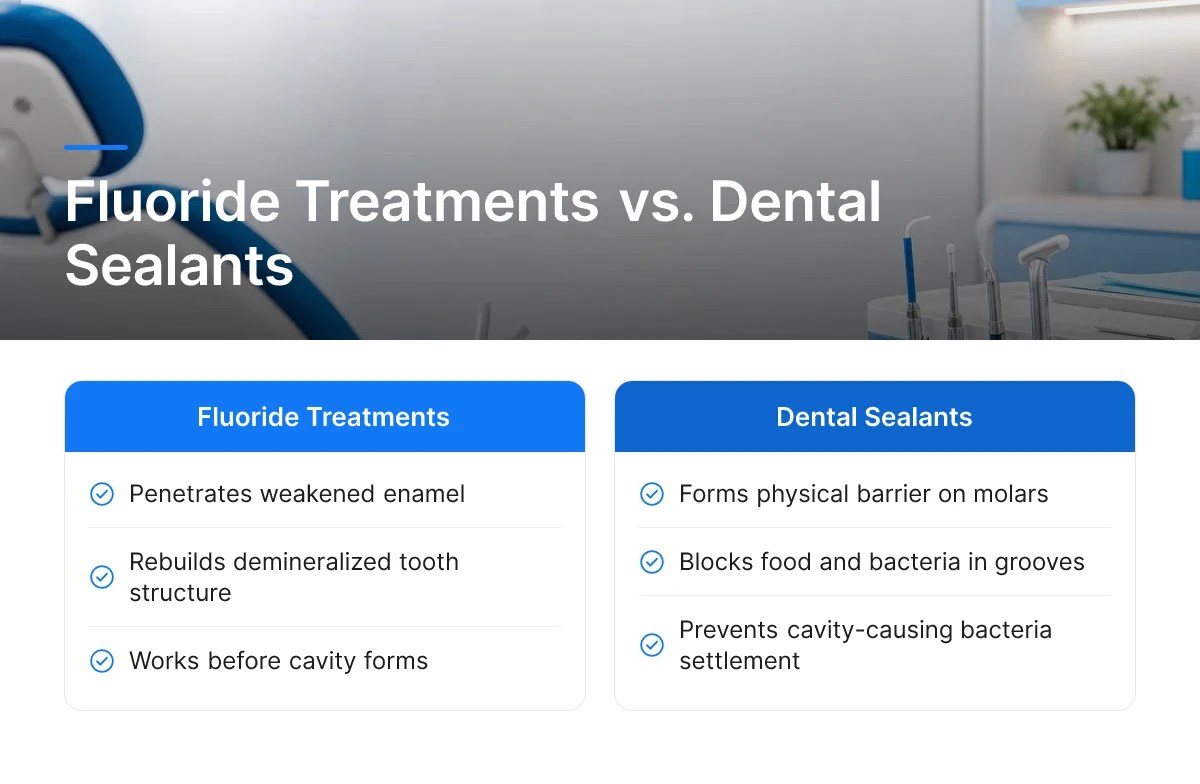
3. Fluoride Treatments and Dental Sealants
Fluoride rebuilds weakened enamel while sealants form a physical barrier over molar grooves where cavity-causing bacteria collect.
The two work through different mechanisms. Fluoride penetrates enamel that’s starting to demineralize and helps it re-harden before a cavity forms [1]. Sealants take a more direct approach, a thin resin coating flows into the deep grooves of back teeth and blocks food particles and bacteria from settling in, since those grooves are notoriously hard to clean with a brush alone [3].
Kids getting their first permanent molars are the classic candidates. But adults with a history of cavities, deep grooves, or chronic dry mouth benefit just as much, a point many practice websites skip entirely, framing sealants as pediatric-only when the same physics apply at any age. Cost-wise, this pairing is one of the cheapest interventions in general dentistry relative to what it prevents: a filling, or worse, a crown.
4. Fillings for Cavities and Tooth Decay
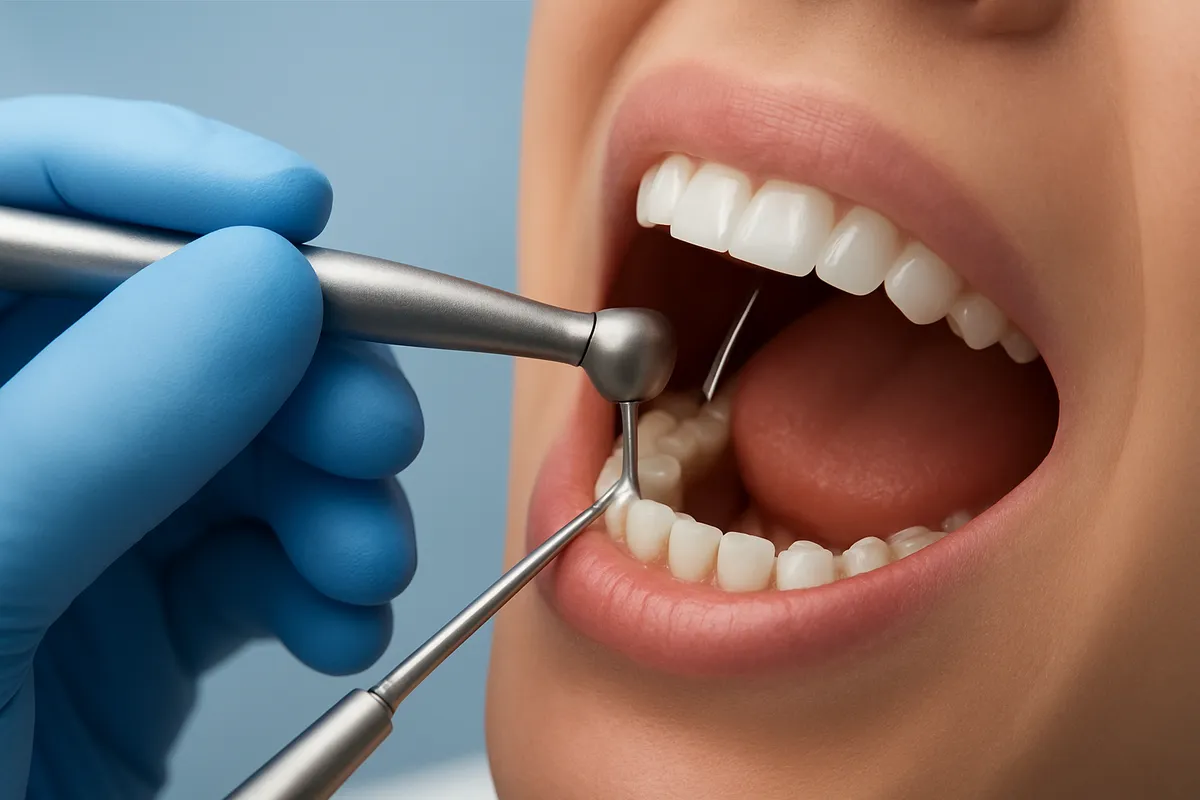
A filling removes decayed tooth tissue and seals the resulting space with composite resin, stopping decay before it reaches the nerve.
The procedure itself is straightforward: the dentist numbs the area, removes the compromised tissue with a drill, and packs the cavity with a filling material, most commonly tooth-colored composite that’s shaped and polished to match the surrounding tooth. Left untreated, that same small cavity doesn’t stay small, decay spreads inward toward the pulp, and what could have been a simple filling turns into a root canal or, in advanced cases, an extraction.
Fillings work best on cavities caught early, which is exactly why the exams and X-rays covered above matter, they’re what catches decay while a filling is still the fix. Many patients still picture the dark metal amalgam fillings from decades past; modern composite material blends with the tooth’s natural shade, which is why fillings today are far less noticeable than what older patients may remember from childhood visits.
5. Gum Disease Treatment and Periodontal Care
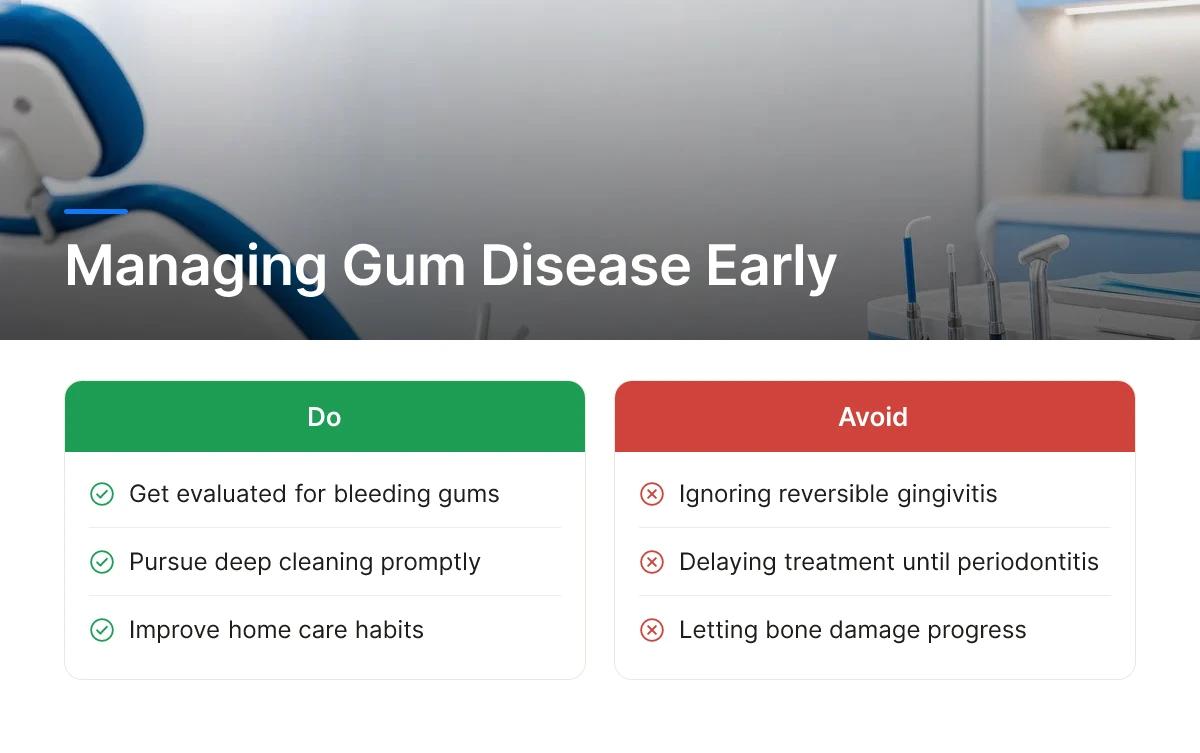
A general dentist treats early gum disease with deep cleanings that remove bacteria below the gumline before it progresses to bone-damaging periodontitis.
Gum disease moves in stages. Gingivitis, red, swollen, bleeding gums, is reversible with a deep cleaning (scaling and root planing) and better home care. Left alone, it advances to periodontitis, where the infection eats into the bone anchoring teeth in place, and that damage doesn’t reverse. Patients noticing bleeding when they brush, breath that won’t go away, or gums that look like they’re pulling back from the teeth should get evaluated before the disease progresses further.
How does oral health connect to my general health and wellness?
Gum inflammation doesn’t stay contained to the mouth. The same bacteria and inflammatory response linked to periodontal disease are associated with cardiovascular strain and harder-to-control blood sugar, which is one reason general dentistry treats gum health as a whole-body issue, not a cosmetic one.
A general dentist manages early-to-moderate cases directly through deep cleanings and monitoring. Advanced periodontitis, with significant bone loss or pockets too deep for standard tools, typically gets referred to a periodontist for surgical treatment, which is the line most patients don’t realize exists until their dentist draws it for them.
6. Tooth Extractions
A general dentist removes a tooth when decay, infection, crowding, or damage has progressed past the point where a filling or crown can save it.
Common reasons include a cracked tooth below the gumline, an abscess that antibiotics and a root canal can’t resolve, a baby tooth that won’t budge for the permanent one underneath, or crowding that needs to be cleared before braces or Invisalign. Most of these fall under a simple extraction, the tooth is visible and comes out with local anesthesia in a single visit. Impacted wisdom teeth or teeth broken at the bone line usually need a surgical extraction, which many general dentistry practices refer to an oral surgeon for safety reasons.
This service fits patients dealing with a painful tooth, a lingering infection risk, or a tooth blocking orthodontic progress. Where Villagio Family & Cosmetic Dental differs from practices that just pull the tooth and send you home: the team discusses replacement options, a bridge, a partial, or an implant referral, in the same visit, so patients in Katy and Fulshear aren’t left wondering what comes next.

7. Root Canal Therapy
Root canal therapy removes infected or inflamed pulp inside a tooth so the tooth can stay in place instead of being extracted.
The pulp is the soft tissue holding nerves and blood vessels at the tooth’s core. When decay or trauma reaches it, bacteria cause swelling and pressure inside a confined space, that’s the pain patients feel before treatment, not the treatment itself. Removing the infected tissue and sealing the canal relieves that pressure. The lingering myth that root canals are painful gets it backward: the infection is the source of the ache, and the procedure is what makes it stop.
Can my general dentist handle root canals or do I need a specialist?
Most straightforward cases, a single infected molar or front tooth with normal root anatomy, are handled in-house as part of routine general dentistry. Complex cases, like teeth with curved or unusually narrow canals, get referred to an endodontist who specializes in exactly that. This service is right for patients with deep decay or a trauma injury that’s reached the nerve, and asking upfront whether your case is one your general dentist treats directly or refers out is a fair question to raise before scheduling.

8. Crowns and Bridges for Damaged or Missing Teeth
Crowns rebuild a tooth weakened by large decay or a root canal, and bridges replace one or a few missing teeth without surgery.
A filling works when enough healthy tooth structure remains to support it. Once decay or a root canal has removed too much of that structure, the tooth becomes prone to cracking under normal chewing force, and a crown caps it to restore strength and shape. A bridge solves a different problem: it replaces a missing tooth by anchoring an artificial tooth to the crowns placed on the neighboring teeth, avoiding the surgical step an implant requires.
These options suit patients with cracked, heavily decayed, or root-canal-treated teeth, and anyone missing one to a few teeth who wants a non-surgical fix. A detail many practices skip: material choice matters. Ceramic crowns blend in better for front teeth, while metal-ceramic options tend to hold up longer under the heavier bite forces of back teeth, a tradeoff worth discussing before deciding, not after the lab work is done.
Together, these eight services represent the full scope of what general dentistry covers for most patients over a lifetime:
- Routine exams and professional cleanings
- Digital X-rays and diagnostic imaging
- Fluoride treatments and dental sealants
- Fillings for cavities and tooth decay
- Gum disease treatment and periodontal care
- Tooth extractions
- Root canal therapy
- Crowns and bridges for damaged or missing teeth
A general dentistry practice that offers all eight in-house gives patients one consistent team to manage nearly every stage of oral health, from prevention through restoration.
How to Choose the Right General Dentist for These Services
Compare how much of this list a dentist handles in-house, what diagnostic technology they use, how easy they are to reach, and how clearly they explain treatment.
A practice that handles extractions, root canals, crowns, and preventive care under one roof means fewer referrals, fewer new offices to vet, and one team tracking your history. Digital X-rays and intraoral cameras help catch problems like enamel erosion or a cracked tooth before they turn into bigger procedures [3]. Appointment availability matters too, a practice that can see you within a day or two for a painful tooth is worth more than one with a three-week wait. For a closer look at how a general dentist structures preventive visits around these services, see The Role of a General Dentist in Preventive Dental Care.
Insurance acceptance and payment flexibility are worth weighing qualitatively: a practice that accepts your plan and offers a clear range of payment arrangements reduces friction later, even without pinning down exact costs upfront. Ask directly which of the eight general dentistry services covered above, cleanings, exams, fillings, sealants, extractions, root canals, crowns, and bridges, the dentist performs in-house versus refers out. When comparing practices, consider asking:
- Which of these services are handled in-house versus referred to a specialist?
- What diagnostic technology, such as digital X-rays, does the practice use?
- How quickly can the practice see you for an urgent issue like a painful tooth?
- Does the practice accept your insurance and offer flexible payment arrangements?
- How clearly does the dentist explain findings and treatment options?
What can I expect during my first visit to a general dentist?
Expect a full exam, X-rays if needed, a review of your health history, and a straightforward conversation about any problem areas, this visit tells you a lot about communication style and pace before you commit to ongoing care.
When should I see a specialist instead of my general dentist?
Surgical extractions, complex root canals with unusual anatomy, and advanced gum disease typically call for a referral, a general dentist who tells you this upfront, rather than after the fact, is one worth keeping.
Frequently Asked Questions
Is there a difference between a dentist and a general dentist?
Not really, “dentist” and “general dentist” are used interchangeably to describe a dental provider trained in broad oral care rather than one specialty. A general dentist handles exams, cleanings, fillings, and referrals to specialists like orthodontists or oral surgeons when a case needs more focused treatment. Most family dentists, including pediatric-friendly practices, fall into this category.
What makes general dentistry different from specialty dentistry like orthodontics or periodontics?
General dentistry covers routine exams, cleanings, fillings, and preventive care, while specialties like orthodontics or periodontics focus on one area in depth, tooth alignment or gum disease treatment, respectively. A general dentist is usually the first point of contact, diagnosing issues and referring patients out when a condition, such as advanced gum disease or an impacted tooth, requires specialized equipment or additional years of training.
What is the recommended dental visit frequency for maintaining good oral health?
Most patients should see a general dentist twice a year for cleanings and exams [4]. Twice-yearly visits let the dentist catch cavities, gum disease, or early signs of oral cancer while they’re still inexpensive and easy to treat [4]. Patients with active gum disease or high cavity risk may need more frequent visits from their general dentistry provider.
What are the best practices for brushing, flossing, and daily dental hygiene?
Brush twice daily with fluoride toothpaste and floss once a day to remove plaque before it hardens into tartar [1]. Fluoride strengthens enamel and helps reverse early decay, while flossing reaches the spaces a toothbrush can’t [3]. Pair these habits with a diet low in sugary snacks and drinks, since sugar feeds the bacteria that cause cavities [3]. Combined with twice-yearly professional cleanings, this routine forms the foundation of preventive dental care [1].
How do dental insurance plans cover preventive versus restorative care?
Most dental plans cover preventive services like cleanings and exams at 100%, often with no deductible, while restorative work like fillings or crowns typically involves co-pays [1]. Insurers prioritize preventive care because it reduces costlier claims later [1]. Some plans also exclude preventive visits from the annual maximum, so checking benefit details before scheduling helps patients budget appropriately for general dentistry needs.

Conclusion
General dentistry works best as a routine, not a reaction, twice-yearly exams, daily brushing and flossing, and fluoride or sealant treatments catch problems while they’re still cheap and simple to fix [4]. Skipping visits or treating dental care as optional tends to turn a small cavity into a root canal, and a routine cleaning into a bigger bill. For families in Katy, Fulshear, Richmond, or Cinco Ranch juggling school schedules and multiple sets of teeth, the practical move is straightforward: book the next six-month checkup now, for every family member, before a minor issue becomes an urgent one, and let general dentistry do the preventive work it’s built for.
Sources & References
- What is Preventive Dental Care | Delta Dental
- What Is Preventive Dentistry? Types, Benefits and Practices | Gentle Dental
- Why You Should Prioritize Preventive Care – Kenosha Breeze Family Dental
Recommended Articles
Explore more from our content library: