Proudly Serving Katy, Richmond & Fulshear Cinco Ranch
(281) 395-2100
|
(281) 394-4001

Understanding why do my teeth ache is essential. Teeth often ache more at night because lying down increases blood flow to your head, raising pressure inside an already inflamed tooth, while the absence of daytime distractions makes pain more noticeable. Nighttime jaw clenching or teeth grinding can also add pressure to teeth and jaw joints during sleep. Common underlying causes include cavities, gum infection, a cracked tooth, or sinus pressure. Pain that is sharp, throbbing, or wakes you up repeatedly is a signal to see a dentist rather than wait it out.
Why Do My Teeth Ache at Night More Than During the Day?
Two physical changes happen the moment you lie down: blood flow to your head increases, and the distractions that normally mask pain disappear. Both push an already irritated tooth from a background annoyance into a throbbing problem.
When you’re upright, gravity keeps blood pressure in your head and jaw relatively low. Lying flat reverses that, sending more blood to the tissue around an inflamed tooth or nerve and raising pressure inside a space that has nowhere to expand [3]. If a cavity has already reached the pulp or an abscess is brewing, that added pressure is what turns a dull twinge into a pulse you can feel with every heartbeat.
The second factor is purely neurological. During the day, work, conversation, and movement compete for your brain’s attention, so mild pain signals get filtered out. At night, with the room quiet and the mind idle, those same signals move to the front of your attention, which is often the real answer to why do my teeth ache more once the lights go off, even when nothing about the tooth itself has changed [4].
Can jaw clenching, teeth grinding, or TMJ disorder cause nighttime tooth pain?
Yes, bruxism and TMJ disorder load your teeth and jaw joints with mechanical pressure for hours while you sleep, unnoticed until morning soreness or a lingering ache sets in. Clenching applies forces well beyond normal biting pressure, and because it’s involuntary during sleep, most people have no idea it’s happening until a dentist spots the wear patterns [1]. Over months, this pressure can crack enamel, loosen teeth, or inflame the jaw joint itself, producing pain that radiates into the teeth long after you wake up.
How do sinus infections, acidic foods, and gum recession lead to tooth aching?
Sinus infections, acidic foods, and receding gums each create tooth sensitivity through a different mechanical or nerve pathway, and all three tend to feel worse after lying down. The maxillary sinuses sit directly above the roots of your upper back teeth and share overlapping nerve branches, so pressure from congestion or infection is easily misread by the brain as tooth pain [1]. Acidic foods or drinks consumed earlier in the day gradually wear down enamel, and gum recession exposes the softer dentin layer underneath, both leave nerve endings more exposed and reactive once you’re lying still with nothing else competing for your attention.
How Do I Know If My Tooth Pain Signals a Serious Dental Problem?
Pain that lingers after hot or cold, that wakes you up, or that arrives with swelling or fever usually means something structural is wrong, not just a sensitive tooth. Sensitivity that fades in a few seconds is worth watching. Pain that persists for minutes, worsens over days, or comes with other symptoms is the kind of pattern that calls for an exam rather than more toothpaste.
What dental conditions like cavities, infections, or nerve damage cause tooth pain?
Most serious cases trace back to one of four mechanisms. A cavity that has eaten through enamel and into the dentin or pulp exposes the nerve to temperature, pressure, and bacteria, which is why deep decay hurts far more than a surface stain. An abscess is a bacterial infection that has taken hold at the root tip or between gum and tooth, building pressure that throbs and often radiates to the jaw or ear. Cracked tooth syndrome happens when a fracture line runs down into the tooth structure, chewing flexes the crack open and closed, firing the nerve each time, even though the tooth may look intact on the surface. Exposed nerve damage, from a worn filling, a receding gumline, or trauma, leaves the most sensitive part of the tooth with no buffer at all.
The hot-and-cold test is a useful clue. Sensitivity that resolves within a couple of seconds usually means the outer layers are irritated but the nerve is still healthy. Pain that lingers after the stimulus is removed, sometimes for a full minute or longer, signals the nerve itself is inflamed or dying, a condition called irreversible pulpitis [2]. That distinction is often what separates a filling from a root canal.
Swelling in the face or gum, a fever, or a persistent bad taste alongside tooth pain point to an infection that has spread beyond the tooth, which needs urgent treatment rather than a wait-and-see approach [2]. Left untreated, an abscess can spread to the jawbone or, in rare cases, become a medical emergency.
Could my tooth pain be caused by medication side effects or other health conditions?
Sometimes the tooth is not the source at all. Medications that cause dry mouth reduce the saliva that normally neutralizes acid and washes away bacteria, which raises decay risk over time, and some bone-density drugs affect how the jaw heals after dental work. Acid reflux can wear enamel from the inside, causing generalized sensitivity across several teeth rather than one. Sinus infections are a well-documented cause of upper tooth pain, since the sinus floor sits directly above the back molar roots [1].
This overlap is exactly why patients asking why do my teeth ache shouldn’t try to self-diagnose from symptoms alone. A dental exam with an X-ray is what actually confirms whether the cause is decay, infection, a crack, or something outside the mouth entirely [2].
What’s the Difference Between Sharp, Throbbing, and Dull Tooth Pain?
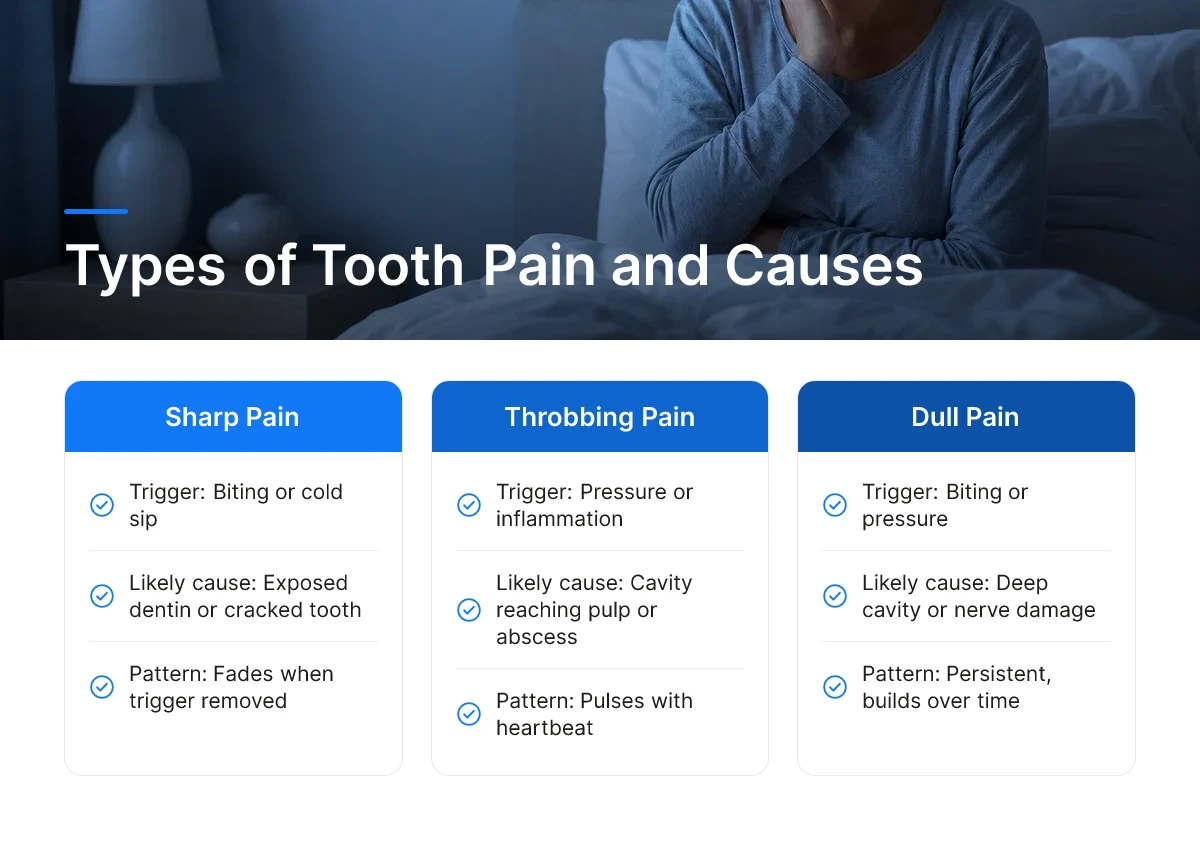
The character of your pain, sharp, throbbing, or dull, points to a different mechanism, and matching that sensation to a likely cause is the fastest way to figure out why do my teeth ache before you even sit in the dentist’s chair.
What does each type of tooth pain tell me about what might be wrong?
Sharp, sudden pain that hits when you bite down or sip something cold usually means exposed dentin, a cracked tooth, or a spot of sensitivity where enamel has worn thin [2]. This type is triggered by a specific action and tends to fade once the trigger is removed, which is a useful clue on its own.
Throbbing, pulsing pain is a different story. It typically signals inflammation or infection inside the tooth’s nerve, a condition dentists call pulpitis, or a developing abscess, and it often gets worse when you lie down because blood flow to the head increases and adds pressure inside an already inflamed tooth [3][4]. Pain that pulses with your heartbeat, keeps you up at night, or comes with facial swelling deserves a same-week dental visit, not a wait-and-see approach.
Dull, constant aches are more often referred pain from somewhere other than the tooth itself. Sinus pressure sitting above the upper molars, nighttime jaw clenching or grinding, and early gum disease can all produce a low-grade ache that feels like it’s coming from a tooth when it isn’t [1]. This is why a dentist will often ask about allergies, stress levels, and morning jaw soreness before assuming the tooth is the problem.
How can I describe my symptoms accurately to my dentist?
Run through three questions before you call: what triggers the pain, how long each episode lasts, and whether it’s localized to one tooth or spread across a general area. A trigger-based pain that vanishes in seconds points toward sensitivity or a crack. A pain that lingers for minutes after the trigger is gone often means the nerve is involved.
When you describe it, give specifics: “sharp pain for 10 seconds after cold water, lower left molar” tells a dentist far more than “my tooth hurts.” Note when it started, whether it’s constant or comes in waves, and if anything, ibuprofen, an ice pack, sleeping upright, changes it [5]. That level of detail narrows the diagnosis before any exam tools come out, which shortens the appointment and the guesswork on both sides.
When Should I See a Dentist About Tooth Pain Versus Treating It at Home?
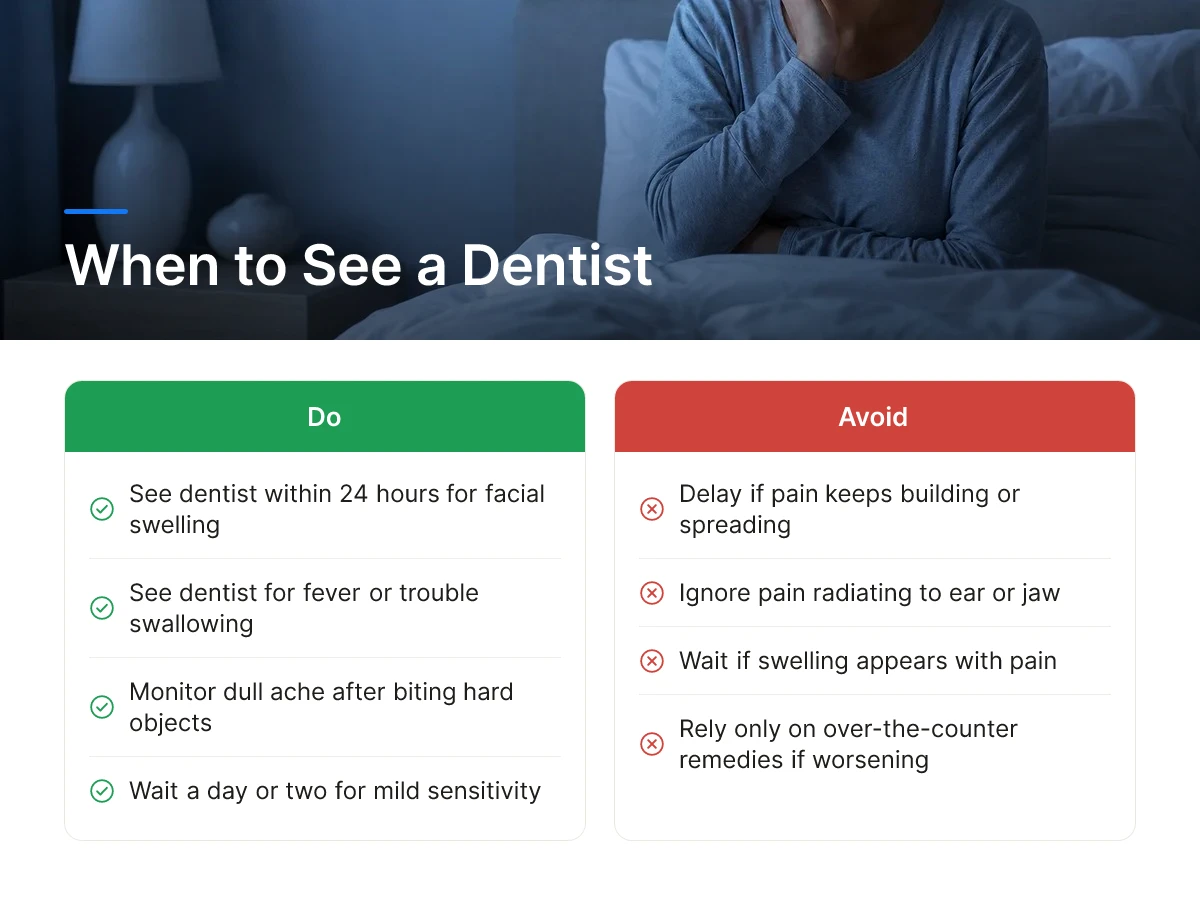
See a dentist within 24 hours for facial swelling, fever, or trouble swallowing; mild, short-lived sensitivity can usually wait a day or two for home care to work.
The gap between “watch and wait” and “go now” comes down to whether the pain is stable or spreading. A dull ache after biting down on something hard, or sensitivity that fades after a day of avoiding cold drinks, is usually safe to monitor. Pain that keeps building, radiates to the ear or jaw, or shows up with swelling is a different situation entirely, and it’s often the honest answer to why do my teeth ache when over-the-counter remedies stop helping.
What are the signs that my tooth pain needs emergency dental care?
Facial swelling, fever, difficulty swallowing or breathing, or pain that spikes suddenly after a fall or blow to the face all count as emergencies, not toothaches to sleep on. These signs point to infection that has moved past the tooth and into surrounding tissue, or to a fracture that has exposed the nerve. Cleveland Clinic notes that while minor gum irritation can cause a toothache, serious pain of this kind needs professional treatment rather than home remedies [2].
The distinction between manageable pain and a spreading infection matters most here. Pain that home care, ibuprofen, a cold compress, saltwater rinses, brings under control for a day or two is one thing. Pain that keeps a person up at night, gets worse despite medication, or comes with a bad taste, a bump on the gum, or swelling in the cheek or jaw suggests an abscess that will not resolve on its own [2]. That kind of infection can spread to the jawbone, neck, or bloodstream if it goes untreated, which is why swelling and fever move a toothache into same-day territory.
Are there age-specific reasons children or elderly patients experience tooth pain differently?
Yes, kids’ tooth pain often traces to cavities in baby teeth or new teeth breaking through, while older adults more often deal with worn fillings, receding gums, or dry mouth from medication.
Parents sometimes brush off a child’s complaint as “just baby teeth,” but cavities in primary teeth can hurt as much as decay in permanent ones, and untreated infection can affect the permanent tooth forming underneath. Eruption discomfort from new molars is common too, but it shouldn’t be assumed without a look inside the mouth, a quick exam rules out decay that needs filling before it spreads.
Older adults tend to have a different mix of causes. Gum recession exposes root surfaces that are far more sensitive to hot and cold, older fillings crack or pull away from the tooth after years of chewing pressure, and medications for blood pressure, allergies, or depression often reduce saliva flow, which lets bacteria build up faster. None of these are less serious than a cavity, they just point to a different fix.
The rule of thumb holds across every age group: pain lasting more than a couple of days, or pain that worsens despite home care, is a signal to book a visit rather than wait it out.
What Can I Do Right Now to Relieve Tooth Pain?
Over-the-counter pain relievers, cold compresses, saltwater rinses, and head elevation can quiet tooth pain enough to get through the night, but none of them fix what’s causing it.
What home remedies and over-the-counter treatments actually work for tooth aching?
Ibuprofen and acetaminophen reduce the inflammation and nerve signaling that make a tooth throb, which is why they tend to outperform topical products for anything beyond surface discomfort [5]. A cold compress against the cheek works the same way a bag of frozen peas works on a sprained ankle, it constricts blood vessels near the site and numbs the area, cutting swelling and dulling pain signals [5]. A warm saltwater rinse, roughly a teaspoon of salt in a glass of warm water, helps by drawing out fluid from swollen gum tissue and flushing debris out of a socket or gum pocket, which is part of why dentists still recommend it as a first step before medication [2].
Numbing gels with benzocaine and clove oil, which contains eugenol, can dull the nerve endings at the surface long enough to fall asleep [5]. Neither one touches decay sitting in the dentin or an infection brewing at the root. Treating the symptom this way can mask a problem that keeps getting worse underneath, which is exactly how a manageable cavity turns into a root canal.
Elevating your head with an extra pillow reduces the blood pooling that builds pressure against an already inflamed or infected tooth when you lie flat, which is a large part of why do my teeth ache more once you’re in bed than they did all day at your desk [3][4]. It’s a positioning trick, not a treatment, the underlying pressure source is still there when you sit back up.
How can I prevent tooth pain from recurring?
A properly fitted night guard stops the clenching and grinding that wear down enamel and strain the jaw joint, one of the more common and overlooked reasons people wake up with aching teeth [1]. If sinus pressure is the culprit, treating the congestion, not the teeth, usually resolves the ache, since upper molar roots sit close to the sinus floor [1]. Routine checkups catch small cracks, early decay, and gum recession before they turn into the kind of pain that no compress or rinse can touch.
None of these steps replace a diagnosis. Home remedies buy you a comfortable night or two, they don’t tell you whether the ache is a loose filling, an abscess, or something a dentist needs to x-ray. If the pain keeps returning, it’s worth getting evaluated at a family dental practice like Villagio Family & Cosmetic Dental before a temporary fix turns into an emergency visit.
Frequently Asked Questions
Can dental anxiety make tooth pain feel worse or cause jaw tension?
Yes, stress and anxiety often lead to jaw clenching and grinding, which strain teeth and mimic or amplify toothache pain [1]. Many people clench during the day without noticing, especially when anxious or focused, and the resulting pressure can loosen teeth or wear down enamel over time. If stress-related clenching seems to be the trigger, a nightguard and stress management can help.
Why does my tooth hurt more when I lie down but not when I’m sitting up?
Lying down increases blood flow to your head, which raises pressure inside an already inflamed or infected tooth [3]. Sitting upright reduces that pressure buildup, so pain feels milder during the day. This pattern often points to an underlying infection or deep cavity that needs a dentist’s evaluation, not just a change in sleep position.
Can a toothache go away on its own without treatment?
A mild toothache from minor gum irritation can fade on its own, but pain from decay or infection almost always needs treatment [2]. Temporary relief doesn’t mean the underlying problem resolved, bacteria can keep spreading beneath the surface. If pain lasts more than a day or two, or returns after fading, schedule an exam rather than waiting it out.
Is it normal for tooth pain to come and go over several weeks?
Intermittent pain over weeks is common with early decay, a cracked tooth, or a slow-developing infection, and it’s not something to ignore. Pain that flares with hot, cold, or pressure and then subsides often signals a problem that’s progressing quietly. Waiting for constant pain to develop usually means more extensive treatment by the time you’re seen.

Conclusion
Tooth pain that worsens at night usually traces back to a specific, findable cause, increased blood flow while lying down, nighttime grinding, sinus pressure, or a cavity that’s finally deep enough to reach a nerve [3][4]. The pattern of your pain matters: constant throbbing, sensitivity that lingers after hot or cold, or pain that returns over several weeks all point toward decay or infection rather than something you can wait out [2]. Don’t rely on over-the-counter pain relief as a long-term plan. If your tooth has ached for more than two days or the pain is disrupting your sleep, call Villagio Family & Cosmetic Dental this week and get the cause identified before it becomes a bigger repair.
Sources & References
- Why Do My Teeth Hurt?, 15 Possible Causes of Your Tooth Pain – University General Dentists
- Toothache: Symptoms, Causes & Remedies
- My Tooth Hurts at Night But Not During the Day: Causes and Solutions | All Care Dental
- Why Toothaches Get Worse at Night: Causes and Solutions
- Toothaches at Night: Treatment, Home Remedies, and Causes
Recommended Articles
Explore more from our content library: