Proudly Serving Katy, Richmond & Fulshear Cinco Ranch
(281) 395-2100
|
(281) 394-4001

Understanding best teeth whitening products is essential. Dentists most often recommend professional in-office or dentist-dispensed take-home whitening kits using hydrogen peroxide or carbamide peroxide, paired with a custom tray for even coverage, over generic drugstore strips. That’s because professional products use higher, dentist-monitored concentrations that work faster and more evenly while limiting gum irritation. For milder cases or maintenance between visits, dentists commonly point patients toward peroxide-based whitening strips or toothpaste with PAP (phthalimidoperoxycaproic acid) as a gentler alternative for sensitive teeth. The right pick depends on your stain type, sensitivity level, and how quickly you want results.
1. Dentist-Dispensed Take-Home Whitening Trays
Custom-fitted trays from a dental office rank among the best teeth whitening products because the tray itself, not just the gel, determines how safely whitening happens. A general dentist takes an impression of the patient’s teeth and molds a tray that matches the exact contours of each tooth.
That fit matters more than most patients assume. A custom tray holds gel evenly against enamel surfaces and keeps it off the gumline, while one-size-fits-all strips or boil-and-bite trays often let gel pool or seep onto soft tissue, causing irritation. This is particularly relevant for best teeth whitening products.
Dentist-dispensed trays typically use carbamide peroxide at concentrations only available through a dental office, applied over consecutive nights until the patient reaches their target shade [1]. Carbamide peroxide breaks down partly into hydrogen peroxide, releasing more slowly than direct hydrogen peroxide formulas, which is part of why supervised nightly wear is standard practice [1].
This option suits patients who want professional-level results without scheduling repeated in-office visits. The differentiator most competitors miss: it’s the custom fit, not the gel strength, that does the most to reduce gum irritation risk. A high-concentration gel in a poorly fitted tray causes more soft-tissue exposure than a moderate concentration in a well-molded one.
2. In-Office Professional Whitening Treatment
In-office whitening delivers the most visible shade change in a single appointment because it uses a higher concentration of hydrogen peroxide under direct professional supervision.
Hydrogen peroxide breaks down faster and more aggressively than the carbamide peroxide used in take-home trays, which is why it can produce noticeable results within one visit rather than over multiple weeks [1]. That speed requires monitoring, which is exactly what a dental office setting provides.
This makes chairside whitening the right call for patients preparing for a wedding, a reunion, or another event where a family dentist near Katy or Cinco Ranch needs to deliver results in a single sitting rather than a multi-week routine. It’s also a fit for anyone who simply wants maximum results with minimal time invested.
Before any gel touches enamel, the dentist checks for existing fillings, crowns, decay, or gum disease. Restorations don’t whiten the same way natural enamel does, and untreated decay or gum issues can turn a routine treatment into a painful one, catching these issues first is what keeps results even across all visible teeth.
The differentiator here is protection, not just power. Dentists apply a barrier gel or a rubber dam to shield gums and soft tissue from the peroxide, a safeguard no over-the-counter strip or pen can replicate at home.
3. Hydrogen Peroxide Whitening Strips
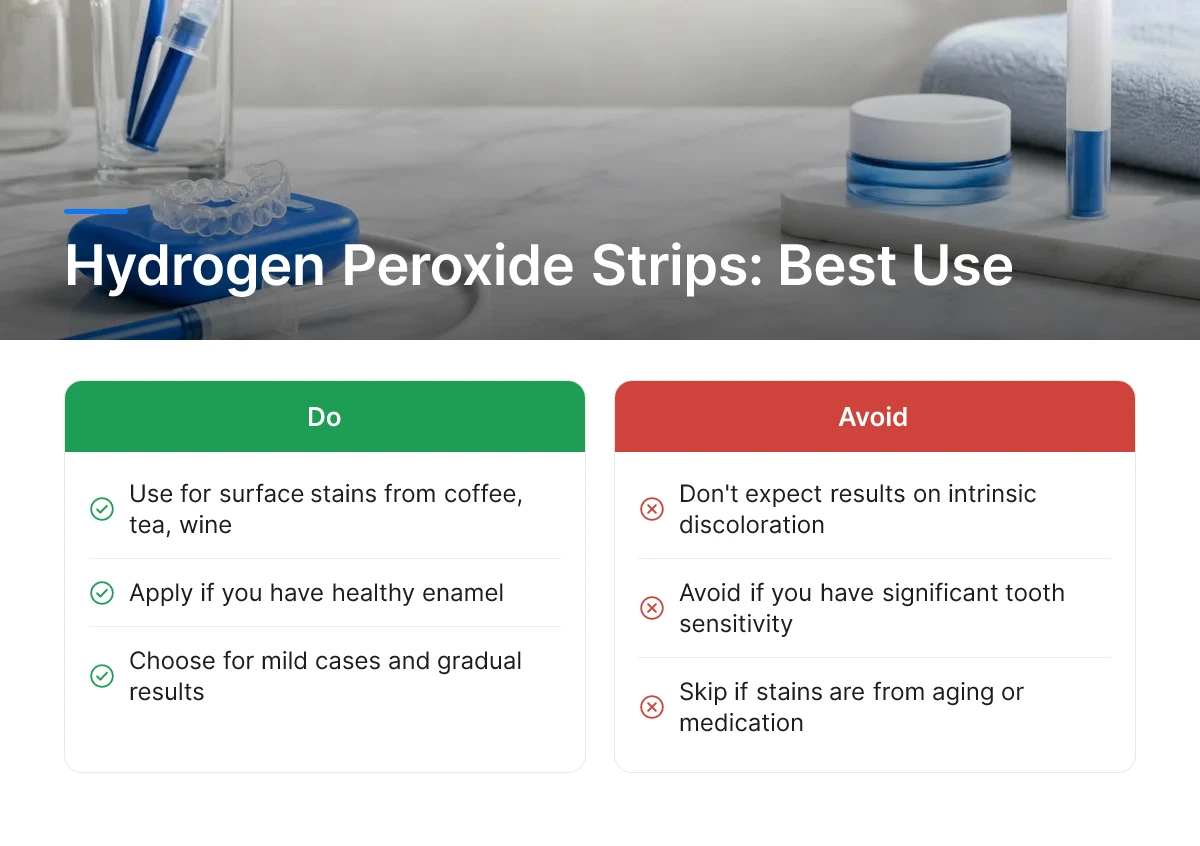
Hydrogen peroxide strips work best on surface-level stains from coffee, tea, wine, and other extrinsic sources, making them a budget-friendly entry point among the best teeth whitening products for mild cases.
The peroxide sits against enamel in a thin film, breaking down staining compounds on the tooth surface rather than altering the deeper structure of the tooth [1]. That makes strips effective for extrinsic staining but limited for intrinsic discoloration caused by aging, medication, or trauma.
They suit patients with healthy enamel, no significant sensitivity, and a preference for a gradual, low-commitment routine over a single dramatic change. Results depend far more on consistent daily use over several weeks than on any single application, skipping days or stopping early is the most common reason strips underperform. When considering best teeth whitening products, this point stands out.
Dentists tend to favor specific strip formulations built with enamel-safe adhesive that resists slipping during wear, keeping the peroxide layer in contact with the tooth surface instead of sliding onto the gums. Generic strips without that adhesive engineering are more prone to uneven coverage and gum contact.
4. PAP-Based Whitening Products for Sensitive Teeth
PAP, or phthalimidoperoxycaproic acid, whitens teeth by targeting stain molecules directly instead of penetrating deep into enamel, which is why dentists increasingly recommend it for sensitivity-prone patients.
Traditional peroxide bleaching works partly by diffusing into the tooth structure, which is effective but can irritate the nerve inside teeth that already have thin enamel or exposed dentin [1]. PAP molecules are larger and act more on the tooth surface, reducing the pathway for that sensitivity trigger.
This makes PAP-based gels, pens, and strips a strong option for patients who have already tried peroxide products and experienced the sharp “zinger” sensation during or after treatment [4]. It’s worth setting expectations early: PAP-based results are typically more gradual than peroxide-based options, so patients trade some speed for comfort.
What features should you look for in whitening products if you have tooth sensitivity?
Look for PAP as the active ingredient rather than peroxide, a lower or no-peroxide formula, and products marketed specifically for sensitive teeth rather than maximum strength. A desensitizing agent like potassium nitrate included in the same formula is a good sign.
PAP remains a newer category, and it’s one that most over-the-counter review roundups skip entirely in favor of familiar peroxide brands. That’s a gap worth noting: dentists fielding questions from sensitive patients are asking about PAP more often than mainstream buying guides currently cover it.
5. Whitening Toothpaste with Desensitizing Agents
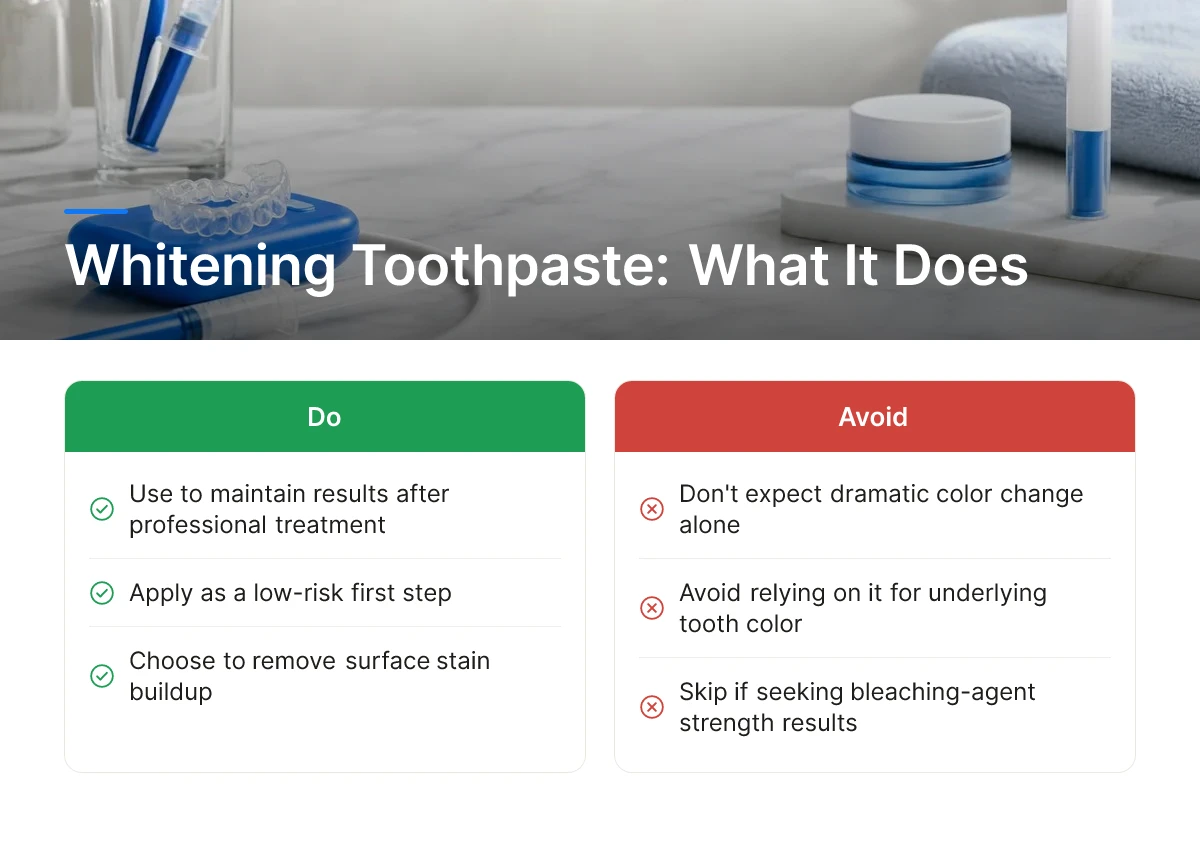
Whitening toothpaste removes surface stains through mild abrasives and polishing agents, but it does not change the underlying color of the tooth the way peroxide-based treatments do.
That distinction matters when patients expect toothpaste alone to deliver dramatic whitening. It works on the outermost layer of stain buildup, similar in mechanism to how whitening strips target extrinsic staining, but without a bleaching agent strong enough to lift color from within the tooth [2].
This makes it best suited for two groups: patients maintaining results after a professional treatment, and patients taking a first, low-risk step before committing to trays or strips. Many formulas also include potassium nitrate or a similar compound that works by blocking the transmission of pain signals along the tooth’s nerve pathways, which helps offset sensitivity from other whitening steps in a patient’s routine [3]. For those exploring best teeth whitening products, this matters.
Dentists at a family and cosmetic dental practice typically recommend whitening toothpaste as a maintenance layer used alongside trays or strips, not as a replacement for them. Used this way, it extends the life of results from a stronger treatment rather than trying to produce those results on its own.
6. Low-Concentration Carbamide Peroxide Gel for Gradual Whitening
Carbamide peroxide gel breaks down slowly into hydrogen peroxide once it contacts saliva, which makes it the gentlest active-ingredient option for patients who want to test their tolerance before committing to anything stronger.
Research on tooth whitening chemistry confirms that carbamide peroxide releases roughly a third of its concentration as hydrogen peroxide, with the breakdown continuing over several hours rather than all at once [1]. That extended-release action is why low-concentration carbamide gels (worn overnight or for a few hours at a time) suit first-time whitening users or anyone with a history of mild sensitivity. They want to see how their teeth respond before trying a higher-strength product.
What’s the difference between hydrogen peroxide and carbamide peroxide for whitening?
Hydrogen peroxide acts fast and whitens in fewer sessions, but it delivers its full concentration to the tooth surface immediately, which can spike sensitivity for some patients. Carbamide peroxide takes longer to show results but tends to be tolerated better across consecutive nights of use because the release is gradual rather than concentrated.
At Villagio Family & Cosmetic Dental, we often recommend low-concentration carbamide peroxide as a step-up path for patients who weren’t good candidates for in-office treatment at their first visit, someone with borderline sensitivity or untreated enamel wear, for example. Once they’ve built tolerance over a few weeks, some move on to stronger options; others find the gradual result is enough.
7. Touch-Up Whitening Pens for Maintenance
Whitening pens apply a thin layer of peroxide gel directly onto teeth with a brush tip, designed for spot maintenance rather than a full whitening cycle.
The mechanism is simple: twist the pen, brush the gel onto visible surfaces, and let it sit without rinsing for a short window. That makes pens best suited for patients who already whitened using trays or in-office treatment and now want to catch early re-staining, a coffee habit creeping back in, for example, before it sets into the enamel. Good Housekeeping’s product testing notes pens among the at-home format options tested alongside strips, gels, and powders [3], but the format’s real value shows up in how it’s used, not just what’s in the tube.
Pens are compact enough to toss in a bag or glovebox, which makes them a practical on-the-go touch-up rather than a primary whitening method. Most competitor roundups list pens next to strips and trays as if they’re interchangeable options among the best teeth whitening products on the shelf. We frame them differently for patients: a pen maintains a result you already achieved, it does not create one. Treating a pen as a stand-alone treatment usually leads to disappointment, since the gel layer and contact time are too thin to shift a baseline shade on their own.
How to Choose the Best Teeth Whitening Product for Your Needs
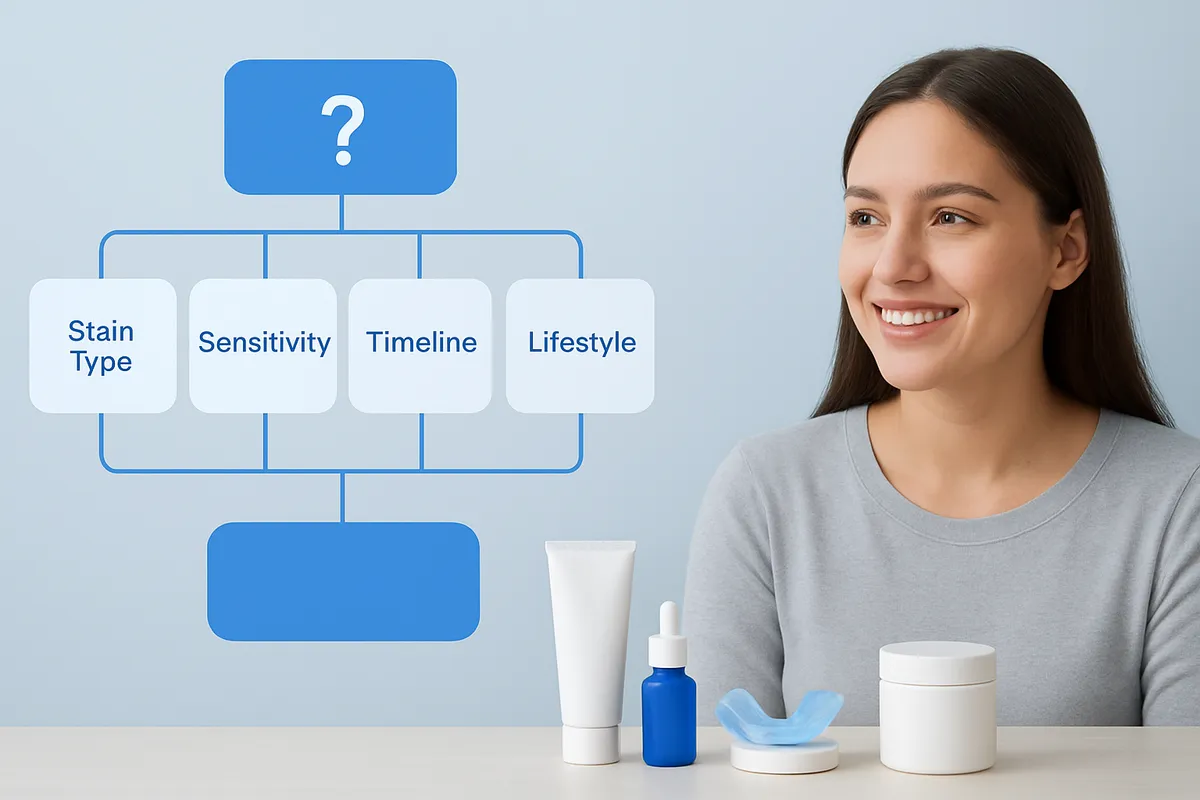
Match the product to your stain type, sensitivity level, and daily habits, no single option on this list works equally well for every mouth.
Start with the stain itself. Surface stains from coffee, tea, red wine, or tobacco (extrinsic stains) respond well to most OTC whitening products, while discoloration from inside the tooth, old trauma, tetracycline exposure, or aging dentin, often needs professional treatment and may not fully respond to any over-the-counter option [2]. If whitening strips or gels haven’t moved the needle after a few weeks, the stain is likely intrinsic, and that’s a signal to talk to a dentist rather than switch brands. This directly impacts best teeth whitening products outcomes.
What demographic factors should guide your choice of whitening product?
Enamel thickness and sensitivity history matter more than age. Thinner enamel or a history of sensitive teeth points toward PAP-based or low-concentration carbamide peroxide products over high-strength hydrogen peroxide, since the latter can trigger the sharp, temporary zing that leads many people to quit whitening altogether [4]. Lifestyle matters too: daily coffee drinkers and tobacco users need a shorter maintenance cycle, think touch-up pens or repeat strip rounds every few months, than someone who stains rarely.
A dental exam before starting any whitening product is worth the appointment. It catches contraindications like untreated cavities, cracked teeth, or gum disease that whitening gel can aggravate, something no OTC box warns about clearly enough.
Can yellow teeth be whitened, or are some cases permanent?
Most yellow discoloration from surface staining lightens with consistent OTC use, but expect gradual change over two to four weeks rather than an overnight transformation [2]. Professional treatments such as Zoom or Opalescence Pro use stronger concentrations under supervision and produce faster, more dramatic shifts [2], worth considering if OTC products plateau or your timeline is tight, like a wedding or reunion.
Frequently Asked Questions
Why might a dentist recommend professional whitening over OTC products?
Dentists control the peroxide concentration, isolate the gums, and check your enamel and existing dental work first, which lowers the risk of sensitivity or uneven results. In-office treatments like Zoom or Opalescence Pro use stronger whitening agents than anything sold over the counter, applied under supervision for faster, more predictable outcomes [2]. For patients with crowns, veneers, or old fillings up front, that oversight matters, whitening doesn’t touch restorations, so a dentist can flag mismatched color before you commit.
How long do teeth whitening results typically last?
Most patients see whitening results hold for several months to about a year, depending on diet and habits. Coffee, tea, red wine, and tobacco speed up re-staining, while twice-yearly cleanings and occasional touch-up treatments help maintain the shade longer [5]. Patients who skip touch-ups and drink staining beverages daily typically notice fading sooner, sometimes within a few months.
What side effects should you watch for when using teeth whitening products?
Tooth sensitivity and temporary gum irritation are the most common side effects reported with whitening products. Research on bleaching agents shows sensitivity is usually short-lived and tied to peroxide concentration and contact time with the tooth surface [1]. Reviewers of at-home strips and gels describe a sharp “zinger” sensation on cold air or liquids after treatment, prompting some users to stop using a product before finishing the course [4]. If sensitivity is severe or doesn’t fade within a day or two, stop and check with your dentist.
Are there dental conditions that make whitening products unsafe or inadvisable?
Yes, untreated cavities, exposed roots, gum disease, and cracked teeth can make whitening painful or risky until they’re treated first. Whitening also won’t work evenly on crowns, veneers, or bonding, which don’t respond to bleaching agents the way natural enamel does [2]. Pregnant patients and children under a dentist-recommended age are typically advised to wait. A dental exam before starting any product, professional or OTC, catches these issues before they turn into bigger problems.
Is professional whitening worth the extra cost compared to at-home products?
For patients wanting fast, even, dependable results, professional whitening is generally worth the added cost. In-office treatments deliver the fastest and most noticeable shade change because they use stronger agents under supervision, reducing guesswork and uneven patching common with OTC kits [2]. At-home products remain a reasonable choice for mild maintenance between professional visits or for tighter budgets.

Conclusion
Whitening works best as a decision made with your dentist, not off a store shelf. Get a shade baseline and an oral health check first, match the product strength to your sensitivity level and goals, and plan for touch-ups since results fade with coffee, tea, and time [5]. Skipping the exam step is where most at-home whitening disappointments start, sensitivity, uneven color, or wasted product on teeth that had a cavity or restoration issue the whole time.
If you’re in Katy, Fulshear, Richmond, or Cinco Ranch and want a straight answer on which product fits your teeth, book a whitening consult with Villagio Family & Cosmetic Dental before you buy anything.
Sources & References
- Tooth Whitening: What We Now Know – PMC
- Best Teeth Whitening Products 2026: A Guide | Great Lakes
- 12 Best Teeth Whitening Products of 2026, Tested by Experts
- We Tested the 7 Best-Selling Teeth Whitening Products of 2026
- Best Teeth-Whitening Products | The Strategist
Recommended Articles
Explore more from our content library: