Proudly Serving Katy, Richmond & Fulshear Cinco Ranch
(281) 395-2100
|
(281) 394-4001

The main factors that separate professional teeth whitening services are the whitening method (in-office light-activated treatment vs. custom take-home trays), the strength and delivery of the whitening agent, how long results are expected to last, and whether the provider screens for sensitivity or enamel risk beforehand. In-office treatments give faster, supervised results in a single visit, while take-home kits work gradually under similar professional guidance. Comparing these factors, not just the price tag, tells you which option fits your timeline, sensitivity level, and desired outcome.
Compare Your Teeth Whitening Service Options Before You Decide
Professional teeth whitening services fall into two categories: in-office treatments completed in a single visit, and dentist-supervised take-home trays used over one to two weeks. Both rely on a peroxide-based whitening agent, but the concentration, activation method, and supervision level differ enough to change your results, timeline, and sensitivity risk.
How In-Office Whitening Compares to Take-Home Professional Kits
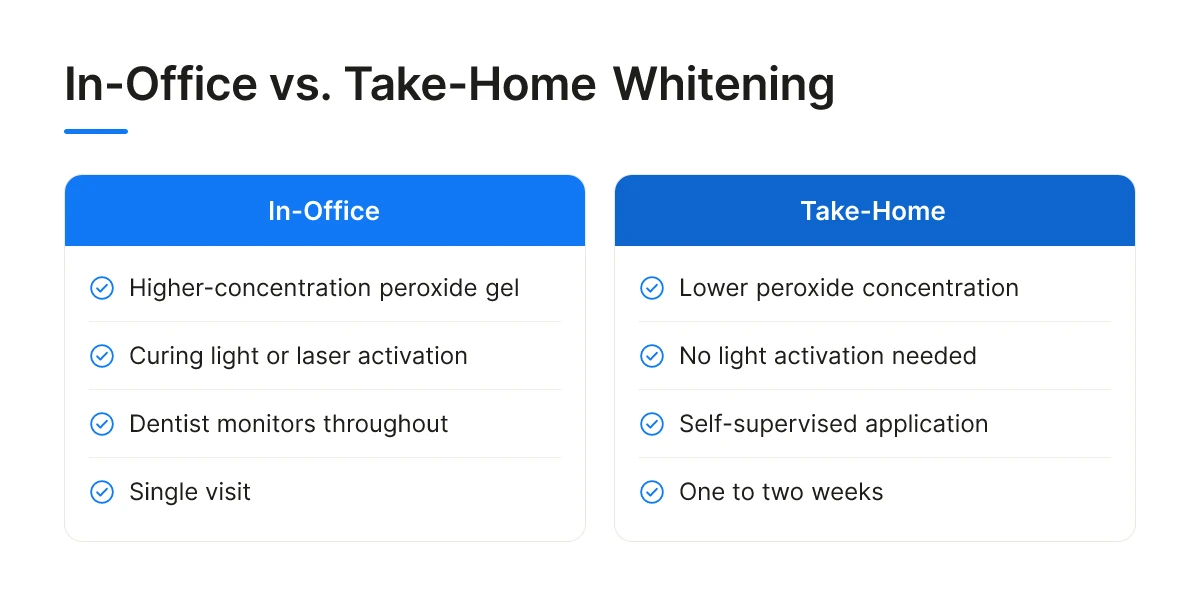
In-office whitening uses a higher-concentration peroxide gel, often paired with a curing light or laser to speed the chemical reaction, and a dentist monitors your gums and enamel throughout the appointment. Take-home trays use a lower-concentration gel worn for shorter daily sessions over one to two weeks, with a dentist checking in periodically rather than supervising in real time [1]. This is particularly relevant for teeth whitening services.
- Treatment time: in-office sessions typically finish in one visit; take-home regimens take days to weeks for comparable results.
- Sensitivity risk: higher-concentration, light-activated gels can trigger more short-term tooth sensitivity than gradual tray-based application [1].
- Supervision level: in-office treatment puts a dental professional in the room for the entire process; take-home kits rely on your adherence between check-ins.
- Expected longevity: results from either method fade based on diet and habits like coffee, tea, and tobacco use, not just the initial treatment strength [3].
What Differentiates Professional Whitening Systems and Brands
Whitening systems differ mainly in peroxide concentration and how the tray is made, and a custom-fitted tray outperforms a generic one on both comfort and results. A tray molded to your exact tooth shape holds gel evenly against enamel, reducing gum contact and uneven whitening that generic boil-and-bite kits can cause [3]. At Villagio Family & Cosmetic Dental, custom-tray fittings are taken in-office specifically to address this consistency problem before any gel touches your teeth.
Higher concentration isn’t automatically the better choice. A stronger agent can clear years of coffee or tobacco staining faster, but it also raises the likelihood of temporary sensitivity, particularly for patients with thin enamel or existing gum recession [1]. Evidence on bleaching agents shows that outcomes depend as much on application time and technique as on raw concentration [1], which is why a dentist’s screening for enamel condition and existing restorations, not just a strength number on a label, should guide which system fits your case [2].
Weigh these factors together before booking: a faster in-office result isn’t worth much if sensitivity keeps you from eating comfortably for a week afterward. When considering teeth whitening services, this point stands out.
Verify What Happens During a Professional Whitening Appointment
A legitimate whitening visit follows a fixed sequence: exam, shade check, gel application in timed cycles, and a final comparison against your starting shade. If a provider skips the exam or shade documentation, that is a warning sign worth asking about before you commit to teeth whitening services.
Step-by-Step Process for In-Office Professional Whitening
Every session should start with an assessment, not a chair reclining and a mouthguard going in.
- Gum and enamel check. The dentist examines gum tissue for recession or irritation and confirms enamel is healthy enough for peroxide exposure, a candidate profile that matters more than most patients realize, since bleaching agents penetrate enamel to reach discolored dentin underneath [1].
- Shade measurement. The team records your baseline shade using a guide, giving both of you a documented reference point to measure results against at the end.
- Restoration identification. Crowns, veneers, and fillings don’t respond to bleaching agents the same way natural enamel does, so the dentist flags these now to set realistic expectations about uneven results [3].
- Gum protection. A barrier gel or rubber dam shields soft tissue before any whitening agent touches the teeth.
- Gel application and activation. The dentist applies a peroxide-based gel, typically hydrogen peroxide at concentrations far higher than what’s legally sold over the counter, for a fixed activation period, often with a curing light [1].
- Shade re-check between cycles. After each cycle, the team wipes the gel, checks the shade, and decides whether another round is needed or whether you’ve hit the target result.
How Professional At-Home Whitening Differs from Over-the-Counter Products
Supervised take-home whitening starts with a tray-fitting appointment, not a box off a shelf. The dentist takes impressions to create trays molded to your teeth, which controls exactly how much gel touches enamel and how much reaches your gums. You leave with a dosed, dentist-formulated gel and a specific wear schedule, then return for a check-in so the provider can track progress and adjust concentration or duration if sensitivity develops.
Unsupervised over-the-counter kits skip all three controls. Generic strips and trays don’t fit your arch precisely, which lets gel migrate onto gum tissue [2]. Concentrations are capped lower for safety since no professional is monitoring use, and there’s no one checking your shade or your soft tissue partway through [3]. That combination, fit, concentration control, and monitoring, is what separates professional teeth whitening services from a drugstore purchase, not marketing on the box.
Estimate How Long Your Whitening Results Will Last
Whitening results last anywhere from several months to a few years, depending on your staining habits, saliva chemistry, and enamel condition, not a fixed number anyone can promise you. For those exploring teeth whitening services, this matters.
Realistic Timeline: How Long Do Results Last
There’s no universal expiration date on a whiter smile. Coffee, tea, red wine, and tobacco are the biggest culprits behind fading results, since these habits reintroduce the same surface stains that whitening removed in the first place [5]. Saliva composition and enamel thickness also play a role, some people’s enamel simply resists new staining better than others, which is why two patients using identical treatments can see different results at the one-year mark.
If you drink coffee daily or smoke, expect to need touch-ups on a shorter cycle. If you’re careful about staining foods and keep up with routine cleanings, results tend to hold longer before a refresh is needed. When we walk patients at Villagio Family & Cosmetic Dental through what to expect, we frame it as a range tied to their specific habits, not a one-size-fits-all number, because that’s what actually determines how long a brighter smile sticks around.
Maintenance Steps That Keep Whitening Results Looking Fresh
Maintenance is what separates a whitening treatment that lasts from one that fades within weeks. A few habits make the biggest difference:
- Use touch-up trays periodically rather than waiting until staining is obvious, small, regular applications maintain shade better than a full redo.
- Treat whitening toothpaste as upkeep, not a substitute for professional treatment, it removes light surface buildup but won’t reproduce the results of in-office or take-home bleaching gels [3].
- Avoid coffee, tea, wine, and tobacco for the first 24 to 48 hours after treatment, when enamel is most porous and prone to picking up new stains [3].
In-office whitening delivers a fast, dramatic shade change, but that result can fade sooner without upkeep since the treatment is a single concentrated session. Take-home trays whiten more gradually, which makes them easier to layer with periodic touch-ups over time, you’re simply repeating a process you already own the tools for. Many patients researching teeth whitening services find that combining an initial in-office visit with take-home trays for maintenance offers the best balance of speed and longevity.
Check Safety for Sensitive Teeth Before You Book
Most people with sensitive teeth can safely use professional teeth whitening services, but a few conditions call for a conversation with your dentist first.
Can People with Sensitive Teeth Safely Get Professional Whitening
The sensitivity people feel during whitening comes from fluid movement inside dentin tubules, the microscopic channels beneath tooth enamel, it is a temporary nerve response, not a sign that the treatment is damaging enamel when administered correctly [1]. Research on bleaching agents shows that properly applied hydrogen or carbamide peroxide affects the tooth surface temporarily and does not cause lasting structural harm [1]. That distinction matters for parents in Katy or Cinco Ranch weighing whitening for themselves or an older teenager: mild, short-lived sensitivity is a known and manageable side effect, not a red flag to avoid treatment altogether. This directly impacts teeth whitening services outcomes.
Where problems arise is with unsupervised use, over-the-counter strips or kits left on too long, or concentrations that aren’t matched to the person’s enamel condition. A dentist evaluates your teeth and gums before recommending a whitening approach, which is the main reason clinic-based treatment carries a different risk profile than a drugstore kit.
What Risks Exist and How Dental Providers Minimize Them
Dental teams reduce sensitivity risk through several adjustments: a desensitizing gel applied before or after bleaching, a lower peroxide concentration for reactive teeth, shorter contact time per session, and custom-fit trays that seal against the gumline to limit exposure to soft tissue [3]. These are standard tools, not upsells, they let a provider tailor the same basic chemistry to many comfort levels.
Some conditions warrant pausing before you book. Gum recession, cracked or fractured teeth, active decay, and very recent dental work (fillings, crowns, or extractions) all change how bleaching agents interact with exposed dentin or open tissue [3][5]. If you’re in active orthodontic treatment, have untreated cavities, or are pregnant, wait and talk to your dentist first, these are timing issues, not permanent disqualifications. A short consultation before any professional whitening session catches these issues early, which is the real difference between manageable sensitivity and the misuse risks tied to unsupervised products. This is particularly relevant for teeth whitening services.
Common Mistakes to Avoid When Choosing a Whitening Service
Most disappointing whitening outcomes trace back to a handful of avoidable decision errors made before treatment ever starts, not the treatment itself.
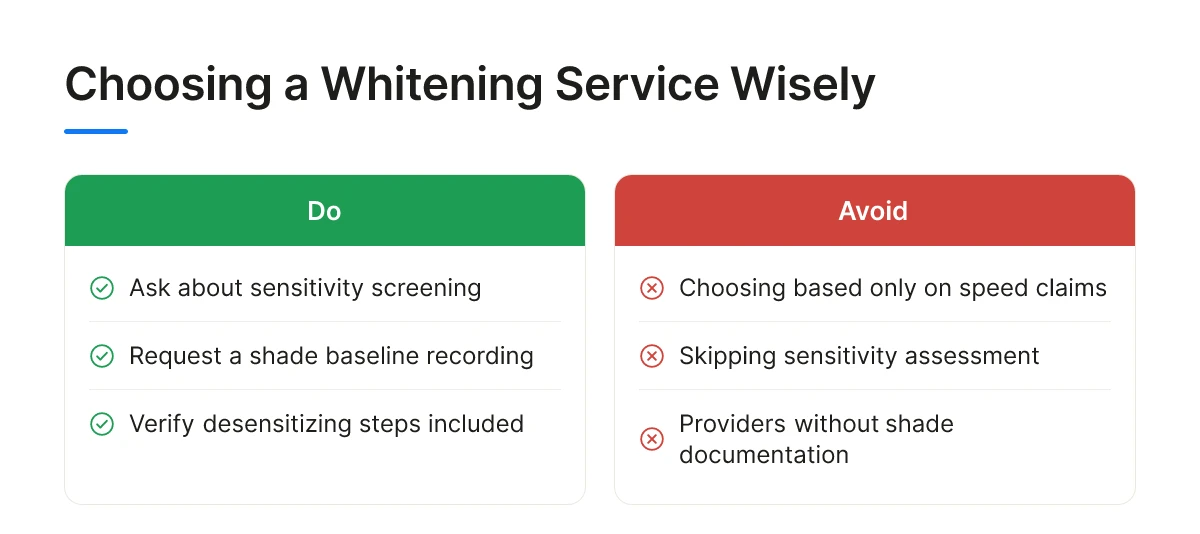
The first mistake is picking a provider based only on advertised speed. A one-visit whitening claim sounds appealing, but faster protocols often mean higher-concentration peroxide gel and longer light exposure, both linked to increased tooth sensitivity [1]. Before booking, ask whether a sensitivity screening or desensitizing step is built into the visit, not added as an afterthought once your teeth start aching.
The second mistake is skipping a shade baseline. Without a recorded starting shade, photographed or matched against a shade guide, you have no objective way to measure how much whiter your teeth actually got. Patients who skip this step tend to either overestimate mild results or underappreciate real improvement, because memory of “how yellow” teeth were before is notoriously unreliable. When considering teeth whitening services, this point stands out.
The third mistake is forgetting about existing dental work. Crowns, veneers, and bonded fillings do not respond to bleaching agents the way natural enamel does [1][3], so any restorations visible in your smile can end up noticeably lighter or darker than the surrounding teeth after whitening. A dentist needs to know exactly where that work sits before recommending a shade target.
The fourth mistake is assuming every take-home kit is interchangeable. Fit of the tray and the level of professional supervision vary widely between a boil-and-bite drugstore kit and a custom tray made from an impression [3][5], and poor fit means gel leaking onto gum tissue instead of staying on enamel.
Who Is a Good Candidate for Professional Whitening
Good candidates have healthy enamel, no active decay or gum disease, and realistic expectations about how much lighter their natural teeth can get. Patients with extensive existing dental work should discuss shade-matching with their dentist before scheduling teeth whitening services, since restorations won’t lighten along with the rest of the smile [1].
Professional vs At-Home: What to Weigh Before Deciding
Weigh supervision, tray precision, and gel strength against convenience and cost before choosing a route [3][5]. It also helps to research how whitening fits into a broader cosmetic dentistry plan, timing it around veneers or bonding, and how a practice’s payment options or insurance handling affect what you’ll actually pay out of pocket. Villagio Family & Cosmetic Dental walks patients through both questions during a whitening consult, so the shade goal and the treatment plan stay aligned from the start. For those exploring teeth whitening services, this matters.
Frequently Asked Questions
Is professional teeth whitening noticeably better than store-bought whitening strips?
Yes, professional treatments typically produce faster, more even results because dentists use higher-concentration peroxide agents under controlled conditions [1]. A custom-fitted tray or in-office light also keeps the whitening gel against the tooth surface more evenly than a one-size-fits-all strip, which reduces blotchy results and protects gum tissue from irritation.
Will whitening work on all types of tooth discoloration?
No, whitening works best on extrinsic stains from coffee, tea, wine, or tobacco, but responds less predictably to intrinsic stains from aging, trauma, or medication [5]. A dentist can examine your teeth first and tell you whether whitening, bonding, or veneers will actually address the type of discoloration you have.
How soon can I eat or drink after an in-office whitening session?
Most dentists recommend avoiding deeply colored foods and drinks like coffee, red wine, and berries for 24 to 48 hours after treatment. Freshly whitened enamel is more porous right after bleaching, so it absorbs stains more easily during this window than it will once it fully rehydrates.
Do I need a dental exam before starting a whitening treatment?
Yes, a short exam helps rule out cavities, exposed roots, or gum disease that whitening gel could irritate or worsen [3]. It also confirms your enamel can tolerate bleaching agents, which matters since not every patient is a good candidate for every whitening method [2].
Conclusion
Choosing a whitening option comes down to three questions: what caused your discoloration, how much control you want over concentration and fit, and how soon you need results. Extrinsic stains from coffee or wine respond well to standard treatments, while intrinsic stains need a dentist’s evaluation before you spend money on a method that won’t work [5]. Custom trays and in-office systems cost more than drugstore strips, but they’re fitted and monitored by a professional, which lowers the risk of gum irritation. Before buying any whitening kit, schedule a short exam at Villagio Family & Cosmetic Dental to confirm which method fits your teeth and your budget.
Sources & References
- Tooth Whitening: What We Now Know – PMC
- 3 Ways to Know If Professional Teeth Whitening Is Right for You, Dentistry In Oro Valley Oro Valley Arizona
- Professional Teeth Whitening vs. At-Home Teeth Whitening
- What Is the Best Teeth Whitening Method? Dentist vs. At-Home
Recommended Articles
Explore more from our content library: