Proudly Serving Katy, Richmond & Fulshear Cinco Ranch
(281) 395-2100
|
(281) 394-4001

Understanding how to treat canker sores is essential. The fastest way to treat a canker sore at home is to rinse with warm salt water or a baking soda solution, apply a topical numbing gel or protective paste, and avoid acidic or spicy foods that irritate the sore. Most canker sores heal on their own within one to two weeks, but pain relief usually improves within a few days of consistent care. See a dentist if a sore lasts longer than two weeks, is unusually large, or keeps recurring, since that can signal an underlying issue needing professional evaluation.
Identify Why Canker Sores Form Before You Treat Them
Canker sores form when the soft tissue inside your mouth breaks down, usually from minor trauma, acidic food, stress, or a hormonal shift, and understanding the trigger is the real starting point for how to treat canker sores effectively. Treating the symptom without knowing the cause often means the same sore returns within weeks.
The most common triggers are mechanical and dietary. Biting your cheek, a poorly adjusted brace bracket, or brushing too hard can all tear the delicate lining of the mouth [3]. Acidic fruits, tomatoes, and spicy dishes irritate that tissue further, while stress and hormonal changes, common during a teen’s growth spurt or a parent’s own hectic week, are frequently cited triggers as well [5]. None of these causes are contagious, which is a key difference from cold sores [3].
What Is the White Film Inside a Canker Sore?
That white or yellow layer is fibrin, a protein mesh your body produces as part of the inflammatory response to cover the open ulcer while new tissue grows underneath. The red border surrounding it is inflamed tissue reacting to the wound [3]. Resist the urge to pick at this film, it’s functioning as a natural bandage, and disturbing it slows healing and increases pain.
Can Nutritional Deficiencies Cause Recurring Canker Sores?
Yes. Low levels of vitamin B12, zinc, iron, or folate are linked to canker sores that keep coming back rather than appearing once and resolving [1]. If your child or you are dealing with sores every month or two, a look at daily diet, leafy greens, lean meats, fortified cereals, is worth more than another tube of gel. This is also where the distinction matters most for parents in Katy and Fulshear: a single sore after biting your cheek during dinner is normal and self-limiting, but a recurring pattern points to something systemic that deserves attention rather than repeat home treatment. Our team at Villagio Family & Cosmetic Dental often asks about diet and frequency during routine visits precisely because recurring sores can signal a deficiency or another condition worth evaluating, not just bad luck with a fork.
How to Treat Canker Sores Fast with At-Home Remedies
The fastest way to calm a canker sore tonight is a salt water rinse followed by a protective paste and a brief ice application to numb the area.
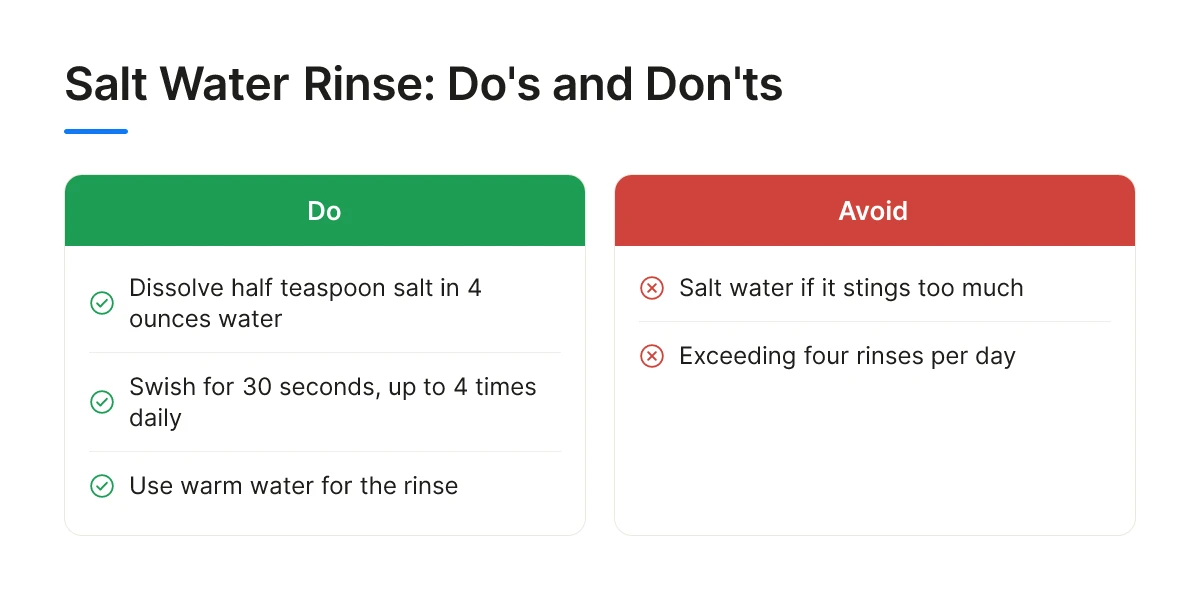
Start with a warm salt water rinse: dissolve half a teaspoon of salt in four ounces of warm water and swish for 30 seconds, up to four times a day. Salt water draws fluid out of the inflamed tissue and reduces swelling, which is why it remains one of the most frequently recommended first steps for anyone researching how to treat canker sores [1]. If salt stings too much, mix a half teaspoon of baking soda into two ounces of water instead, it neutralizes acid in the mouth without the sharp sting, making it a gentler option for kids or anyone with a larger sore.
Once the rinse is done, dab a small amount of milk of magnesia directly on the sore with a cotton swab, or use a dedicated canker sore paste. Both create a physical barrier that blocks acidic saliva and food particles from aggravating the ulcer [2]. Let it sit uncovered for a few minutes before eating or drinking.
For the first few minutes of a flare-up, press an ice cube or a cold compress directly against the sore. Cold temporarily numbs the nerve endings and takes the edge off sharp pain almost immediately [4], which makes it a good first move before a rinse or topical treatment.
Which Over-the-Counter Products Work Best for Pain Relief?
Benzocaine-based numbing gels and canker sore patches address pain directly, while some coating products only reduce friction without touching the nerve irritation.
Numbing gels containing benzocaine temporarily block pain signals at the sore site and work well before meals [3]. Hydrocolloid patches, similar to what’s used for cold sores, stick over the ulcer and both protect it and relieve pain by cushioning it from teeth and food contact. Plain protective coatings without an active numbing ingredient still help by reducing friction, but they won’t dull the sting the way benzocaine or a patch does, read labels closely if pain relief is the priority.
What Lifestyle Changes Help Prevent Future Canker Sores?
Avoiding acidic, salty, and rough foods during a flare-up prevents re-irritation and shortens how long the sore stays painful.
Skip citrus fruits, tomato-based sauces, salty chips, and crusty or rough-textured bread while the sore heals, these foods either sting on contact or physically scrape the ulcer [2][5]. Favor soft, bland foods like yogurt, scrambled eggs, and oatmeal instead. Managing stress and using a soft-bristled toothbrush also lowers the odds of a repeat sore, since minor mouth injury and stress are among the most commonly cited triggers [1][5].
Compare How Home Remedies, OTC Products, and Prescription Options Stack Up
Home remedies calm irritation, OTC products numb pain for daily life, and prescription treatments target severe or recurring sores, matching the right tier to your symptoms is how to treat canker sores efficiently.
Salt water rinses and diet adjustments, skipping acidic fruit, citrus, and spicy food, don’t make a canker sore heal dramatically faster. They reduce the irritation that makes a sore feel worse, which helps the mouth’s own healing process along [1]. Most sores resolve within about two weeks regardless of intervention [1], so think of this tier as damage control rather than a cure.
Over-the-counter topical products step up the response. Gels and pastes containing benzocaine or similar numbing agents form a protective layer over the sore, which blocks food and saliva from aggravating exposed tissue [2]. This is the tier most parents reach for when a child’s sore makes lunch or brushing teeth painful, it won’t shrink the sore, but it buys comfort during meals and conversation.
Prescription options are a different category entirely. Stronger topical corticosteroids and antimicrobial mouth rinses are reserved for sores that are unusually large, intensely painful, or keep recurring multiple times a year [1]. These require an evaluation first, because a dentist needs to rule out other causes before prescribing something stronger than a drugstore gel.
What Should You Expect During Each Stage of Healing?
A canker sore typically moves through a tingling or burning stage, a visible ulcer stage with a white or yellow center and red border, and a healing stage where the tissue closes over [3]. Home remedies and OTC products are most useful in the first two stages, when pain is sharpest and eating or talking hurts most. By the healing stage, most sores are already resolving on their own, which is why escalating to prescription treatment mid-healing rarely makes sense.
The decision isn’t about always reaching for the strongest option, it’s about matching intensity to what you’re actually dealing with. A single small sore that shows up once a year rarely needs more than salt water and a numbing gel. But if sores recur frequently or linger well past two weeks, no amount of rinsing or topical treatment fixes the pattern, that’s a sign to address whatever underlying trigger is driving the recurrence, with a dentist’s help.
Recognize When a Canker Sore Needs a Dentist’s Attention
See a dentist if a sore lasts beyond three weeks, grows unusually large, spreads toward the lips, or shows up alongside fever and swollen lymph nodes.
Most canker sores heal on their own within one to two weeks without any treatment at all [1]. Knowing how to treat canker sores at home only goes so far, once a sore crosses certain thresholds, home care stops being the right answer and a dental exam becomes the responsible next step.
What Warning Signs Mean You Need Professional Evaluation?
Watch for these specific signals, especially if you’re managing a child’s mouth sore in Katy or Cinco Ranch and aren’t sure whether it’s routine or something more:
- Duration beyond two to three weeks: A typical canker sore resolves within two weeks [1]; one that lingers longer needs a professional look.
- Unusually large size: Sores larger than a pencil eraser, sometimes called major aphthous ulcers, heal more slowly and scar more often.
- Spreading to the lips or outer skin: Canker sores normally stay inside the mouth; spread to the lip border can signal a different condition entirely.
- Fever or swollen lymph nodes: These point to a possible infection or systemic issue beyond a simple mouth ulcer.
- Sores that interfere with eating, drinking, or talking for several days: Pain severe enough to disrupt daily function is a sign to stop waiting it out.
Frequent clusters deserve attention too. If sores keep recurring in groups rather than appearing as isolated, occasional spots, that pattern can point to nutritional gaps, such as low vitamin B12, folate, or iron, or an underlying systemic condition that needs ruling out [1]. A single sore is usually nothing to worry about; a recurring pattern is data worth investigating.
A dental evaluation for recurring or severe sores typically starts with a visual exam and a review of your health history: recent illnesses, medications, stress levels, and diet. Depending on what the dentist sees, they may refer you for bloodwork to check for deficiencies or immune-related markers [1]. At Villagio Family & Cosmetic Dental, that visit also rules out look-alike conditions, like oral herpes or a reaction to a sharp tooth edge, before recommending next steps, so you’re not guessing at a diagnosis on your own.
Avoid These Common Mistakes When Treating Canker Sores
Most delayed healing comes from five habits: picking at the ulcer, overusing alcohol-based rinses, ignoring diet triggers, skipping reassessment, and confusing it with a cold sore.
Patients learning how to treat canker sores often undo their own progress with small, repeated habits that feel harmless in the moment.
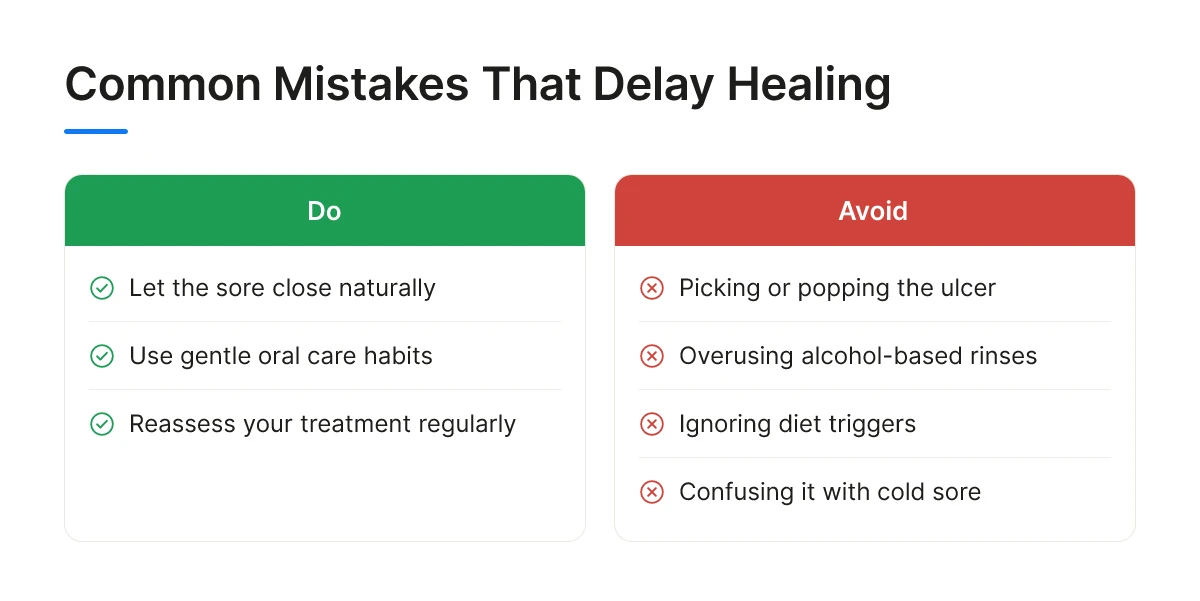
- Picking or popping the sore. A canker sore is already an open ulcer in the mouth’s soft tissue, not a blister with fluid to release. Touching it with a fingernail, tongue, or toothpick reopens tissue that’s trying to close and introduces bacteria from your hands or mouth, which raises infection risk and can stretch a one-week healing window into two or more [1].
- Rinsing with alcohol-based mouthwash too often. The sting might feel like it’s “working,” but alcohol dries out the ulcer’s surface and irritates the surrounding tissue, slowing the body’s own repair process. A bland saltwater or baking soda rinse does the antibacterial job without the burn [2].
- Ignoring diet triggers. Acidic fruits, citrus juice, tomatoes, and sharp or crunchy foods like chips can re-irritate the same spot every time it starts to close [5]. If a sore keeps reopening in the same location, look at what’s hitting that spot at mealtime before assuming it’s a new outbreak.
- Self-treating for weeks without checking in. Most canker sores resolve within about two weeks even without treatment [1]. If pain, size, or frequency isn’t improving after that window, continuing the same home routine without reassessment just delays a diagnosis that might need a different approach.
- Mistaking it for a cold sore. Canker sores form inside the mouth, on the cheeks, lips’ inner lining, tongue, or gum base, and aren’t contagious, while cold sores appear on the outer lip and spread through contact [3][5]. Applying a cold sore antiviral cream to a canker sore, or vice versa, wastes time on the wrong treatment entirely.
At Villagio Family & Cosmetic Dental, we see Katy and Cinco Ranch patients who’ve spent two or three weeks managing a sore that turned out to need a prescription-strength rinse or a closer look at an underlying cause. If yours isn’t healing on schedule, that’s the signal to stop guessing and get it checked.
Frequently Asked Questions
How long do canker sores usually take to heal on their own?
Most canker sores clear up within one to two weeks without any treatment [1]. Over-the-counter gels, salt water rinses, and avoiding acidic or spicy foods can ease pain while the sore heals, but they don’t speed up healing dramatically. If a sore lingers past three weeks, schedule a dental visit to rule out other causes.
Can stress cause canker sores?
Yes, stress is one of the most common triggers dentists see, along with minor mouth injuries from biting your cheek or brushing too hard [1]. Hormonal shifts, certain foods, and vitamin deficiencies can also play a role. The exact cause often varies from person to person [3].
Are canker sores contagious like cold sores?
No, canker sores are not contagious, unlike cold sores, which spread through viral contact [1]. You can’t catch them from sharing drinks, utensils, or kissing. They form on soft tissue inside the mouth, cheeks, lips, tongue, and gum base, rather than on the outer lip [3].
What’s the difference between a canker sore and a cold sore?
Canker sores form inside the mouth and aren’t contagious, while cold sores appear on or around the lips and spread easily through contact [1] [3]. Cold sores come from the herpes simplex virus and often start with tingling or blistering before they open. Canker sores show up as round, white or yellow ulcers with a red border, usually without warning signs beforehand.
Can children get canker sores, and is treatment different for them?
Yes, children get canker sores frequently, often from biting their cheek, braces irritation, or stress around school. Treatment is largely the same, saltwater rinses, avoiding acidic foods, and topical gels made for kids. For young children, watch dosing on any OTC product and bring them in if sores are large, recurring, or paired with fever.
Conclusion
Most canker sores respond well to simple care: rinse with salt water, dab on an OTC gel, and steer clear of acidic or crunchy foods until the sore closes up, usually within two weeks [1]. The exceptions matter, a sore larger than a pencil eraser, one that lingers past three weeks, or one that keeps recurring alongside fever or swollen glands needs a dentist’s eyes, not another home remedy. If you’re in Katy, Fulshear, Richmond, or Cinco Ranch and a sore isn’t improving, book an evaluation with Villagio Family & Cosmetic Dental this week rather than waiting out a third painful week.
Sources & References
- Canker Sore: Symptoms, Causes & Treatment
- Canker Sore Treatment: Get Rid of Them Fast | Aspen Dental
- Ouch! The Best Home Remedies for Fast Canker Sore Relief | Kings Dental
- How To Get Rid of Canker Sores Fast | Tend
- 8 Super-Fast Ways to Clear up a Canker Sore | Bloor West
Recommended Articles
Explore more from our content library: