Proudly Serving Katy, Richmond & Fulshear Cinco Ranch
(281) 395-2100
|
(281) 394-4001

Understanding how often should I floss is essential. Most dentists recommend flossing once a day, and the timing matters less than consistency, any time you can thoroughly clean between all your teeth works. Daily flossing removes plaque and food particles that brushing alone can’t reach, which is what actually prevents gum disease and cavities between teeth. Some situations call for more frequent attention: braces, dental implants, or existing gum disease often mean flossing after every meal or using a specific tool your dentist recommends. For most healthy adults and kids with all their teeth in, once daily is the real target, not twice, not twice weekly.
What Does the Research Actually Say About How Often You Should Floss?
Dental associations agree on the answer to how often should I floss: once a day, every day, with technique mattering more than any second session [2]. The American Dental Association has held this position for years, grounding it in how fast bacterial plaque forms once it’s disturbed [2].
Is the ‘2-2-2 Rule’ Backed by Dental Science?
You may have heard of the “2-2-2 rule”, brush twice, floss twice, rinse twice daily, but dentists we work with at Villagio Family & Cosmetic Dental don’t treat it as a clinical requirement. One deliberate flossing session, done correctly, accomplishes what the mouth actually needs. Doubling the frequency without doubling the care, rushing floss between teeth without working it below the gumline, adds no protective benefit.
What matters is the mechanism. A toothbrush cleans the flat surfaces of your teeth, but its bristles can’t reach the tight contact points between teeth or slip beneath the gumline. Floss physically disrupts the plaque biofilm building in those gaps, the sticky layer of bacteria that forms within hours of eating [1]. Skip that step and brushing alone leaves roughly 40% of each tooth’s surface untouched, which is part of why flossing removes a meaningful share of plaque that brushing misses [1].
What Happens If I Skip Flossing for a Few Days?
Soft plaque left undisturbed between teeth for several days starts to mineralize into tartar, a hardened deposit that no amount of brushing or home flossing can remove [5]. At that point, only a professional cleaning can take it off, which is why gaps in flossing habits often show up as a harder appointment at your next checkup rather than an immediate symptom. Over months, that same neglected plaque is what drives the gum inflammation behind early gingivitis [3].
It’s fair to acknowledge the public confusion here. A few years back, headlines questioned whether flossing evidence held up, and the honest answer is that many clinical trials on flossing are short, small, and hard to control, people’s home technique varies, and studies rarely run long enough to track cavities or gum disease over years. That’s a limitation of study design, not proof that flossing fails. The biofilm-disruption mechanism remains well understood even where the long-term trial data is thinner than dentists would like [3].
How Often Should I Floss With Braces, Implants, or Gum Disease?
Braces, implants, and periodontal disease each change the answer to how often should I floss, usually pushing it well past the standard once-a-day rule.
Braces create tight spaces where food and plaque collect around brackets and under wires. A toothbrush can’t reach most of it. For kids and teens in orthodontic treatment at our Katy office, we often recommend flossing after every meal using a floss threader or an orthodontic flosser designed to slide under the archwire. Skipping even one day lets plaque harden into the kind of buildup that leaves white spots or decay once the brackets come off.
Do People With Periodontal Disease Need to Floss More Frequently?
Yes, patients with gum disease are typically advised to floss more than once daily, because deeper gum pockets trap more bacteria than healthy gum tissue does. Gingivitis, the early and most common form of gum disease, starts when plaque is allowed to sit along the gumline [3]. Once pockets form between the tooth and gum, they become reservoirs for bacteria that a single daily pass with floss may not fully clear.
For these patients, we usually recommend flossing both morning and night, sometimes with an interdental brush or water flosser added for pocket depths a standard strand can’t reach. The exact number isn’t universal, it depends on how advanced the gum disease is and how the tissue is responding to treatment.
What Flossing Routine Should I Follow Around Dental Implants?
Implants need daily flossing with careful, gentle technique around the crown and gumline to prevent peri-implantitis, an infection that behaves like gum disease but targets the tissue and bone around an implant. Implants don’t have natural periodontal ligament the way real teeth do, so once bacteria get a foothold, the surrounding bone can break down faster than most patients expect. Daily flossing, using floss designed to avoid scratching the implant surface, or a soft interdental brush, keeps that risk low.
Across all three situations, the common thread is that pocket depth and healing stage matter more than a generic number. A dentist or hygienist can measure gum pockets at a checkup and set a routine suited to what’s actually happening in your mouth, rather than guessing from a one-size-fits-all guideline. At Villagio Family & Cosmetic Dental, our hygienists check pocket depth at every cleaning and adjust flossing frequency recommendations for patients in orthodontics, with implants, or managing periodontal disease.
If you fall into any of these categories, don’t guess at how often should I floss on your own, get a routine confirmed at your next visit. What works for a patient with healthy gums can fall short for someone managing braces, an implant, or active gum disease.
Traditional Floss vs Water Flossers vs Interdental Brushes: How Often Should You Use Each?
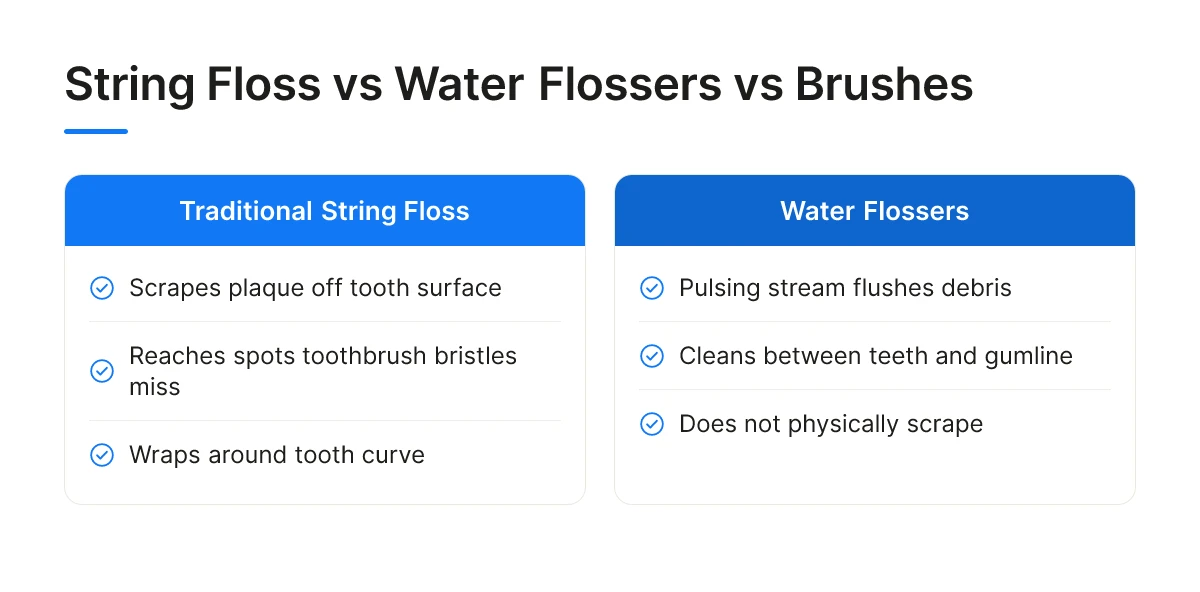
All three tools belong in a daily routine once a day, but they clean different ways, the right pick depends on your gaps, your gums, and who in your family is holding the floss.
Traditional string floss scrapes plaque off the tooth surface as you slide it up and down, wrapping around the curve of each tooth to reach spots a toothbrush bristle never touches [5]. Water flossers use a pulsing stream to flush loose debris and bacteria out from between teeth and along the gumline, useful, but it doesn’t physically scrape the way string floss does. Interdental brushes work like a tiny bottle brush, sliding into the gap between teeth to sweep away plaque, which makes them a good fit for wider spaces. None of these replace brushing, flossing removes a large share of the plaque between teeth that a toothbrush simply can’t reach [1], which is part of why dentists keep asking patients how often should I floss at every checkup.
Why Do Some Dentists Recommend Against Floss Picks?
Floss picks work fine occasionally, but the short, rigid string can’t wrap around the curve of each tooth the way a length of floss pulled from a spool can. That rigid shape limits how much of the tooth surface actually gets scraped, especially near the gumline where plaque builds up fastest. We don’t tell Katy and Fulshear families to throw out their floss picks, they’re handy for a quick clean after lunch at a Cinco Ranch restaurant, but for the deep daily clean that actually prevents gum disease, spooled floss or an interdental brush does more work.
Which Method Is Most Effective for My Family’s Different Ages and Needs?
Match the tool to the person. Kids and anyone with limited dexterity, think grandparents visiting from Richmond, or a Cinco Ranch teenager rushing out the door, often stick with the habit better using floss picks or a water flosser, since both are faster and easier to control. Adults with tight contacts between teeth usually need waxed string floss, which glides through snug spaces without shredding. Interdental brushes tend to suit wider gaps, bridges, or gum recession better than string floss, since the bristles fill the space string floss would just slide past; if you’re noticing longer-looking teeth or gum recession, our gum recession guide covers when that’s a bigger concern worth a visit to Villagio Family & Cosmetic Dental. Whichever tool fits your family, once daily is still the target, water flossers can stand alone or complement string floss, but skipping interdental cleaning altogether leaves plaque behind regardless of how often you brush.
Why Do My Gums Bleed When I Floss, and Does That Change How Often I Should Do It?
Bleeding gums almost always mean the tissue is inflamed from plaque that’s been sitting along the gumline, not that floss is hurting you or that you’re overdoing it. The fix is rarely to back off, it’s to keep going.
When plaque accumulates at the gumline, the gum tissue becomes irritated and swollen, a condition called gingivitis [3]. That inflamed tissue bleeds easily when disturbed, even gently. Floss doesn’t cause the problem, it’s revealing a problem that was already there. This is one reason the question of how often should I floss matters more than most parents in Katy and Cinco Ranch realize: skipping days lets plaque rebuild and keeps that cycle of bleeding going.
Is Bleeding a Sign I’m Flossing Too Much or Not Enough?
It’s almost always too little, not too much. Daily flossing is what clears the plaque responsible for the inflammation in the first place [2]. Most patients who floss consistently see bleeding taper off within one to two weeks, as the gum tissue heals and tightens back up. If bleeding hasn’t improved after two weeks of daily flossing, or if you notice swelling, pain, or gums that look pulled away from the teeth, that’s no longer a normal adjustment period, it warrants a visit so we can check for gum disease that needs treatment beyond a floss-more approach.
How Do I Floss Teeth That Are Hard to Reach Without Pain?
Technique causes more bleeding than frequency does. Snapping floss straight down into the gumline bruises the tissue, which is a common habit among people trying to get the job done quickly. Instead, curve the floss into a C-shape against the side of each tooth and slide it gently under the gumline rather than forcing it. For back molars or tight contacts between teeth, a water flosser can reach spots that string floss struggles with, especially for kids and teens still building the habit. The goal is consistent gentle pressure, not speed.
If bleeding persists despite good technique, we can check for the real cause at your next cleaning at Villagio Family & Cosmetic Dental rather than guessing at home.
How Can I Make Flossing a Daily Habit That Actually Fits My Life?
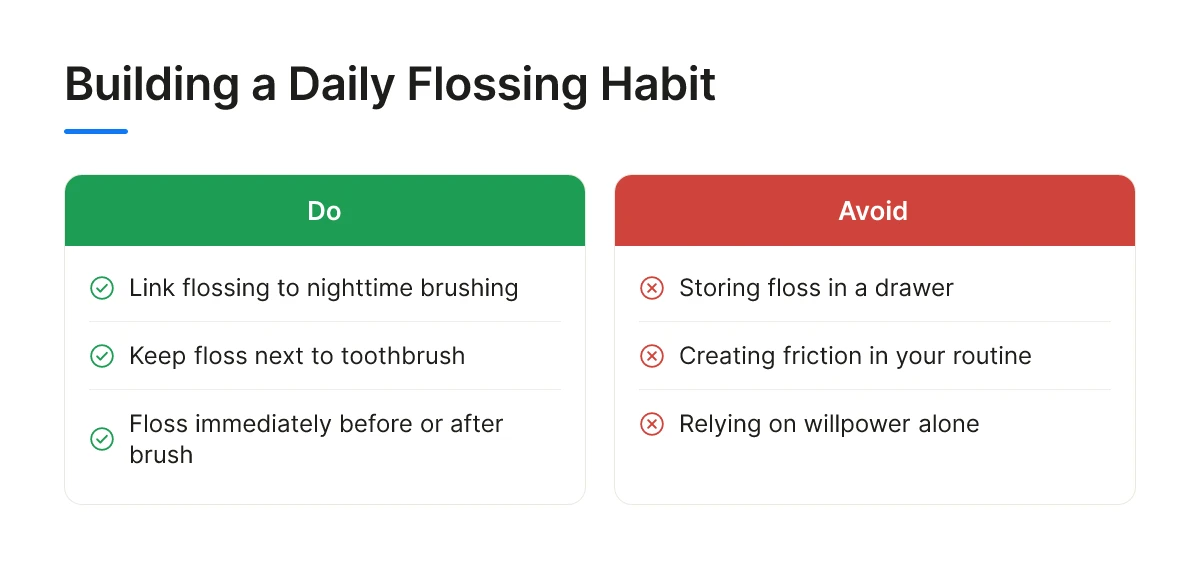
The easiest way to turn “how often should I floss” from a nagging question into an automatic habit is to attach flossing to something you already do every night without thinking.
Habit researchers call this stacking: link a new behavior to an existing cue so you don’t have to rely on willpower. For flossing, the cue is already built into most routines, nighttime brushing. Keep floss sitting next to the toothbrush, not in a drawer, and floss immediately before or after you brush at night. The goal is to remove the moment of decision. If flossing requires walking to another room or digging through a cabinet, that friction is often the real reason it gets skipped, not lack of motivation.
What Are Realistic Flossing Routines for Busy Families?
Stock floss or interdental brushes in two or three spots, the bathroom, the kitchen junk drawer, a backpack or purse, so there’s never an excuse of “I don’t have any with me.” For families in Katy, Fulshear, Richmond, and Cinco Ranch juggling school drop-offs, sports practice, and work schedules, a five-minute window after dinner or during a nightly TV show often works better than trying to squeeze flossing into a rushed morning. Pre-threaded flossers can help kids and tired parents alike move faster without sacrificing technique.
Should Everyone in My Family Floss at the Same Frequency?
No, frequency depends on what’s happening in each person’s mouth. Young kids with baby teeth and naturally wide gaps may need less frequent, lighter flossing with adult supervision, while teens in braces typically need more deliberate daily attention to avoid plaque traps around brackets. Adults with tighter contacts or a history of gum issues benefit most from flossing once daily, as covered earlier in this guide [2]. Treat frequency as a per-person decision, not a household rule.
A simple visible checklist on the bathroom mirror works well for younger kids building the habit, a checkmark for each night flossed turns it into a small win rather than a chore. Once the routine sticks, the chart can disappear.
Even a consistent routine benefits from a professional check-in. At Villagio Family & Cosmetic Dental, we use routine visits to confirm technique is actually removing plaque where it counts and to catch spots a toothbrush and floss miss, so your family’s daily effort keeps paying off between appointments.
Frequently Asked Questions
Can flossing too much damage my gums?
Flossing more than once a day usually isn’t harmful if your technique is gentle, but aggressive or rough flossing can irritate or cut gum tissue [5]. Snapping floss into the gum line or sawing too hard is the real culprit, not frequency itself. Use a soft, curving motion and let technique, not willpower, drive results.
Should I floss before or after brushing?
Flossing before brushing is the order many dentists recommend, since it loosens debris that brushing can then sweep away [4]. One ADA representative has noted people are also more likely to floss consistently when it comes first, before fatigue sets in [4]. Either order works if you floss daily, consistency matters more than sequence.
Is it bad to floss only a few times a week instead of daily?
Flossing a few times a week is better than skipping it, but it falls short of the daily habit dentists recommend for controlling plaque [2]. Plaque bacteria rebuild quickly between teeth, and gaps of several days give it room to harden into tartar and irritate gums along the way.
At what age should kids start flossing daily?
Kids should start daily flossing as soon as two teeth touch, which often happens between ages 2 and 6 depending on spacing. Parents typically need to floss for younger children until they develop the hand coordination to do it well themselves, usually around age 8 to 10.

Conclusion
Daily flossing remains the standard dentists recommend, and the habit matters more than perfecting timing or technique on day one [2]. Floss once every 24 hours, be gentle around the gum line to avoid irritation, and get kids into the routine as soon as their teeth start touching. If your family has fallen out of the habit, don’t try to overhaul everything overnight, pick one anchor time, like right before bed, and build from there. For a technique check or to catch gum issues early, schedule a cleaning visit at Villagio Family & Cosmetic Dental, where our hygienists can watch you floss and correct small mistakes before they become bigger problems.
Sources & References
- How Many Times a Day Should You Floss? | 209 NYC Dental
- How Often Should You Floss? An Expert Dentist’s Advice
- Rinse, brush, floss, scrape, and repeat – Harvard Health
- When To Floss | Floss Before or After You Brush
- How Often Should You Floss? – Elice Dental Care
Recommended Articles
Explore more from our content library: