Proudly Serving Katy, Cinco Ranch, Richmond & Fulshear
Cinco Ranch (281) 395-2100
|
Fulshear (281) 394-4001

Family dentistry services bring preventive, restorative, and cosmetic dental care for every age group, toddlers through grandparents, into a single practice, so one provider manages your whole household’s oral health instead of you juggling separate pediatric, general, and specialist offices. This matters because shared records let a dentist catch patterns across generations (like inherited bite issues or cavity risk), scheduling gets simpler when siblings and parents can book back-to-back visits, and building one long-term relationship with a dental team tends to reduce missed appointments and delayed treatment.
What Does Family Dentistry Mean, and How Is It Different from General Dentistry?
“Family dentist” describes which patients a practice treats, not a separate license or board certification a dentist earns on top of dental school.
Dental schools train general dentists to treat patients of any age, there is no separate “family dentistry” degree or residency track [4]. What makes a practice a family practice is a business decision: it chooses to equip itself for toddlers, teenagers, parents, and grandparents, and it builds its systems around that mix. A general dentist technically can see a 4-year-old and an 84-year-old in the same afternoon. Many don’t, because their equipment, scheduling model, and staff training assume an adult patient base.
What’s the Difference Between a Dentist and a Family Dentist?
When a Katy parent compares “a dentist” to “a family dentist” for booking purposes, the real differences show up in the details rather than the credentials. A family practice typically stocks smaller instruments and x-ray shields sized for children, trains front-desk staff to talk a nervous 6-year-old through a first cleaning, and keeps appointment slots flexible enough to seat siblings back-to-back after school [2]. A practice marketed strictly to adults may not carry any of that, not because the dentist is less qualified, but because the business never built for it.
This is the practical lens worth applying when researching family dentistry services near Cinco Ranch or Fulshear: ask what the office actually has in place for a toddler’s first visit or a senior managing dry mouth from medication, not just whether the dentist is licensed to treat them [5].
Some practices extend this further by bringing in associates with pediatric-focused training or partnering with an orthodontist, rather than expecting one general dentist to handle every age group and every procedure solo. That model, one roof, several specialized team members, lets a practice offer family dentistry services that go beyond routine cleanings without referring every complex case out the door [1]. Villagio Family & Cosmetic Dental structures its team this way, pairing general dental care with partners suited to kids, teens, and older adults under one scheduling system.
What Family Dentistry Services Can a Dentist Provide for Patients of All Ages?
A single practice can cover sealants for a 6-year-old, a filling for a teenager, and a denture fitting for a grandparent, all under one roof. The breadth of family dentistry services is what separates a true family practice from an office that only treats adults or only treats kids.
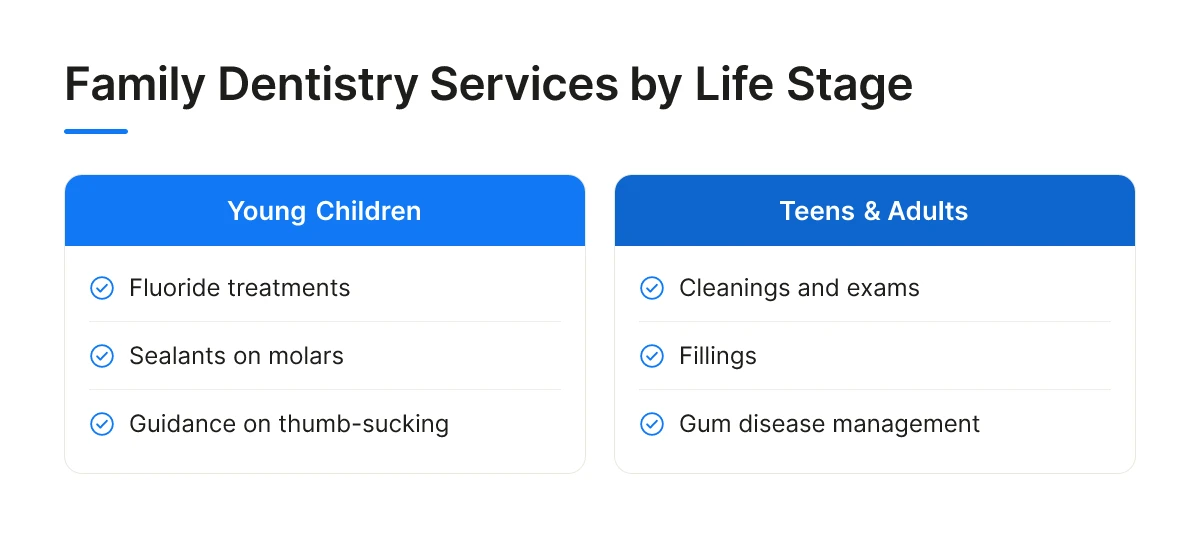
Services group naturally by life stage. Young children need preventive care: fluoride treatments, sealants on molars, and guidance on thumb-sucking or teething [1]. Teens and adults need the staples of general dentistry, cleanings, exams, fillings, and gum disease management [4]. Older adults often need more restorative work: crowns, bridges, root canals, or dentures to replace teeth lost over decades of wear [4][5]. One provider tracking a patient through all three stages catches problems earlier, because the dentist already knows that patient’s history instead of starting from a blank chart.
What Pediatric-Specific Services Do Family Dentists Offer for Children?
Pediatric-focused family dentists use smaller instruments, shorter appointment blocks, and behavior-friendly techniques built for kids as young as 12 months [1]. First visits are often more about building comfort than performing treatment, letting a toddler sit in the chair, count instruments, or watch a parent get a quick exam first. This matters for Katy-area parents juggling school schedules: a 20-minute pediatric slot fits into an afternoon in a way a full adult-length appointment doesn’t.
Family practices also build in early orthodontic screening, checking bite alignment and jaw development around age 7 so issues get flagged before they require more invasive correction later [4]. Catching a crossbite or crowding early can mean a simpler, shorter treatment path down the road.
What Emergency Dental Care Services Are Available, and How Quickly Can You Be Seen?
Most family dental offices reserve same-day or next-day slots for pain, trauma, or a knocked-out tooth, rather than sending you to an unfamiliar emergency clinic. A chipped tooth from a Little League collision or a sudden abscess doesn’t wait for a convenient Tuesday, and a practice that already has your child’s or spouse’s records on file can triage faster than a walk-in clinic that’s never seen either of you.
Family practices also tend to coordinate specialist referrals internally, orthodontics, oral surgery, or periodontics, rather than handing you a list of unfamiliar names [4]. Villagio Family & Cosmetic Dental, for example, manages that kind of continuity so a referral for a wisdom tooth extraction or an Invisalign consult stays inside a relationship the family already trusts. That same continuity extends to concerns like replacing a missing tooth or routine general dentistry, different needs, same dependable point of contact.
Why Should Your Whole Family See the Same Dentist?
One provider who treats every generation builds a complete picture of your household’s dental history, which means faster diagnoses, fewer missed appointments, and less anxiety at every visit.
What Are the Advantages of Having One Dental Provider for Your Entire Family?
Dental patterns run in families. If a parent has a history of deep grooves that trap plaque, or a grandparent battled gum disease for years, a dentist who treats the whole household can flag those same risk factors in a child or teenager before they become serious problems [4]. Clenching and grinding habits, enamel weaknesses, and even the pace of gum recession often repeat across generations, and a single chart spanning parents, kids, and grandparents makes those connections visible in a way that scattered, single-visit records never do [5].
Scheduling is where this pays off in a very practical sense. Families juggling school drop-offs, work shifts, and after-school activities in Katy and Fulshear don’t have time to manage three separate dental offices with three separate calendars. A practice built around family dentistry services can block out back-to-back appointments for siblings, or pair a parent’s cleaning with a child’s checkup on the same morning, cutting the number of trips away from work or class roughly in half compared to juggling separate providers.
Familiarity also calms nerves. A child who sees the same hygienist at every visit learns what to expect, and that predictability matters just as much for an adult who’s uneasy about dental work. Trust built over several visits with the same team tends to reduce the dread that keeps people from scheduling checkups in the first place [2].
There’s also a paperwork advantage that’s easy to overlook. One office handling insurance verification and billing for everyone in the household means one intake form, one point of contact for claims questions, and no repeating the same history three separate times. Villagio Family & Cosmetic Dental sets up household accounts this way specifically so parents aren’t re-explaining coverage details at every new patient visit.
How Affordable Is Family Dental Care, and What Are Your Payment Options?
Family dentistry services typically cost less over time than managing separate dental relationships for each family member, and most practices offer financing or payment plans to spread out larger treatment costs.
Cost is often the real reason families delay care, not confusion about what’s needed. The good news: consolidating care under one provider and understanding how insurance and financing actually work usually makes the number less intimidating than parents expect.
Why Bundling Family Care Under One Provider Saves Money
Every new dental office a family member visits repeats the same overhead: a new patient exam, new X-rays, new records, new consultation time. When a toddler, a teenager, and two parents all see the same practice, that redundancy disappears. One shared chart system, one office relationship, and often one coordinated visit day reduce the administrative cost that gets passed on to patients, whether through exam fees or time taken off work for multiple appointments. A general dentistry practice built around the whole household structures pricing and scheduling around that efficiency, rather than treating each patient as a fresh acquisition.
How Do I Fix My Teeth If I Don’t Have Money?
Ask the practice about sliding-scale pricing, in-house discount plans, or payment arrangements before deciding to skip treatment altogether. Most offices would rather work out a plan than see a problem go untreated and become an emergency later. If several issues need attention, ask the dentist to rank them by urgency; addressing an active infection or a cavity near the nerve first, while scheduling cosmetic or lower-priority work later, keeps costs manageable without risking your health. Villagio Family & Cosmetic Dental maintains a dedicated guide to payment plans and financing structures for families weighing these options, which goes deeper into specifics than a single section here can cover.
What Financing Options and Insurance Plans Does a Family Dentist Accept?
Most family practices accept a mix of dental insurance, in-house payment plans, and third-party financing companies that split treatment cost into monthly installments. Dental insurance generally covers preventive care, cleanings, exams, X-rays, more fully than restorative or cosmetic work, which usually comes with higher out-of-pocket percentages or annual maximums [4]. That split matters for budgeting: a routine checkup might cost little to nothing after insurance, while a crown or orthodontic treatment requires planning ahead. In-house plans let patients pay over several months directly through the practice, while third-party financing providers run a quick approval process and let patients start treatment before paying it off in full. Asking the front desk to walk through both insurance benefits and financing options before treatment begins avoids surprises on the bill.
How Do You Find a Family Dentist with Convenient Hours and Transparent Pricing?
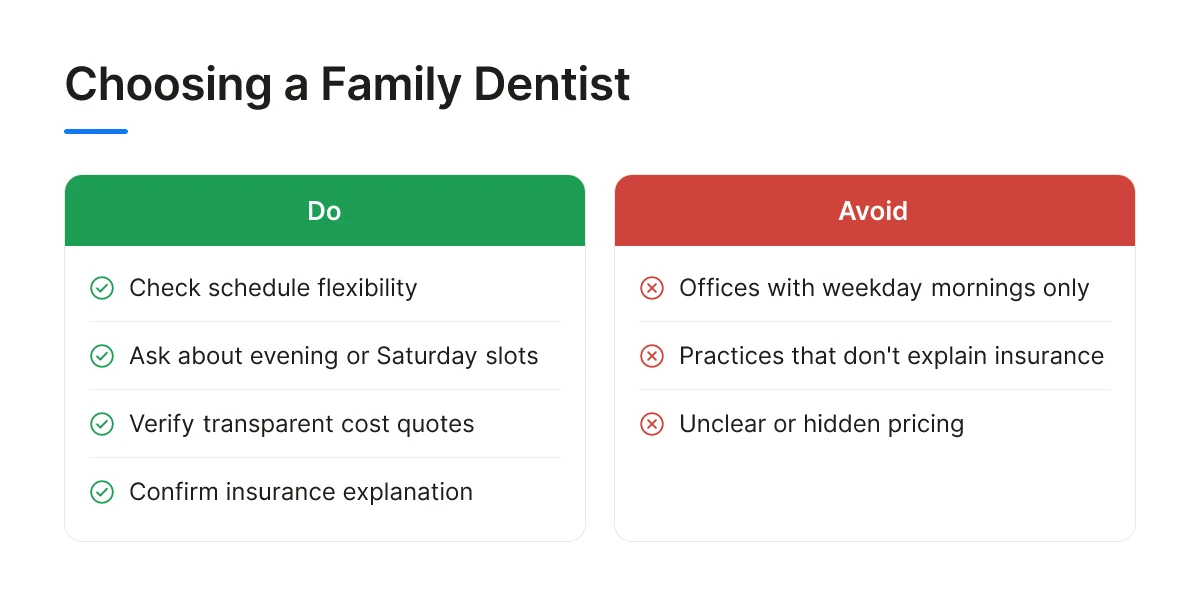
Check four things before booking: schedule flexibility, how the practice quotes costs, how it explains insurance, and how it treats nervous or first-time patients. Those four answer whether a practice can actually deliver family dentistry services for a household with mixed ages and schedules, rather than just advertising the phrase.
What Should You Look for When Choosing a Family Dentist in Your Area?
Start with hours. A parent in Katy or Cinco Ranch juggling school pickups and work schedules needs evening or Saturday appointment slots, not just weekday mornings when everyone is at school or work. Ask directly whether the practice offers same-day or next-day slots for emergencies, a cracked molar or a child’s fall on the playground does not wait for next Tuesday.
Confirm that pediatric and adult care both happen in-house. If a practice refers toddlers out to a separate pediatric specialist, you lose the single-location convenience that makes family dentistry services worth choosing in the first place. Ask the front desk point blank: “Do you see patients from toddler to grandparent in this same office?” The answer should be immediate, not hedged.
On cost, ask for a written treatment estimate before any work begins, not a verbal ballpark at checkout. A trustworthy practice will walk through what is being quoted and roughly where it falls on a budget-friendly-to-premium spectrum, whether that’s a routine cleaning versus a crown or an orthodontic consultation. If a practice is vague or defers cost questions until after treatment starts, treat that as a warning sign [4].
Insurance and financing should come up at scheduling, not at the billing counter. Ask whether the office verifies your benefits before your visit and whether it offers payment plans for larger procedures like root canals or implants. Practices that explain this upfront tend to be the same ones that handle treatment planning honestly overall.
Last, read how a practice talks about first pediatric visits and anxious patients, a reviews section or a dedicated page on handling kids’ first cleanings tells you more about real family fit than a homepage banner that just says “family-friendly” [2][5].
Frequently Asked Questions
Can one dentist treat a toddler and a grandparent equally well?
Yes, most general dentists train to handle the full age range, from a child’s first cleaning to denture care for seniors [4]. The difference lies in experience and approach, not equipment. A family practice adjusts technique, pacing, and communication style for each patient’s age and comfort level, whether that’s a nervous 3-year-old or an 80-year-old managing bone density changes.
Do family dentists handle orthodontic needs like braces or Invisalign?
Many family dental practices do offer braces or Invisalign, though coverage varies by office. Some provide full orthodontic treatment in-house, while others handle early screening and refer complex cases to a specialist. Ask directly what orthodontic services are offered before assuming a given practice covers it.
How often should each family member visit the dentist?
Most patients, children and adults alike, should visit every six months for a cleaning and checkup [1]. Some family members, kids with braces, seniors with gum disease, or anyone with active decay, may need more frequent visits. A family dentist tracks each person’s schedule individually, not on one fixed calendar.
What happens if a family member needs a specialist a family dentist doesn’t provide?
A family dentist refers out and coordinates the handoff, so the patient doesn’t have to find a specialist alone. This typically applies to complex oral surgery, root canals in difficult cases, or advanced orthodontics. The family dentist usually stays involved, handling follow-up care and keeping the patient’s full dental record in one place rather than splitting it across unconnected providers.

Conclusion
Comprehensive family dental care comes down to three things: one practice that tracks every family member’s history, preventive visits scheduled on each person’s own timeline, and a team equipped to handle both a toddler’s first cleaning and a grandparent’s denture fitting without a referral to a separate office. For families in Katy, Fulshear, Richmond, and Cinco Ranch, that means fewer appointments to juggle and fewer gaps in care between generations. Start by booking a single checkup for your youngest and oldest family member on the same day at Villagio Family & Cosmetic Dental, and see firsthand how one visit can cover both ends of the age range.
Sources & References
- Family Dentistry Services South Burlington, VT | Pediatric Dental Care
- 10 Ways a Family Dentist Simplifies Oral Care for All Ages
- Why Choosing a Family Dental Clinic Is the Smartest Decision for Your Household | Burke Parkway Dental
- From Children to Grandparents: How a Family Dentist Supports All Ages
Recommended Articles
Explore more from our content library: