Proudly Serving Katy, Cinco Ranch, Richmond & Fulshear
Cinco Ranch (281) 395-2100
|
Fulshear (281) 394-4001

Understanding why is my tooth sensitive is essential. A single sensitive tooth usually means something localized is exposing the dentin or nerve inside that specific tooth, like a cavity, a cracked filling, receding gum, or a recent dental procedure, rather than a general sensitivity issue affecting your whole mouth. Sudden, sharp pain when you bite, drink something cold, or breathe in cold air often points to a crack, decay, or an exposed root. If the sensitivity is new, worsening, or paired with swelling or lingering pain, it’s worth having a dentist check that one tooth rather than waiting it out.
What Causes Tooth Sensitivity in a Single Tooth?
One tooth hurts and not the others because the damage exposing its nerve is local, a crack, a cavity, or gum recession on that tooth alone, not a mouth-wide condition. Figuring out why is my tooth sensitive starts with understanding what’s happening under the enamel of that specific tooth.
The Dentin Tubule Mechanism, Localized
Underneath enamel sits dentin, a softer layer riddled with microscopic tubules that lead straight to the tooth’s nerve [1]. When enamel wears away or gum tissue recedes and exposes the root surface, those tubules let hot, cold, sweet, or even cold air reach the nerve and trigger a sharp jolt [2]. Enamel wear and gum recession rarely happen evenly across all 32 teeth, a toothbrush angled too hard on one side of the mouth, a single tooth taking more bite force, or one area with thinner gum tissue will wear down faster than its neighbors [3]. That uneven pattern is often the simplest answer to why is my tooth sensitive while the rest of your mouth feels fine.
Tooth-Specific Damage
Several localized problems point to one culprit tooth rather than a general sensitivity issue. A cavity eats through enamel and dentin at a single site [1]. A cracked or fractured tooth opens a direct path to the nerve, often causing pain specifically when biting down [3]. A filling that’s cracked, loose, or leaking at the edges lets bacteria and temperature stimuli slip underneath it [3]. And a tooth with inflamed or infected pulp, the kind that eventually needs root canal treatment, can feel sensitive to pressure and temperature well before pain becomes constant [1].
Is Tooth Sensitivity Different Depending on My Age?
Yes, age shifts which cause is more likely, though it doesn’t change the basic mechanism of exposed dentin. Younger patients, including kids and teens in Katy and Cinco Ranch who snack frequently or aren’t yet consistent with flossing, tend to see sensitivity tied to cavities. Older adults more often deal with enamel that has simply thinned over decades of wear, along with gum recession from years of brushing habits or periodontal changes, both of which expose root surfaces directly [1].
Can Recent Dental Work or Orthodontic Treatment Cause Sensitivity?
Temporary sensitivity after a filling, crown, or orthodontic adjustment is common and usually settles within days to a few weeks. A newly placed filling or crown can leave a tooth reactive to temperature while the nerve calms down from the procedure. Braces or clear aligners like Invisalign apply steady pressure to shift teeth, and that pressure can make one or two teeth tender to bite on for a short stretch. Teeth grinding, or bruxism, works differently but produces a similar single-tooth pattern, it tends to concentrate wear and stress on whichever teeth take the brunt of the clenching, leaving those specific teeth sensitive while others are unaffected.
Why Did My Tooth Suddenly Become Sensitive?
Sudden sensitivity usually means a specific, identifiable event, a crack, a lost filling, a new cavity, while sensitivity that builds over months points to slow enamel wear or gum recession.
The timing of your symptoms is one of the most useful clues you can hand a dentist. If a patient at our Katy office tells us their tooth went from fine to painful overnight, we’re already thinking differently than if they describe months of creeping discomfort. Both patterns answer the question “why is my tooth sensitive,” but they point toward different root causes and different urgency levels.
What’s the Difference Between Gradual and Sudden Tooth Sensitivity?
Gradual sensitivity tends to come from enamel thinning or gum recession that exposes the dentin layer bit by bit [1]. You might notice it first with cold water, then later with sweets, as more dentin becomes exposed over time. This pattern is common and often manageable with a desensitizing toothpaste or a fluoride treatment.
Sudden, isolated sensitivity in one tooth tells a different story. It often signals a cracked tooth, a loose or failing filling, an abscess, or decay that has progressed far enough to reach the dentin or nerve [3][4]. A cavity that was silent for months can cross a threshold and start causing real pain within days, which is why a single sensitive tooth deserves more scrutiny than generalized sensitivity across your whole mouth [3].
Pay attention to what triggers the pain, too. Sharp pain specifically when you bite down usually points to a crack or a restoration that has come loose and is flexing under pressure. Sensitivity that shows up mainly with hot or cold foods, without any biting pain, more often traces back to exposed dentin from wear or recession [5]. And pain that lingers for 30 seconds or more after the stimulus is gone, rather than fading the instant you stop drinking the ice water, is a signal that the nerve inside the tooth may be irritated or inflamed, which is a different, more urgent situation than simple dentin exposure [1][5].
Recent habits matter as well. A new teeth-whitening treatment, a weekend of citrus and soda, or switching to a stiffer toothbrush can all irritate one tooth or a cluster of teeth within days [2][3]. If you can tie the onset to something you changed recently, that’s worth mentioning at your next visit, it narrows down the cause faster than guessing.
How Do I Treat a Sensitive Tooth at Home?
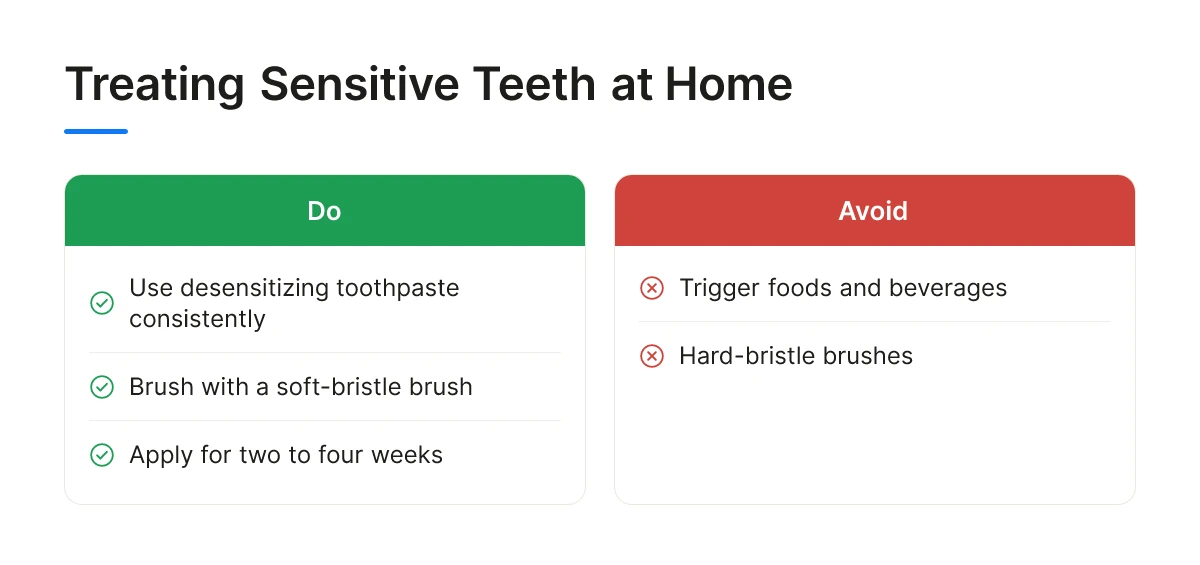
A desensitizing toothpaste used consistently for two to four weeks, paired with a soft-bristle brush and avoidance of trigger foods, resolves mild sensitivity in many cases.
These products work by targeting one of two things: the exposed dentin tubules themselves, or the nerve signal traveling through them. Potassium nitrate, found in most drugstore desensitizing pastes, calms the nerve fiber inside the tooth so it stops firing in response to temperature changes [1]. Other formulations contain stannous fluoride or arginine, which physically plug the microscopic tubules in exposed dentin, blocking the fluid movement that triggers pain [2]. Neither mechanism works overnight, the active ingredient needs to build up in the tubules or around the nerve, which is why dentists recommend daily use for several weeks before judging whether it’s working [1]. Switching brands every few days defeats the purpose.
How Do Over-the-Counter Sensitivity Toothpastes Compare in Effectiveness?
Most OTC desensitizing toothpastes perform similarly when used correctly, the active ingredient matters more than the brand name on the box. Fluoride mouth rinses add another layer of protection by strengthening enamel over time, though they work more slowly than toothpaste applied directly to the sensitive area. A soft-bristle brush is not a treatment in itself, but it’s a precondition for any of these products to work, a stiff brush used with heavy pressure can keep wearing away enamel and gum tissue faster than toothpaste can rebuild protection [2]. For patients asking why is my tooth sensitive despite switching toothpaste twice already, the answer is often technique: brushing too hard, at the wrong angle, or right after acidic food or drink, which temporarily softens enamel and makes it more vulnerable [3].
Simple adjustments help across the board: brush in small circular motions rather than back-and-forth scrubbing, wait about 30 minutes after acidic foods before brushing, and limit how often very hot or very cold items hit the same spot. None of this reverses existing gum recession, but it slows further damage.
What’s the Cost Difference Between At-Home Remedies and Professional Treatments?
Home care is the budget-friendly first move, a tube of desensitizing toothpaste and a soft brush cost little and carry almost no risk. Professional treatment sits in a different category because it addresses the actual source of the problem rather than muting the symptom. A fluoride varnish application or bonding to cover an exposed root is typically a mid-range investment, while a crown, root canal, or treatment for a cracked tooth runs toward the premium end, depending on the extent of damage [3].
Home remedies only mask pain, they do nothing for a cavity, a crack, or an infection underneath the tooth. If sensitivity is caused by decay or a fracture, desensitizing toothpaste may dull the discomfort for a while, but the underlying problem keeps progressing [4]. At Villagio Family & Cosmetic Dental, we treat the first two weeks of home care as a diagnostic window: if nothing improves, that’s the signal to get it looked at rather than keep experimenting with toothpaste.
When Should I See a Dentist About Tooth Sensitivity?
See a dentist promptly if sensitivity lingers more than a few seconds, if you notice swelling, a visible crack, or pain when biting down, these point to a problem that won’t resolve on its own.
How Do I Know If My Sensitive Tooth Is a Dental Emergency or Can Wait?
Mild, occasional twinges from cold water or ice cream that fade within a few seconds are reasonable to monitor for a week or two, especially if you recently started whitening or switched toothpaste. That category of discomfort rarely signals anything urgent on its own [1].
The picture changes when pain lingers after the trigger is gone, when it’s getting worse day by day instead of staying steady, or when it shows up specifically when you bite down. Lingering or spontaneous pain often means the irritation has reached closer to the nerve, which is a different situation than surface-level enamel wear [5].
Fever, facial swelling, or a throbbing ache that keeps you up at night are signs of possible infection or abscess. These need same-week care, not a wait-and-see approach, an untreated dental abscess can spread beyond the tooth and become a more serious medical problem, not just a dental one [1]. If you’re asking “why is my tooth sensitive” and swelling or fever is part of the picture, that’s not a question for home remedies; it’s a reason to call a dentist that day.
Red Flags That Warrant a Same-Week Appointment
- Sensitivity that lasts more than a few seconds after eating or drinking something hot, cold, or sweet
- Visible swelling in the gum or face near the affected tooth
- A crack, chip, or hole you can see or feel with your tongue
- Sharp pain specifically when biting or chewing on that tooth
- Fever accompanying tooth pain
Why a Dental Exam and X-Ray Matter for a Single Sensitive Tooth
When only one tooth is sensitive, a clinical exam paired with an X-ray is the only reliable way to find a hidden crack, an early cavity between teeth, or a failing filling that isn’t visible to the naked eye [3][4]. Patients often describe the pain accurately but can’t pinpoint the cause themselves, because the damage is frequently below the gumline or inside the tooth structure.
This is exactly why we built routine exams at Villagio Family & Cosmetic Dental around catching these issues early, a technical SEO issue left unaddressed compounds the same way a hairline crack does: quietly, until the cost of fixing it multiplies. Regular general dentistry checkups catch sensitivity causes while they’re still a filling-sized problem, before they progress to needing a root canal or crown.
Can a Sensitive Tooth Heal on Its Own?
Sometimes, yes, but only if the cause is minor irritation rather than structural damage, which is the real answer to why is my tooth sensitive in many short-lived cases.
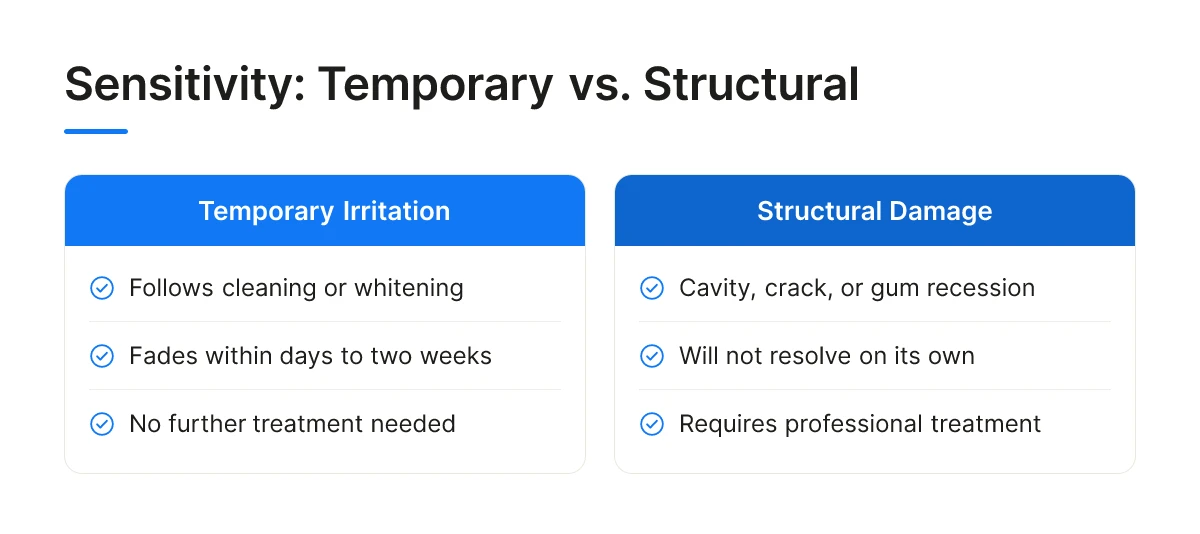
Sensitivity that follows a routine cleaning, a new whitening treatment, or a recently placed filling often fades within a few days to about two weeks as the tooth settles down [1]. This type of discomfort is usually a temporary response of the nerve inside the tooth, not a sign of ongoing damage. If it’s gone within that window, no further treatment is typically needed.
Structural causes behave differently. A cavity, a crack, or an exposed root from gum recession will not resolve without intervention [3][4], and in most cases, these problems get worse the longer they’re left untouched. A small cavity can grow into one that reaches the nerve. A hairline crack can spread with normal chewing pressure. Exposed dentin from recession stays exposed until something physically covers it again. None of these fix themselves, no matter how much the discomfort comes and goes.
What Professional Treatments Are Available If Home Care Doesn’t Work?
When desensitizing toothpaste and softer brushing don’t bring relief, dentists have a sequence of options that scale with the severity of the problem.
- In-office fluoride or desensitizing gel: A quick, non-invasive application that strengthens enamel and blocks the microscopic channels in dentin that transmit pain signals [1].
- Bonding: A tooth-colored resin applied over exposed root surfaces or small areas of worn enamel, sealing the sensitive dentin underneath [3].
- Gum grafting: For significant recession, tissue is added to cover exposed roots permanently, a more involved procedure reserved for advanced cases [4].
- Root canal: When sensitivity signals that the nerve itself is inflamed or infected, removing the damaged pulp is often the only way to stop the pain and save the tooth [1][5].
The order matters. Most patients start with the least invasive option and only move further down the list if the underlying cause turns out to be more advanced than expected. That’s also why waiting out structural sensitivity rarely pays off, a problem that could have been solved with fluoride or bonding today can turn into a root canal months later.
At Villagio Family & Cosmetic Dental, an exam typically starts with identifying whether sensitivity is coming from the enamel surface, the root, or the nerve before recommending a fix, so patients in Katy, Fulshear, Richmond, and Cinco Ranch aren’t guessing at which category their tooth falls into. Catching a structural cause early keeps the treatment simple; catching it late usually doesn’t.
Frequently Asked Questions
Can stress or teeth grinding make one tooth sensitive?
Yes, grinding puts repeated bite stress on specific teeth, which can irritate the nerve and wear down enamel over time. If you clench at night, one tooth often takes more force than the rest, leading to sensitivity that feels localized rather than spread across your whole mouth [5]. A nightguard usually resolves this once a dentist confirms grinding is the cause.
Is it normal for a tooth to stay sensitive after a filling?
Mild sensitivity to cold or pressure for a few days to a few weeks after a filling is normal. The tooth’s nerve needs time to settle after the procedure disturbs the dentin [3][4]. But if sensitivity lingers past a month, worsens, or turns into sharp pain, the filling may be too high, leaking, or the nerve may be inflamed, worth a follow-up visit.
Can sinus problems cause one tooth to feel sensitive?
Yes, sinus pressure can mimic tooth sensitivity, especially in upper back teeth whose roots sit close to the sinus floor. A cold, allergies, or sinus infection can create dull, widespread pressure that feels like it’s coming from a tooth [2]. If sensitivity clears up once sinus symptoms resolve, the tooth itself likely isn’t the problem.
Does tooth sensitivity mean I need a root canal?
Not necessarily, most sensitivity comes from worn enamel, gum recession, or a cavity, all of which have simpler fixes than a root canal. A root canal becomes necessary when the inner nerve is infected or badly inflamed, usually signaled by lingering pain, spontaneous throbbing, or sensitivity that continues well after the trigger is removed [5]. Only an exam and X-rays can confirm which situation you’re in.

Conclusion
A single sensitive tooth is rarely random, it usually points to something specific: a crack, a cavity, gum recession, or a filling that’s failing [3][4]. The pattern matters as much as the pain. Sharp, brief twinges from cold drinks are worth watching; lingering throbbing or pain that wakes you up at night means the nerve needs attention soon, not eventually.
Don’t wait out a problem that’s getting worse. Call Villagio Family & Cosmetic Dental in Katy to schedule an exam and X-rays, pinpointing the cause now is faster and less costly than treating a tooth that’s gone untreated for months.
Sources & References
- Sensitive Teeth: Causes, Treatment & Prevention
- Common Sensitive Teeth Causes and Cures | PDM at PHMC on Cedar
- Is One Sensitive Tooth A Serious Issue? | Colgate®
- Is One Sensitive Tooth A Serious Issue?
- Why Does Only One Tooth Feel Sensitive? | CoTreat Dental Library
Recommended Articles
Explore more from our content library: