Proudly Serving Katy, Cinco Ranch, Richmond & Fulshear
Cinco Ranch (281) 395-2100
|
Fulshear (281) 394-4001

Choose a teeth cleaning service by matching the practice to three things: your family’s schedule, your budget tier, and the specific oral health needs of each member. Look at appointment flexibility, whether the office explains pricing and insurance clearly before treatment, the range of cleaning types offered (routine prophylaxis versus periodontal deep cleaning), and how the team handles kids, anxious patients, or those with gum disease. The right fit minimizes friction between visits, not just during them.
Identify What Your Family Needs Before You Choose a Teeth Cleaning Service
Write down four things before you call a single office: household size, age range, any existing gum or dental issues, and your weekly schedule. Those four variables determine which teeth cleaning service actually fits, and skipping this step is why families end up switching practices twice in a year.
Start with the people. A household of two working adults has different needs than a family with a toddler, a teenager in braces, and a grandparent on blood thinners. Each life stage changes what “cleaning” even means: kids often need fluoride and sealant checks alongside their cleaning, teens may need coordination with an orthodontist, and adults over 40 are more likely to need periodontal maintenance rather than a standard six-month polish. If anyone in the house already has gum disease, sensitive teeth, or a history of cavities, that’s a filter you apply immediately, not a detail you mention after you’ve already picked a practice.
Schedule constraints matter just as much as clinical history. Families juggling work hours and school pickups in Katy or Cinco Ranch need a practice with early morning, evening, or Saturday slots, otherwise every cleaning turns into a half-day logistics problem.
Budget tier is the third variable, and it’s worth settling before you tour a single office. Deciding upfront whether you’re looking for budget-friendly, mid-range, or premium care keeps you from falling for a practice during a consultation and then discovering its fee structure or payment options don’t match what your household can sustain twice a year, per family member.
Mixed-needs households deserve a specific note: if one child needs sealants while a parent needs periodontal maintenance, prioritize a practice offering the full range of cleaning types under one roof. Villagio Family & Cosmetic Dental, for example, structures visits so routine prophylaxis and deeper periodontal care can both happen without referring part of the family elsewhere. Defining these variables first turns the rest of your search into a matching exercise instead of trial-and-error guesswork.
Evaluate a Teeth Cleaning Service for Convenience, Transparency, and Fit
The right teeth cleaning service fits your family’s calendar, states its costs upfront, and treats anxious kids and adults with patience rather than rushed efficiency.
What Makes a Practice Convenient and Welcoming for Families With Different Schedules?
Convenience starts with scheduling that matches how families actually live, not how a front desk prefers to run its calendar. Look for evening or weekend hours, online booking that shows real-time availability, and the ability to book two or three family members back-to-back or on the same day. Parents juggling school pickups, work shifts, and multiple kids’ activities don’t have the bandwidth for four separate trips across four separate weeks.
A welcoming environment matters just as much as the time slot. Watch how staff talk to children during a visit, do they explain what the tools do before they start, or just begin working? Comfort options like noise-canceling headphones, weighted blankets, or simply a hygienist who narrates each step can turn a dreaded appointment into a routine one. Families around Katy, Fulshear, Richmond, and Cinco Ranch often mention this exact detail when comparing practices: a team that talks to a nervous eight-year-old the same way they’d talk to a nervous adult tends to earn repeat visits, not just one-off bookings.
Why Transparent Pricing Matters When Selecting a Teeth Cleaning Service
Transparent pricing lets you budget months ahead instead of absorbing surprise charges after the chair reclines. A practice that lists what’s included in a standard cleaning, exam, polishing, X-rays if needed, fluoride treatment, makes it possible to compare tiers across two or three local offices before committing. This matters most for larger families, where even a modest per-visit difference compounds across four or five people twice a year.
Surprise costs do more than strain a budget, they erode trust mid-treatment, which is often when a family decides to shop for a new dentist altogether. Ask directly how the practice handles insurance verification, what happens if additional treatment is found during a cleaning, and whether estimates are provided before any added work begins.
Credentials deserve the same direct approach. Skip the marketing language and ask specific questions: how long has the hygienist been practicing, what sterilization protocol does the office follow between patients, and how are complex cases referred out to specialists. A practice that answers plainly, without deflecting to brochure claims, is usually the one worth booking.

Match the Cleaning Type and Frequency to Each Family Member
Not every household member needs the same teeth cleaning service, and the right cadence depends on gum health, medical history, and age, not a flat twice-a-year rule.
What’s the Difference Between a Standard Cleaning and a Deep Cleaning?
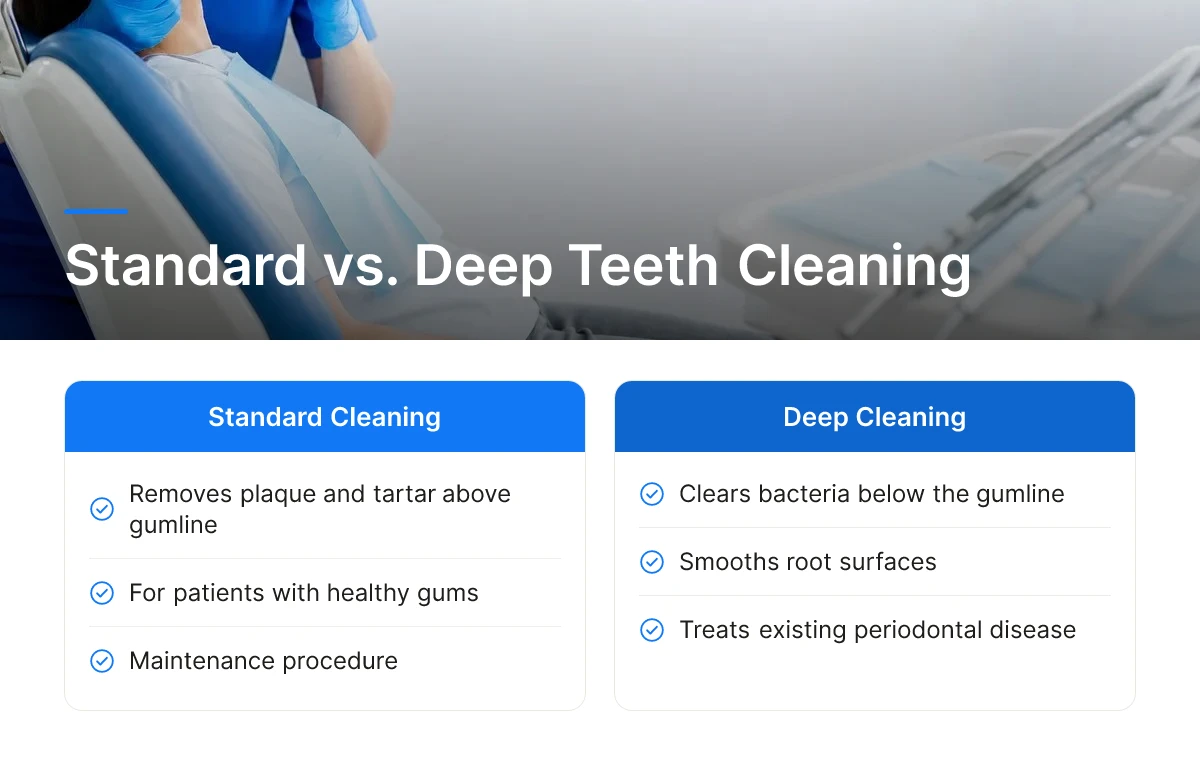
A standard cleaning, called prophylaxis, removes plaque and tartar above the gumline for patients with healthy gums. A deep cleaning, scaling and root planing, reaches below the gumline to clear bacteria and smooth root surfaces where periodontal disease has already started.
The distinction matters because the two procedures treat different problems. Prophylaxis is maintenance. Scaling and root planing is treatment for infection that, left alone, can lead to bone and tooth loss. A dentist decides which one your family member needs based on specific findings, not guesswork:
- Bleeding gums during probing or brushing
- Pocket depths measuring 4mm or greater between tooth and gum
- Visible tartar buildup at or below the gumline
- Bone loss visible on dental x-rays
If your spouse’s last visit flagged pocket depths of 5mm in multiple spots, that’s a deep cleaning conversation, not a routine polish.
How Do Gum Health and Risk Factors Affect Cleaning Frequency?
Risk factors like smoking, diabetes, pregnancy, orthodontic appliances, and a family history of gum disease often push recommended frequency beyond the standard twice-a-year visit [5]. Diabetes slows healing and raises infection risk, so a diabetic parent may need cleanings every three to four months instead of six. Pregnancy hormones can intensify gum inflammation, making a mid-pregnancy cleaning worth scheduling even if the last one was recent. Teenagers with braces accumulate plaque around brackets faster than wires can be adjusted, so orthodontic patients frequently need more frequent visits for the length of treatment [2].
Family history carries weight too, if a grandparent lost teeth to gum disease, that genetic risk is worth flagging to the dentist so monitoring starts earlier rather than after symptoms appear.
Routine cleaning visits also typically bundle in an oral cancer screening, a quick visual and physical check of the mouth, throat, and neck [5]. Skipping it is a mistake, particularly for adult and senior family members, since early detection meaningfully improves treatment outcomes and the screening adds only a few minutes to an appointment already on the calendar.
Children’s needs run on a separate track within the same visit schedule. Tooth eruption timing, sealant placement on new molars, and fluoride treatments are assessed at each checkup because a child’s mouth changes faster than an adult’s [2][4]. A practice built around family care, including the kind Villagio Family & Cosmetic Dental provides for households across Katy, Fulshear, Richmond, and Cinco Ranch, can evaluate a toddler’s first molars and a grandparent’s periodontal pockets in the same afternoon, adjusting frequency for each person individually rather than applying one generic interval to everyone.
Maintain Results at Home and Plan for Costs Between Visits
Protecting the results of a teeth cleaning service comes down to two habits: a consistent home-care routine and a clear understanding of what your insurance actually pays for.
What At-Home Products and Practices Support Professional Cleaning Results?
Four categories do most of the work between visits: electric toothbrushes, interdental brushes or floss, antimicrobial rinses, and a fixed twice-daily brushing schedule. Electric toothbrushes remove plaque more consistently along the gumline than manual brushing for most patients, and interdental brushes or floss reach the tight spaces a toothbrush head cannot. An antimicrobial rinse adds a layer of protection against the bacteria that accumulate between meals, particularly useful for Katy and Cinco Ranch families juggling kids’ sports schedules where brushing times can slip.
The mechanism matters here. Plaque is soft and removable with a toothbrush for roughly the first day or two after it forms. Left in place, it mineralizes into tartar, a hardened deposit that bonds to the tooth surface and can only be removed with professional scaling instruments. Skip a few days of thorough brushing and flossing repeatedly, and that tartar buildup pushes a routine cleaning toward a deeper periodontal treatment, which takes longer, costs more, and sometimes requires multiple visits. Daily plaque removal is what keeps your next appointment a simple preventive visit instead of a more involved procedure.
What Does Dental Insurance Typically Cover for Cleanings?
Most dental plans separate coverage into tiers, and preventive care, routine cleanings, exams, and X-rays, usually carries the highest reimbursement rate, often covered close to in full. Periodontal treatment, which addresses gum disease or heavier tartar removal below the gumline, typically falls into a different coverage category with higher out-of-pocket costs and sometimes annual limits. The distinction trips up a lot of families who assume “cleaning” means one flat coverage rate regardless of what the hygienist finds.
Call your insurer before booking and ask specifically whether your plan covers preventive cleanings at 100%, what frequency limits apply (most plans cap at two per year), and how periodontal cleanings are classified. Verifying benefits ahead of time avoids a surprise bill after the visit.
If you’re uninsured or your plan has gaps, ask any practice you’re considering about in-house membership plans, financing arrangements, or phased treatment options that spread larger procedures across multiple visits. Villagio Family & Cosmetic Dental discusses these options directly with families during scheduling, so cost conversations happen before treatment, not after.
Common Mistakes to Avoid When Choosing a Teeth Cleaning Service
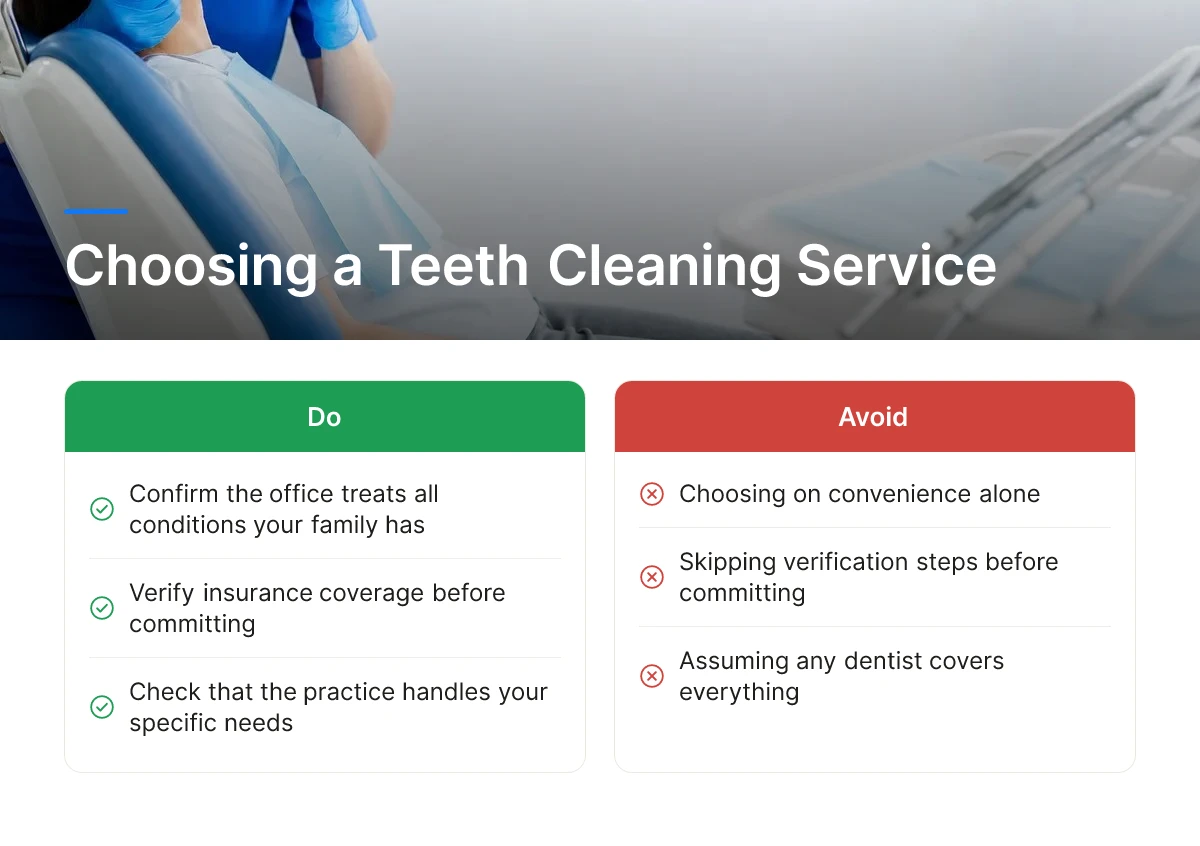
Most families don’t pick the wrong practice, they skip a verification step and find out months later, usually at the front desk, holding a bill they didn’t expect.
Here are the five errors that show up most often once families have already committed to a teeth cleaning service.
- Choosing on convenience alone. A practice five minutes from home sounds ideal until you learn it doesn’t handle periodontal maintenance and refers your spouse to a specialist across town. Confirm the office treats every condition your family actually has, gum disease, orthodontic retainers, high cavity risk, before assuming “any dentist” covers it.
- Skipping insurance verification. Routine cleanings are often covered at or near 100%, but deep cleanings, periodontal maintenance, and extra screenings frequently are not. Call and ask what’s covered under your specific plan rather than assuming the quoted “cleaning” price is the final number.
- Defaulting to a generic schedule. Twice a year is a reasonable starting point, not a rule. Someone with gum disease or a family history of periodontal issues may need visits every three to four months, while a low-risk adult with strong home care may do fine on a longer interval. Ask your hygienist to set frequency based on actual gum health, not habit.
- Treating professional cleaning as a substitute for daily hygiene. A cleaning every few months doesn’t offset brushing twice daily or skipping floss. Professional care removes tartar you can’t reach at home, it doesn’t undo months of inconsistent routine in between appointments.
- Not asking how pricing and treatment plans get communicated. Some offices walk you through costs before any work starts; others surprise you mid-visit. Ask upfront how a practice presents treatment plans and whether estimates come before, not after, additional procedures are recommended.
Villagio Family & Cosmetic Dental addresses these directly during new-patient intake, reviewing insurance details, setting individualized recall schedules, and walking through pricing before any work begins, so Katy-area families aren’t guessing at costs or frequency after the fact.
Frequently Asked Questions
How often should my family get professional teeth cleanings?
Most patients need a professional cleaning every six months, though some benefit from a three- or four-month schedule. Children, adults with gum disease, and anyone prone to plaque buildup often need more frequent visits. Your dentist should set the interval based on your actual gum health and risk factors, not a one-size-fits-all rule.
When would my family need a deep cleaning instead of a regular cleaning?
A deep cleaning, scaling and root planing, is needed when plaque and tartar have spread below the gumline, a sign of early gum disease. Regular cleanings address the visible tooth surface only. If your dentist measures gum pockets deeper than 3 millimeters during an exam, that’s usually the trigger for recommending deep cleaning instead.
Are there flexible payment options for professional teeth cleaning services?
Many family dental practices offer in-house membership plans, financing, and insurance coordination to make cleanings more affordable. Ask upfront whether the practice accepts your insurance, offers payment plans, or has a savings plan for uninsured families before scheduling.
What oral cancer screening should accompany regular cleanings?
A visual and physical exam of the mouth, tongue, throat, and neck should accompany every routine cleaning. Dentists check for unusual lumps, sores that haven’t healed, or discoloration. This screening typically adds just a few minutes to the appointment and costs nothing extra in most practices.

Conclusion
Choosing where your family gets professional cleanings comes down to three things: a dentist who adjusts care by age and risk rather than treating every patient the same [5], transparent answers on insurance and payment flexibility, and a practice that pairs cleanings with real screening, gum measurements, oral cancer checks, not just polishing [1]. Trust and communication matter as much as technical skill [3]. Before your next visit, call the office and ask how they customize cleaning frequency for kids versus adults in your own household, the answer will tell you quickly whether the practice fits your family’s actual needs.
Sources & References
- Finding the Right Dentist for Your Family
- Choosing the Right Dentist for Your Family
- How to Choose a Dentist Who Truly Understands Family Needs | Family Dentist White Rock
- How to Choose the Right Family Dentist, Pacific View Smile Center Santa Monica California
- Choosing the Right Family Dentist: Factors To Consider – Legacy Dental Pa
Recommended Articles
Explore more from our content library: